


















Lesson 33 of 47 · Vibrations
Chapter 7 overview: vibrations
Meet the mass-spring-damper model, the equation m a + c v + k x = F(t), and the three questions of vibration analysis: free, damped and forced response.
A guitar string, a car on a bumpy road, a tall building in the wind, a washing machine during the spin cycle and a bridge with marching soldiers on it all do the same thing: they oscillate. Sometimes oscillation is wanted (a clock, a tuning fork). More often it is a problem: noise, wear, discomfort and, in the worst case, failure.
Vibration analysis turns out to be one of the most reusable parts of dynamics. A single model, a mass on a spring with a damper, describes a huge range of real systems, and its behavior is governed by just three numbers.
What you will learn
- Identify the roles of mass, stiffness and damping.
- Write the equation of motion
m ẍ + c ẋ + k x = F(t). - Know the three kinds of response: free, damped and forced.
- Estimate natural frequencies of everyday systems.
Key terms
Degree of freedom: an independent coordinate needed to describe the position of a system; this chapter uses one.
Natural frequency ωn: the frequency at which a system oscillates by itself, √(k/m).
Damping: any mechanism that removes vibration energy as heat.
Resonance: large response when the driving frequency matches the natural frequency.
The model
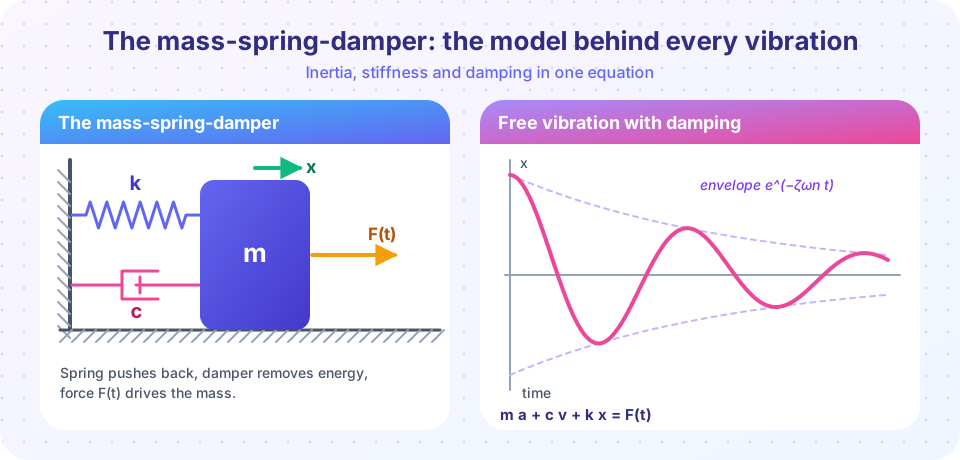
Take a body of mass m that can move along one line, with coordinate x measured from its equilibrium position. Three things act on it:
- A spring pushes back in proportion to displacement:
−k x. Stiffnesskhas units N/m. - A damper resists velocity:
−c ẋ. Damping coefficientchas units N·s/m. A shock absorber is an example. - An external force
F(t), which may be zero.
Newton's second law gives
m ẍ + c ẋ + k x = F(t)
where ẍ is acceleration and ẋ is velocity. Every term has units of force. If gravity acts along the line of motion, it only shifts the equilibrium position, so you measure x from the equilibrium and gravity disappears. You will see that in free undamped vibration.
The same equation describes a rotating system, with angle, moment of inertia, torsional stiffness and torque in place of x, m, k and F. Electrical engineers will recognize it as the series RLC circuit: m ↔ L, c ↔ R, k ↔ 1/C.
Three questions
| Question | Equation | Lesson |
|---|---|---|
| How does it oscillate on its own? | c = 0, F = 0 |
Free undamped vibration |
| How does the oscillation die out? | c ≠ 0, F = 0 |
Damped vibration |
| How does it respond to a push? | F = F₀ sin ωt |
Forced vibration and resonance |
Three ingredients
Three responses
One danger
Natural frequencies in real life
A rough estimate often tells you whether to worry. For a mass m on stiffness k, f_n = (1/2π) √(k/m). A car's body (about 400 kg per wheel) on a spring of 20 kN/m gives about 1.1 Hz, a pleasant "floating" feel; footsteps at 2 Hz are comfortably above it. A person standing on a mattress has a frequency of a few hertz. A tall building has f_n around 0.1 to 1 Hz, so wind gusts can excite it. Engineers keep machine speeds away from these values.
Common misconceptions
"Vibration is always bad." Clocks, musical instruments, ultrasonic cleaners and vibrating conveyors depend on it.
"A stiffer spring lowers the frequency." Stiffness raises it: ωn = √(k/m). A heavier mass lowers it.
"Damping changes the natural frequency a lot." For light damping the change is tiny, but damping controls the amplitude.
Try it
Change mass, stiffness and damping and watch the free response after you pull the mass 1 unit and release it. The readout shows the natural frequency and damping ratio.
The second tool turns the rule of thumb f_n = √(k/m)/2π into a table for a few familiar systems. The numbers are rough, made-up but typical values; the point is the order of magnitude.
Press Run (or Ctrl + Enter) to see the result here.
Program input · what you'd type while the program runs
Type the answers before you press Run, one per line. Each time the program reads a line (with input()), it gets the next line from this box.
Check your understanding
Quick check · 4 questions
of 4 answered You scored / 4 · perfect!
-
1. Which term in m ẍ + c ẋ + k x = F(t) removes energy from the system?
The damper force is proportional to velocity and always opposes motion, so it dissipates energy. -
2. A mass of 4 kg on a spring of 400 N/m has natural frequency:
ωn = √(400/4) = 10 rad/s. -
3. How does the natural frequency change if the stiffness is quadrupled?
ωn is proportional to √k, so a factor 4 in k gives a factor 2. -
4. What is resonance?
At resonance the energy input builds up, limited only by damping.
Summary
- The mass-spring-damper
m ẍ + c ẋ + k x = F(t)models a vast range of systems. ωn = √(k/m)depends only on stiffness and mass.- Free, damped and forced response answer the three basic questions.
- Resonance is the main danger and the main design target.
Next: Free undamped vibration
Track your progress
Create a free account to tick off lessons and pick up where you left off on any device.
of Engineering Dynamics lessons completed