


















Lesson 36 of 47 · Vibrations
Forced vibration and resonance
Understand the steady response of a mass-spring-damper to a harmonic force: amplitude, phase, resonance, rotating unbalance and why r = 1 is dangerous.
Free vibration is what a system does when you leave it alone. Real machines are not left alone: engines run at a speed, rotors have small imbalances, roads have bumps, wind gusts push on buildings. A repeating push drives the system, and after a short transient, the system follows the driving frequency, not its own.
How large the response is depends on how close the driving frequency is to the natural frequency. At resonance a small force can produce a huge motion. Understanding this curve is the basis for designing quiet machines and safe structures.
What you will learn
- Write the steady-state amplitude and phase for
F = F₀ sin ωt. - Read the magnification curve and explain the three regions.
- Estimate the resonance peak
X ≈ δ_st/(2ζ). - Handle rotating unbalance and understand why damping matters at resonance.
Key terms
Frequency ratio r = ω/ωn: driving frequency over natural frequency.
Static deflection δ_st = F₀/k: the displacement if the force were applied slowly.
Magnification factor M = X/δ_st: how much the dynamic amplitude exceeds the static one.
Steady state: the response that remains once the free decay has died out.
The steady response
Apply F(t) = F₀ sin ωt to m ẍ + c ẋ + k x = F(t). The solution is a sum of the free decaying motion (the transient, which vanishes) and a steady-state oscillation at the driving frequency:
x(t) = X sin(ωt − φ)

X = (F₀/k) / √((1 − r²)² + (2 ζ r)²)

tan φ = 2 ζ r / (1 − r²)
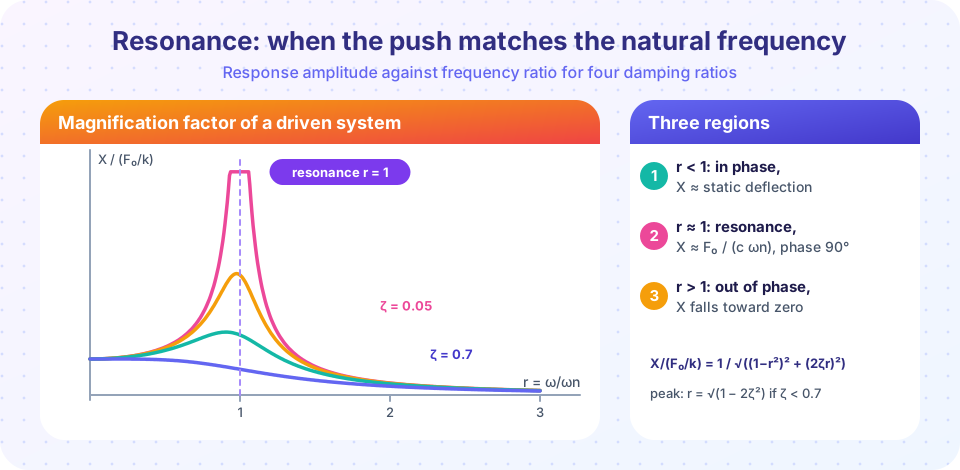
The ratio M = X/(F₀/k) is the magnification factor plotted in the figure. Three regions stand out:
r ≪ 1:M ≈ 1. The system follows the force slowly, like a static load. Phaseφ ≈ 0.r = 1: resonance. The denominator reduces to2ζ, soX = δ_st/(2ζ). The phase is exactly 90°. Forζ = 0.05, the amplitude is ten times the static deflection. The maximum ofMlies atr = √(1 − 2ζ²)forζ < 0.707, very close to 1 for light damping.r ≫ 1:M → 1/r², small. The mass barely moves because the force reverses before it can respond. The phase approaches 180°: motion is opposite to the force.
At resonance the driving force does work on the system every cycle that exactly equals the energy lost to damping per cycle, so only c limits the amplitude. With no damping the amplitude would grow forever (linearly in time).
Worked example
A 10 kg machine part is on a spring of k = 4000 N/m with ζ = 0.05, driven by F₀ = 20 N. Then δ_st = 20/4000 = 5 mm, and ωn = 20 rad/s. At r = 1, X = 5/(2 × 0.05) = 50 mm. At r = 0.5: M = 1/√(0.75² + 0.05²) = 1.33 and X = 6.6 mm. At r = 3: M = 1/√(64 + 0.09) = 0.125 and X = 0.6 mm. Moving the operating speed from r = 1 to r = 3 reduces the response by a factor of 80.
Rotating unbalance
Most machine vibration comes from a rotor whose mass is not perfectly centered. An unbalanced mass m_e at eccentricity e spinning at ω produces a force m_e e ω² rotating with the shaft. The component along the line of motion is F₀ = m_e e ω²: the force grows with the square of speed. The amplitude is
X = (m_e e / M) · r² / √((1 − r²)² + (2 ζ r)²)
where M is the total mass. For r ≫ 1 this tends to m_e e / M: a constant. A running rotor at high speed settles to rotating about its own mass center, which is why a washing machine shakes violently during the speed run-up but runs quieter once past its resonance. Balancing the rotor is the cure; moving the speed away from r = 1 is the workaround.
Common misconceptions
"Resonance happens at exactly ωn for every damping." The amplitude peak shifts slightly below ωn as damping grows; for ζ > 0.707 there is no peak at all.
"Resonance means infinite amplitude." Only with zero damping. Real systems are limited by damping or by nonlinearity.
"A stiffer mount always reduces vibration." It moves ωn up, which may put the machine at resonance or below it. It depends on r.
"The system vibrates at its natural frequency under a harmonic force." The steady response is at the driving frequency; the natural-frequency motion is the decaying transient.
Try it
Drive the system at different frequency ratios and watch the response. The pink line is the force; the indigo line is the displacement (scaled). Look at the lag at r = 1 and the reversal at large r.
The next program verifies the formula by brute force: it integrates the equation of motion with the force switched on at time zero, waits for the transient to die and compares the steady amplitude with X.
Press Run (or Ctrl + Enter) to see the result here.
Program input · what you'd type while the program runs
Type the answers before you press Run, one per line. Each time the program reads a line (with input()), it gets the next line from this box.
Check your understanding
Quick check · 5 questions
of 5 answered You scored / 5 · perfect!
-
1. At r = 1 with damping ratio ζ = 0.1, the magnification factor is:
At r = 1, M = 1/(2ζ) = 1/0.2 = 5. -
2. What is the phase lag of the response at resonance?
At r = 1 the stiffness and inertia terms cancel, leaving the damping force in balance with the load: phase 90°. -
3. For r much greater than 1, the response is:
M → 1/r² and φ → 180°. -
4. Why does a rotating unbalance produce a force proportional to ω²?
The force on the shaft is m_e e ω², the centripetal reaction of the unbalanced mass. -
5. A system with k = 4000 N/m is driven at ω = ωn. Which parameter limits the amplitude?
At resonance X = F₀/(c ωn); only damping limits it.
Summary
- The steady response is at the driving frequency:
X = (F₀/k)/√((1 − r²)² + (2ζr)²). - Resonance at
r ≈ 1givesX ≈ δ_st/(2ζ)with a 90° phase lag; damping alone limits it. - Above resonance the response is small and out of phase; below it follows the load.
- Rotating unbalance gives a force
m_e e ω²; design by keepingraway from 1.
Next: Chapter 7 review
Track your progress
Create a free account to tick off lessons and pick up where you left off on any device.
of Engineering Dynamics lessons completed