


















Lesson 8 of 47 · Kinematics of Particles
Projectile Motion
Analyze projectiles by splitting motion into independent horizontal and vertical parts: time of flight, maximum height, range, launch from a height, and drag.
A thrown ball, a water jet, a motocross jump, a shell: once an object is in the air and nothing pushes it, gravity is the only force, and the path is a parabola. Galileo recognized this around 1608, and the key idea is surprisingly simple: horizontal and vertical motion do not interfere with each other.
What you will learn
- Why a projectile's motion splits into a constant-velocity part and a constant-acceleration part.
- How to find time of flight, maximum height and range.
- Why 45° gives the longest range on level ground, and why complementary angles give equal ranges.
- What changes when the launch and landing heights differ, or when air drag is included.
Key terms
Projectile: a body moving under gravity alone (air drag neglected unless stated).
Trajectory: the path of the projectile, here a parabola.
Time of flight: how long the projectile is in the air.
Range: horizontal distance from launch to landing.
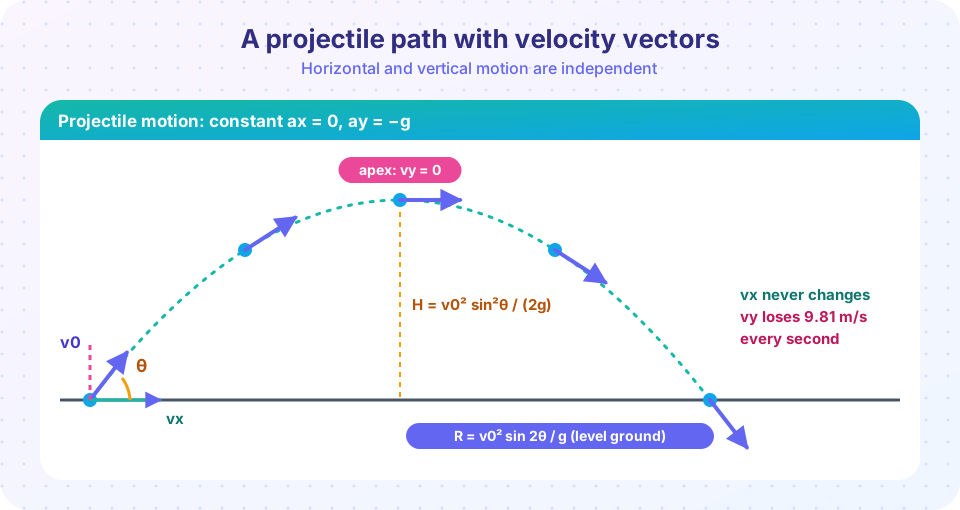
Apex: the highest point, where the vertical velocity is zero.
The two independent motions
Put x horizontal and y upward, origin at the launch point. With launch speed v0 at angle θ:
| Horizontal | Vertical | |
|---|---|---|
| Acceleration | ax = 0 |
ay = −g |
| Velocity | vx = v0 cos θ |
vy = v0 sin θ − g t |
| Position | x = v0 cos θ · t |
y = v0 sin θ · t − ½ g t² |
Eliminating t gives the parabola y = x tan θ − g x² / (2 v0² cos² θ).
Key results (level ground)
- Time of flight:
T = 2 v0 sin θ / g - Maximum height:
H = v0² sin² θ / (2 g) - Range:
R = v0² sin 2θ / g
Worked example. A ball leaves a bat at 30 m/s, 40° above the horizontal (ground level).
vx = 22.98 m/s,vy0 = 19.28 m/s.T = 2 × 19.28 / 9.81 = 3.93 s.H = 19.28² / (2 × 9.81) = 18.9 m.R = 22.98 × 3.93 = 90.3 m. Check withv0² sin 2θ / g = 900 × 0.985 / 9.81 = 90.3 m. ✓.
Because sin 2θ is largest at 2θ = 90°, the best angle on level ground is 45°. And since sin(2θ) = sin(180° − 2θ), angles that add to 90° (such as 30° and 60°) give the same range, although the higher one stays in the air longer.
Launch from a height
If you throw from height h above the landing ground, solve the quadratic h + v0 sin θ · t − ½ g t² = 0 for the positive root. In that case the best angle is less than 45° (a rule of thumb: the higher the launch, the flatter the best throw).
How the real world differs
Air drag reduces range and makes the descent steeper than the climb. For a baseball the effect is large, for a heavy shell with low speed small. In the third example below, a 30 m/s throw with drag proportional to speed squared (Chapter 3) loses about a quarter of its range. Chapter 8 simulates such flights in more detail. Wind, spin (the Magnus effect) and the curvature of the Earth also matter for long shots.
Common misconceptions
"At the top, the velocity is zero." Only the vertical component is zero. The horizontal component is still v0 cos θ, so the speed at the apex is not zero.
"A heavier ball goes farther (or falls faster)." Without drag, mass does not appear in any equation above.
"A force carries the projectile forward." After release, the only force is gravity. The "forward motion" is simply inertia.
Try it
First, compare launch angles. Every curve starts at the same speed; look at how 30° and 60° meet at the same landing point.
Press Run (or Ctrl + Enter) to see the result here.
Program input · what you'd type while the program runs
Type the answers before you press Run, one per line. Each time the program reads a line (with input()), it gets the next line from this box.
Second, a live projectile. Drag the sliders and watch the path, the apex and the range update. (The horizontal coordinate and the vertical coordinate use the same scale, so the picture is honest.)
Third, add air drag with a simple numerical method and see how much range is lost. The drag acceleration is −c |v| v with c = 0.005 1/m (a sample value, similar to a smooth ball; real values depend on size and mass).
Press Run (or Ctrl + Enter) to see the result here.
Program input · what you'd type while the program runs
Type the answers before you press Run, one per line. Each time the program reads a line (with input()), it gets the next line from this box.
Check your understanding
Quick check · 5 questions
of 5 answered You scored / 5 · perfect!
-
1. A ball is thrown horizontally from a table and another is dropped from the same height at the same instant. They hit the floor
Vertical motion is independent of horizontal motion; both have the same initial vertical velocity (zero) and acceleration. -
2. On level ground without drag, which launch angle gives the same range as 25°?
Complementary angles (adding to 90°) give equal ranges. -
3. A projectile is launched at 20 m/s and 30°. Its maximum height is (g = 9.81 m/s²)
H = (20 sin 30°)² / (2 × 9.81) = 100 / 19.62 = 5.1 m. -
4. What is the projectile's speed at the apex of a 30 m/s, 40° launch?
Only the vertical component vanishes, leaving vx = 30 cos 40° = 22.98 m/s. -
5. Adding air drag to a projectile generally
Drag removes horizontal speed, so the descent is steeper than the climb.
Summary
- Projectile motion = uniform motion horizontally plus constant downward acceleration
gvertically. - Level ground:
T = 2 v0 sin θ / g,H = v0² sin² θ / (2g),R = v0² sin 2θ / g. - 45° gives the maximum range on level ground; complementary angles give equal ranges.
- Drag shortens the range; simulation (Chapter 8) handles it.
Track your progress
Create a free account to tick off lessons and pick up where you left off on any device.
of Engineering Dynamics lessons completed