


















Lesson 19 of 47 · Work, Energy and Momentum
Potential Energy and Conservation of Energy
Learn gravitational and elastic potential energy, conservative forces, and how to use conservation of mechanical energy, with friction losses, springs and pendulums.
Lift a book to a shelf and you have done work on it. Where did the energy go? Nowhere: it is stored in the book's position, ready to come back as kinetic energy if the book falls. Potential energy is the bookkeeping that tracks this stored energy. When only forces that can store energy do the work, the total of kinetic and potential energy never changes, and a hard-looking problem becomes a one-line equation.
What you will learn
- Gravitational and elastic potential energy.
- What makes a force conservative and why friction is not.
- How to apply
T₁ + V₁ = T₂ + V₂and the version with friction. - How to analyze a pendulum, a spring launcher and a hill with energy.
Key terms
Potential energy (V): energy stored by a conservative force; only changes in V matter, so the zero level is your choice.
Conservative force: work depends only on the endpoints, not on the path (gravity, ideal springs).
Non-conservative force: work depends on the path (friction, drag); it converts mechanical energy to heat.
Mechanical energy: E = T + V.
Two potential energies
- Gravity near the ground:
V_g = m g h, withhmeasured from any chosen level. - Linear spring:
V_e = ½ k x², withxthe stretch or compression from the natural length.
Far from the Earth gravity weakens, and V = −G M m / r, with V = 0 at infinity. A body launched fast enough to just escape has T + V = 0 at the surface, giving the escape speed v = √(2 G M / R) = 11.2 km/s for Earth.
Conservation of mechanical energy
If only conservative forces do work, T₁ + V₁ = T₂ + V₂. With friction or other non-conservative forces:
T₁ + V₁ + U_nc = T₂ + V₂, where U_nc is the work of those forces (negative for friction).
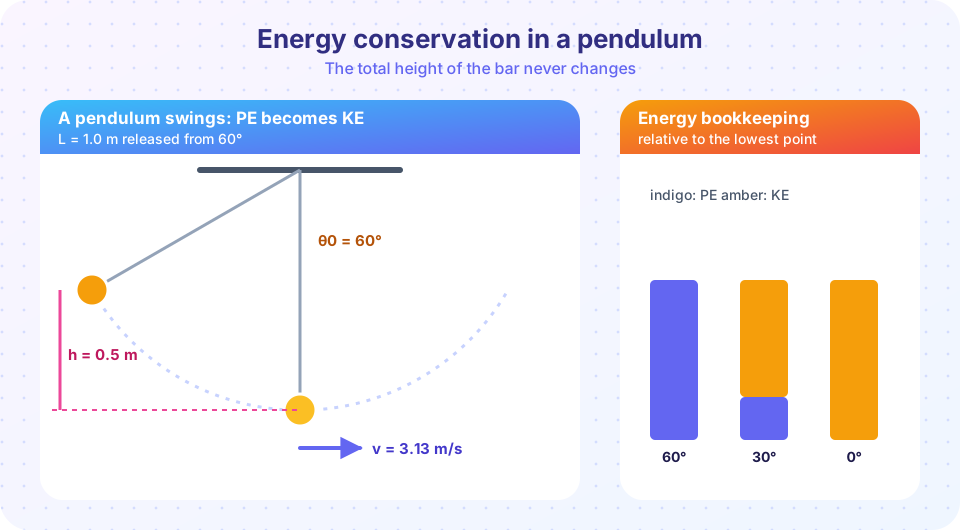
Worked example 1: a pendulum. A 1.0 m pendulum is released from 60° from the vertical. The bob falls by h = L (1 − cos 60°) = 0.5 m. Energy conservation: m g h = ½ m v², so v = √(2 × 9.81 × 0.5) = 3.13 m/s at the bottom. The tension does no work (it is perpendicular to the motion), so only gravity matters. To find the tension at the bottom you would switch to Newton's law in normal-tangential axes: T − m g = m v²/L, so T = m (g + 9.81) = 2 m g, twice the weight.
Worked example 2: a spring launcher. A 0.50 kg block is pressed against a spring (k = 400 N/m) by 0.20 m and released on a frictionless horizontal surface. Stored energy: ½ × 400 × 0.04 = 8 J. At the natural length it has T = 8 J, so v = √(2 × 8 / 0.5) = 5.66 m/s. If the block then slides up a frictionless ramp, it rises until m g h = 8 J, i.e. h = 8 / (0.5 × 9.81) = 1.63 m.
Worked example 3: with friction. If the horizontal surface has μk = 0.2 and the block slides 1.0 m before reaching the ramp, friction removes μ m g d = 0.2 × 0.5 × 9.81 × 1.0 = 0.98 J, leaving 7.02 J: v = 5.3 m/s, h = 1.43 m.
When to use energy
Energy methods shine when the force depends on position (springs) or the path is complicated (curved tracks) and you need a speed or a height. They fail when you need accelerations, forces at a point (tension, normal force) or times; there, return to ΣF = m a. Often the best solution uses both: energy for the speed, Newton for the force at that point.
Common misconceptions
"Potential energy belongs to the object alone." It belongs to the system (object plus Earth, or object plus spring).
"The zero level of potential energy matters." Only differences matter; choose the most convenient zero and stay consistent.
"Energy conservation includes friction automatically." Friction removes mechanical energy; either include the work U_nc or say that heat gains the difference.
Try it
First, simulate the pendulum with a numerical solver and watch the energies. Kinetic and potential energy swap, and the total stays flat (apart from tiny numerical drift).
Press Run (or Ctrl + Enter) to see the result here.
Program input · what you'd type while the program runs
Type the answers before you press Run, one per line. Each time the program reads a line (with input()), it gets the next line from this box.
Second, a spring-launcher calculator with optional friction. See how much energy friction steals and how that changes the launch speed and the height reached.
Press Run (or Ctrl + Enter) to see the console output here.
No output.
Check your understanding
Quick check · 5 questions
of 5 answered You scored / 5 · perfect!
-
1. A 2 kg ball is dropped from rest from 5 m. Ignoring drag, its speed at the ground is
v = √(2 g h) = √98.1 = 9.9 m/s; the mass cancels. -
2. Which force is NOT conservative?
Friction's work depends on the path and turns mechanical energy into heat. -
3. A spring (k = 100 N/m) is compressed by 0.3 m. The stored energy is
½ k x² = 0.5 × 100 × 0.09 = 4.5 J. -
4. A pendulum bob is released from rest at height h above the bottom. The tension in the string does what?
The tension is always perpendicular to the bob's velocity, so U = 0. -
5. A 0.5 kg block sliding 2 m on a surface with μk = 0.3 loses how much mechanical energy to friction?
μ m g d = 0.3 × 0.5 × 9.81 × 2 = 2.94 J.
Summary
V_g = m g handV_e = ½ k x²; the zero level is a free choice.- Conservative forces:
T₁ + V₁ = T₂ + V₂; addU_ncfor friction and drag. - Energy gives speeds and heights quickly; Newton's law gives forces and accelerations.
- Escape speed from Earth is about 11.2 km/s.
Next: Impulse and Momentum
Track your progress
Create a free account to tick off lessons and pick up where you left off on any device.
of Engineering Dynamics lessons completed