


















Lesson 4 of 47 · Getting Started
Modeling and Free-Body Diagrams
Decide when an object is a particle, draw correct free-body and kinetic diagrams, and solve a crate-on-a-ramp problem step by step with friction and checks.
Real objects are messy. A crate has corners, a floor has bumps, the air pushes back, and the crate's temperature changes as it slides. If you tried to include everything, you could never write an equation. Engineers instead build a model: a simplified version of reality that keeps what matters and drops what does not. Then they draw the model's forces in a free-body diagram.
This lesson teaches both steps. Good modeling and a clean diagram are worth more marks, and more safety, than any clever algebra.
What you will learn
- When an object can be treated as a particle and when it cannot.
- How to draw a free-body diagram (FBD) and a kinetic diagram.
- How to write
ΣF = m afrom the diagram for each axis. - How to solve a ramp problem with friction and check the result.
Key terms
Particle: a body treated as a point; only its translation matters.
Free-body diagram (FBD): a sketch of one body, isolated from its surroundings, with every external force drawn as an arrow.
Kinetic diagram: a companion sketch showing m a (the "effective force") for the same body.
Normal force (N): the push of a surface perpendicular to it.
Kinetic friction: f = μk N, opposing sliding; static friction is at most μs N and just balances other forces when there is no sliding.
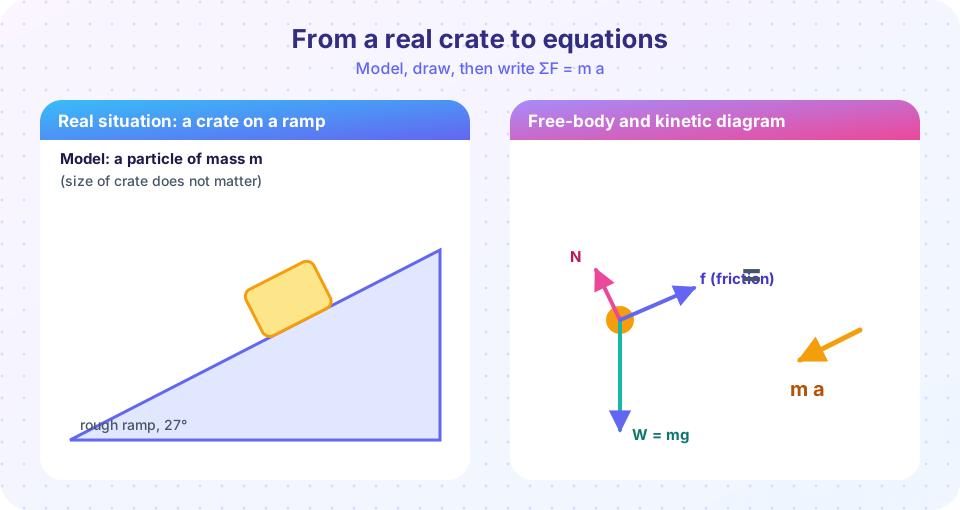
Step 1: choose the model
A body can be treated as a particle when its size and rotation do not affect the question. A car braking along a road is a particle if you only want its stopping distance. A car skidding and spinning is not, because the orientation matters. Good habits:
- Ask: Do I need to know how it rotates? If no, use a particle.
- State your assumptions: massless rope, frictionless pulley, no air drag, constant gravity.
- Decide what the system is. You may isolate one body or a group; the system boundary decides which forces count as external.
Step 2: draw the free-body diagram
- Sketch the body alone, as a dot or simple shape.
- Add every external force: weight
m g(downward, always), contact forces from every surface or rope touching it (normal, friction, tension), and any applied loads. - Label each arrow with a symbol, not a number, and draw directions you know.
- Add the axes, aligned with the expected acceleration.
- Beside it, draw the kinetic diagram: an arrow
m ain the direction of the acceleration (if the body accelerates; a dot with no arrow ifa = 0).
The two diagrams are equal: the vector sum of the forces on the left equals the arrow m a on the right. Splitting the equality along each axis gives one equation per axis. This idea, due to d'Alembert's way of organizing equations, keeps you honest about direction.
Common contact forces:
| Contact | Force | Direction |
|---|---|---|
| Smooth surface | Normal force N | perpendicular to the surface, pushing on the body |
| Rough surface | N plus friction f | f opposes sliding, along the surface |
| Rope or cable | Tension T | along the rope, pulling on the body |
| Spring | k x |
along the spring, toward its natural length |
Step 3: write and solve the equations
Worked example. A 20 kg crate slides down a rough ramp inclined at 27° to the horizontal. The kinetic friction coefficient is μk = 0.20. Find its acceleration and the normal force.
Choose the x-axis down the slope and the y-axis perpendicular to it. The weight mg splits into mg sin θ along the slope and mg cos θ into the slope.
- Perpendicular (y): the crate does not accelerate this way, so
N − m g cos θ = 0, givingN = m g cos θ = 20 × 9.81 × cos 27° = 174.8 N. - Friction:
f = μk N = 0.20 × 174.8 = 35.0 N, directed up the slope. - Along the slope (x):
m g sin θ − f = m a, soa = g (sin θ − μk cos θ) = 9.81 × (0.4540 − 0.20 × 0.8910) = 2.71 m/s².
Notice that the mass cancelled in a, as it will in many gravity problems.
Check the answer
- Units: m/s². ✓.
- Limit
μk = 0:a = g sin θ = 4.45 m/s², the frictionless ramp. ✓ Friction reduced it, as it should. - Limit
θ = 90°(vertical):a = g, free fall. ✓ Sensible. - When does the crate not slide at all? When
tan θ ≤ μs. That is a statics condition (no acceleration), and it uses static friction.
Common misconceptions
"There is a force in the direction of motion." There is no such thing as a force of motion. Only real pushes and pulls from other bodies appear in the FBD. The arrow m a belongs in the kinetic diagram, not as a force.
"The normal force equals the weight." Only on a level surface with no vertical acceleration. On a slope N = m g cos θ, and when you pull upward at an angle, N shrinks.
"Friction always equals μN." Only when sliding. Before sliding, static friction takes whatever value is needed (up to μs N) to hold the body.
Try it
A ramp calculator. Change the angle, the friction coefficient and the mass. Notice the mass has no effect on a, but it does change the forces N and f.
Press Run (or Ctrl + Enter) to see the result here.
Program input · what you'd type while the program runs
Type the answers before you press Run, one per line. Each time the program reads a line (with input()), it gets the next line from this box.
Now an interactive version: drag the sliders and watch the forces and the outcome change. Static and kinetic coefficients are set equal to keep it simple, which is a simplification (in reality μs is a little larger).
Check your understanding
Quick check · 5 questions
of 5 answered You scored / 5 · perfect!
-
1. Which of these may be treated as a particle?
A particle model works when only translation matters. Rotating bodies need rigid-body methods (Chapters 5 and 6). -
2. In the FBD of a crate on a ramp, which force is NOT drawn?
Only real external forces appear. m a is the result of the forces and belongs in the kinetic diagram. -
3. A 10 kg block rests on a level table. A string pulls it upward with 30 N. The normal force from the table is (g = 9.81 m/s²)
Vertical equilibrium: N + 30 = 98.1, so N = 68.1 N. -
4. On a 27° ramp, what happens to the acceleration if the crate's mass doubles (same μk)?
a = g(sin θ − μk cos θ) has no m in it: weight and friction both scale with mass. -
5. A crate sits on a ramp with μs = 0.5. It begins to slide when the angle exceeds
Sliding starts at tan θ = μs, so θ = atan(0.5) = 26.6°.
Summary
- Choose a model (particle or body) and state your assumptions.
- Draw a free-body diagram of the isolated body with all external forces, plus a kinetic diagram with
m a. - Write
ΣF = m aalong each axis, solve in symbols, then substitute numbers. - Check units and limiting cases (no friction, vertical ramp).
Next: Chapter 1 Review
Track your progress
Create a free account to tick off lessons and pick up where you left off on any device.
of Engineering Dynamics lessons completed