


















Lesson 11 of 47 · Kinematics of Particles
Chapter 2 Review: Kinematics of Particles
Review particle kinematics: constant acceleration, projectiles, normal-tangential and polar components, and relative motion, with a recap table and ten questions.
You can now describe motion in a line, in a parabola, along any curved path and from any moving observer. This review ties the chapter together with a one-page summary, a recap table and a ten-question quiz.
What you will learn
- The key formulas of Chapter 2 in one place.
- How to decide which coordinates and equations suit a problem.
- A mixed self-test covering all four lessons.
Key terms
Rectilinear: along a straight line.
Projectile: moves under gravity alone.
Normal acceleration: v²/ρ, toward the center of curvature.
Relative velocity: v_B/A = v_B − v_A.
Recap table
| Topic | Key formulas |
|---|---|
| Constant acceleration | v = v0 + a t, s = s0 + v0 t + ½ a t², v² = v0² + 2 a Δs |
| Variable acceleration | v = ∫a dt, v dv = a ds, dt = dv / a(v) |
| Projectile (level ground) | T = 2 v0 sin θ / g, H = v0² sin² θ / 2g, R = v0² sin 2θ / g |
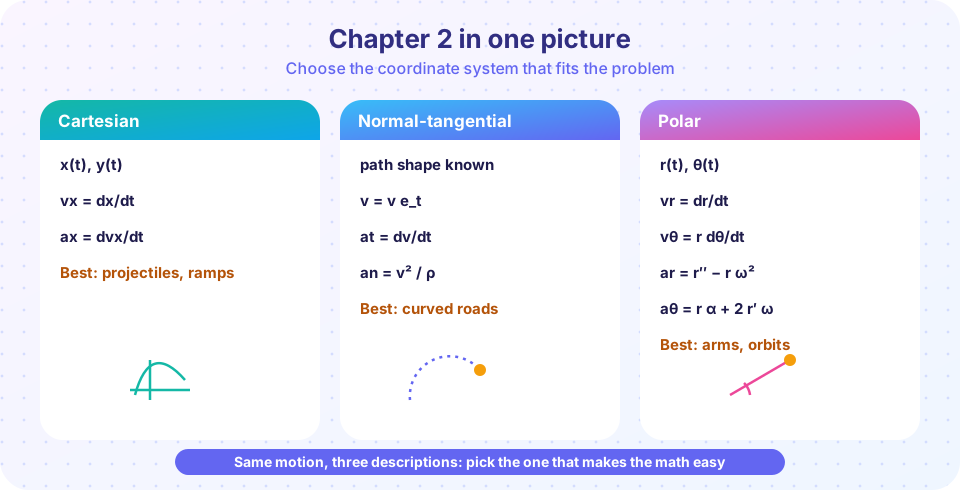
| Normal-tangential | a_t = dv/dt, a_n = v²/ρ |
| Polar | v_r = ṙ, v_θ = r ω, a_r = r̈ − r ω², a_θ = r α + 2 ṙ ω |
| Relative motion | v_B = v_A + v_B/A |
Decision guide
- Straight line? Use rectilinear equations; pick the one missing the unwanted quantity.
- Constant acceleration vector (gravity)? Cartesian components.
- Known curved path (road, track)? Normal-tangential.
- Rotating line or central point (arm, orbit)? Polar.
- Moving observer or fluid? Relative velocity with a vector triangle.
Common misconceptions
"Constant speed means constant velocity." Velocity is a vector; direction counts.
"Constant-acceleration formulas are universal." They are the special case; start from the definitions otherwise.
Try it
A mixed calculator: one function per topic, so you can check any homework answer quickly.
Press Run (or Ctrl + Enter) to see the console output here.
No output.
A second box shows the time and place where two particles meet, using relative motion in Python.
Press Run (or Ctrl + Enter) to see the result here.
Program input · what you'd type while the program runs
Type the answers before you press Run, one per line. Each time the program reads a line (with input()), it gets the next line from this box.
Check your understanding
Quick check · 10 questions
of 10 answered You scored / 10 · perfect!
-
1. A train brakes uniformly from 30 m/s to rest in 150 m. Its deceleration is
a = v²/(2 d) = 900 / 300 = 3 m/s². -
2. A ball is thrown at 20 m/s, 30° above the horizontal from level ground. The time of flight is (g = 9.81)
T = 2 × 20 × 0.5 / 9.81 = 2.04 s. -
3. At the top of a projectile's path, the acceleration is
Gravity does not switch off; ay = −g throughout the flight. -
4. A cyclist rides at 8 m/s on a circle of radius 16 m. The normal acceleration is
a_n = v²/ρ = 64 / 16 = 4 m/s². -
5. A particle starts from rest with a = 2t (SI). Its velocity at t = 3 s is
v = ∫ 2t dt = t² = 9 m/s. -
6. In polar coordinates, a bead at r = 0.5 m turns at constant ω = 4 rad/s with no radial motion. Its radial acceleration is
a_r = −r ω² = −0.5 × 16 = −8 m/s², inward. -
7. A plane flies at 200 km/h airspeed north with a 50 km/h west wind (from the west). Its ground speed is about
√(200² + 50²) = 206 km/h, tracking about 14° east of north. -
8. Two cars on a straight road travel at 30 and 20 m/s in the same direction. The faster one is 500 m behind. It catches up after
Closing speed 10 m/s: 500/10 = 50 s. -
9. Which pair gives equal ranges on level ground without drag?
Angles adding to 90° give equal ranges. -
10. The slope of a position-time graph is
v = ds/dt.
Summary
- Rectilinear, projectile, n-t, polar and relative motion are tools for describing the same physical reality.
- Pick the representation that makes the unknown simple.
- Always check units, signs and limiting cases.
Track your progress
Create a free account to tick off lessons and pick up where you left off on any device.
of Engineering Dynamics lessons completed