


















Lesson 1 of 47 · Getting Started
Course Map: How This Dynamics Course Works
Meet the nine chapters of this Engineering Dynamics course, see what you need to know first, and learn a study routine that makes mechanics problems click.
Dynamics is the part of mechanics that answers a simple question: what will move, and how, when forces act? A bridge in a storm, a car taking a bend, a robot arm, a washing machine drum, a rocket leaving the ground: every one of them is a dynamics problem. This course takes you from the first idea (a force changes motion) to the tools engineers use daily: free-body diagrams, energy methods, rotation, vibration and computer simulation.
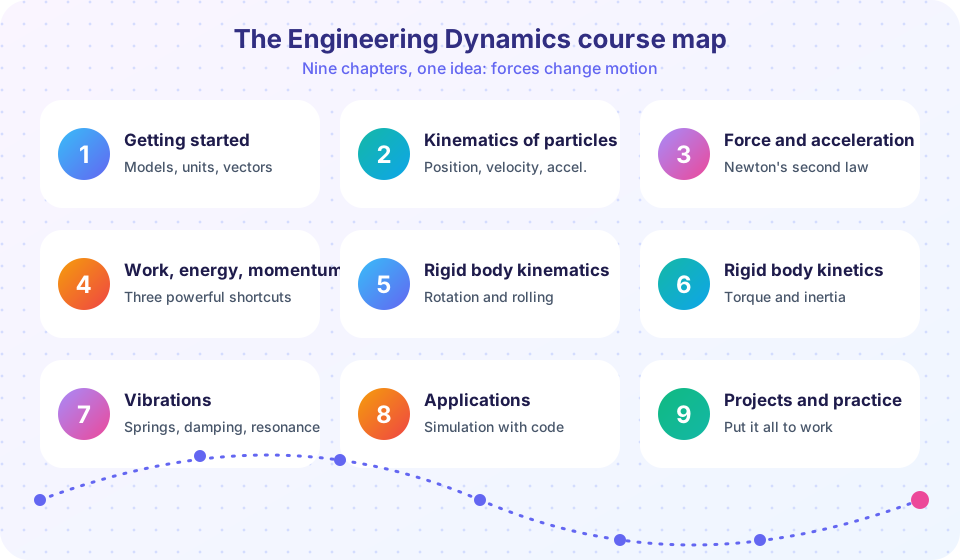
What you will learn
- What the course covers and how the nine chapters fit together.
- Which math and physics you should be comfortable with before you start.
- A repeatable routine for studying dynamics and solving problems.
- How the interactive examples work, and how to use them to test your own ideas.
Key terms
Dynamics: the study of motion and the forces that cause it.
Kinematics: describing motion (position, velocity, acceleration) without asking about its cause.
Kinetics: relating forces to the resulting motion, mostly through Newton's second law.
Particle: an object modeled as a single point with mass, used when its size and rotation do not matter.
Rigid body: an object whose parts keep fixed distances from each other, so it can rotate as well as translate.
The big picture in eight slides
Why dynamics?
Two halves
Chapters 1 to 3
Chapter 4
Chapters 5 and 6
Chapter 7
Chapters 8 and 9
Who this course is for
The course suits first-year engineering and physics students, advanced school students (A Level, IB Higher Level, AP Physics C) and adults who want a solid, calculation-based grip on mechanics. We use SI units throughout and the international notation used by most universities. You will see both algebra and some calculus.
You should be comfortable with:
- algebra, including solving two simultaneous equations;
- right-triangle trigonometry (sine, cosine, tangent);
- the idea of a derivative as a rate of change, and of an integral as an area (we review both when they first appear);
- basic statics: forces as vectors, free-body diagrams, equilibrium. If this is rusty, the track on engineering statics on this site is a good refresher.
How to study dynamics
Dynamics is learned by doing. A reliable routine looks like this:
- Read the idea, then close the page. Explain it aloud in two sentences. If you cannot, read it again.
- Redo each worked example without looking. Change one number and predict how the answer moves.
- Draw before you calculate. Every problem starts with a sketch, axes and a free-body diagram. Most mistakes are diagram mistakes.
- Write symbols first, numbers last. Solve in letters, then substitute. You can check units and limiting cases before any arithmetic.
- Check the answer. Does it have the right unit, sign and size? Would a car really brake at 70 m/s²? (It would not.)
Keep a one-page "error log". Each time you lose marks, write the cause in one line: wrong sign, forgot a force, mixed units. After two weeks you will see your own patterns and stop repeating them.
Common misconceptions
"A moving object needs a force to keep moving." It does not. A force is needed to change velocity. On a frictionless ice rink a puck keeps sliding without any push.
"Dynamics is just plugging into formulas." The formulas are the easy part. Choosing the model, the axes and the diagram is where the skill is.
Try it
The code boxes in this course are real programs that run in your browser. Press Run, then edit the numbers and run again. The first one is a preview of Chapter 8: a bouncing ball simulated step by step. The ball loses some speed in every bounce, so each peak is lower than the last.
Press Run (or Ctrl + Enter) to see the result here.
Program input · what you'd type while the program runs
Type the answers before you press Run, one per line. Each time the program reads a line (with input()), it gets the next line from this box.
The second box is a small interactive: choose a world and drop a ball from 10 m. The fall time is t = √(2h/g), so a weaker gravity gives a longer fall.
Check your understanding
Quick check · 4 questions
of 4 answered You scored / 4 · perfect!
-
1. Which pair correctly names the two halves of dynamics?
Kinematics describes motion on its own. Kinetics links the motion to the forces that cause it. -
2. A rocket coasts in deep space with its engine off. What does Newton's laws say about its velocity?
With zero net force, acceleration is zero, so velocity does not change. -
3. In which order should you work a dynamics problem?
Diagrams and symbols first catch most mistakes before any arithmetic is done. -
4. A ball is dropped from 10 m on the Moon (g = 1.62 m/s²). Compared with Earth, the fall time is
t = √(2h/g). A smaller g makes the fall take longer (about 3.5 s here against 1.4 s on Earth).
Summary
- Dynamics asks how forces change motion; kinematics describes motion, kinetics links it to forces.
- The course runs from models and kinematics, through force, energy and momentum, to rigid bodies, vibrations and simulation.
- A sketch, a free-body diagram and symbolic algebra come before any numbers.
- Forces change velocity; they are not needed to keep it.
Next: What Is Dynamics?
Track your progress
Create a free account to tick off lessons and pick up where you left off on any device.
of Engineering Dynamics lessons completed