


















Lesson 21 of 47 · Work, Energy and Momentum
Collisions and the Coefficient of Restitution
Solve one-dimensional and oblique collisions with momentum conservation and the coefficient of restitution; compare elastic and perfectly inelastic cases.
Two billiard balls click together; two cars meet at a junction; a bullet embeds in a block. Collisions are brief and violent, so the forces are enormous and impossible to describe in detail. But two facts survive every collision between objects isolated from outside pushes: total momentum is conserved, and the fraction of the approach speed that comes back as separation speed is a property of the materials. That fraction is called the coefficient of restitution.
What you will learn
- How to conserve momentum in a collision and add the restitution equation.
- The elastic (
e = 1), partly elastic and perfectly plastic (e = 0) cases. - How much kinetic energy is lost.
- How to handle oblique impacts and the ballistic pendulum.
Key terms
Coefficient of restitution (e): e = (v₂′ − v₁′)/(v₁ − v₂), the ratio of separation speed to approach speed along the line of impact.
Elastic collision: e = 1; kinetic energy is conserved.
Perfectly inelastic collision: e = 0; the bodies move together afterward.
Line of impact: the common normal at the contact point, perpendicular to the touching surfaces.
Two equations for two unknowns
For two bodies colliding along a line, with positive to the right:
- Momentum:
m₁ v₁ + m₂ v₂ = m₁ v₁′ + m₂ v₂′ - Restitution:
v₂′ − v₁′ = e (v₁ − v₂)
Solving both gives
v₁′ = [(m₁ − e m₂) v₁ + (1 + e) m₂ v₂] / (m₁ + m₂)v₂′ = [(1 + e) m₁ v₁ + (m₂ − e m₁) v₂] / (m₁ + m₂)
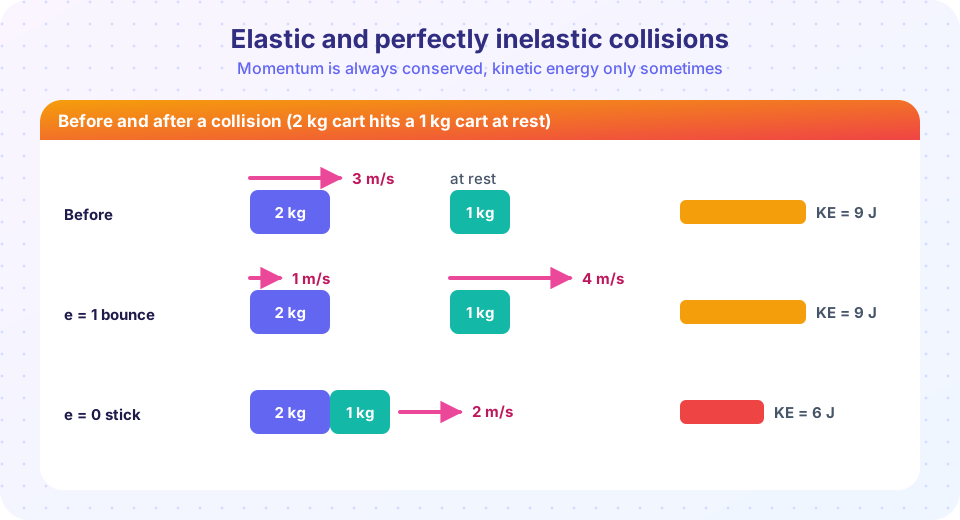
Worked example. A 2 kg cart moving at 3 m/s hits a 1 kg cart at rest.
| Case | v₁′ |
v₂′ |
KE after | KE lost |
|---|---|---|---|---|
Elastic e = 1 |
1.0 m/s | 4.0 m/s | 9 J | 0 |
e = 0.5 |
1.5 m/s | 3.0 m/s | 6.75 J | 2.25 J |
Plastic e = 0 |
2.0 m/s | 2.0 m/s | 6 J | 3 J |
The initial KE is ½ × 2 × 9 = 9 J. Momentum before: 6 kg·m/s; check the elastic row: 2 × 1 + 1 × 4 = 6. ✓.
The maximum loss occurs for e = 0: ΔT = ½ μ_r (v₁ − v₂)², with the reduced mass μ_r = m₁ m₂ / (m₁ + m₂) (here 2/3 kg, giving 3 J).
Special cases worth knowing
- Equal masses, elastic, one at rest: the moving body stops, the other takes its velocity (Newton's cradle).
- Light object hits a very heavy one: it bounces back with almost its own speed.
- A ball dropped on the floor: the floor does not move, so
e = v_after/v_before = √(h₂/h₁). A ball dropped from 1.0 m that rebounds to 0.64 m hase = 0.8.
The ballistic pendulum
A 10 g bullet embeds in a 2.0 kg wooden block hung as a pendulum; the block swings up by 0.20 m. Two stages: the (perfectly plastic) impact conserves momentum, and the swing conserves energy.
- Swing:
v′ = √(2 g h) = √(2 × 9.81 × 0.20) = 1.98 m/s. - Impact:
m v = (m + M) v′, sov = (2.01/0.010) × 1.98 = 398 m/s.
Never apply energy conservation across the impact (much is lost), and never apply momentum conservation across the swing (gravity and the string act).
Oblique impacts
For smooth bodies, the impact force acts only along the line of impact. So:
- Momentum and restitution apply along the line of impact.
- The component of each body's velocity perpendicular to it (the tangential part) does not change.
A ball hitting a wall at 30° to the wall's normal with e = 0.8, at 20 m/s: the normal component is 20 cos 30° = 17.3 m/s and becomes 0.8 × 17.3 = 13.9 m/s going back; the tangential component 20 sin 30° = 10 m/s stays. The exit speed is √(13.9² + 10²) = 17.1 m/s.
Common misconceptions
"Inelastic collisions do not conserve momentum." Momentum is conserved in all collisions without external impulses; only kinetic energy is lost.
"The lost energy vanishes." It becomes heat, sound and deformation.
"Energy is conserved if the bodies stick." Sticking is the most lossy case.
Try it
First, a collision calculator across all restitution values. Watch the two final velocities and the kinetic energy fraction lost as e goes from 0 to 1.
Press Run (or Ctrl + Enter) to see the result here.
Program input · what you'd type while the program runs
Type the answers before you press Run, one per line. Each time the program reads a line (with input()), it gets the next line from this box.
Second, the ballistic pendulum and the bouncing-ball restitution from a measured rebound.
Press Run (or Ctrl + Enter) to see the console output here.
No output.
Check your understanding
Quick check · 6 questions
of 6 answered You scored / 6 · perfect!
-
1. In a perfectly inelastic collision, the two bodies
e = 0 means zero separation speed along the line of impact. -
2. A 1,000 kg car at 20 m/s hits a stationary 1,000 kg car, and they lock together. The speed afterward is
1000 × 20 = 2000 v′, so v′ = 10 m/s. Half of the kinetic energy is lost. -
3. A ball dropped from 2.0 m rebounds to 1.28 m. The coefficient of restitution is
e = √(1.28/2.0) = 0.8. -
4. In a smooth oblique impact, the velocity component perpendicular to the line of impact
No impulse acts along the tangent for smooth surfaces. -
5. In an elastic collision (e = 1) of equal masses with one at rest, the moving mass
From the formulas with m₁ = m₂ and e = 1: v₁′ = 0 and v₂′ = v₁. -
6. In the ballistic pendulum, which principle applies during the swing (after the bullet has stopped in the block)?
During the swing only gravity does work; momentum is not conserved because gravity and the string act.
Summary
- Momentum is conserved along the line of impact in any collision without external impulses.
- The restitution equation
v₂′ − v₁′ = e (v₁ − v₂)closes the system;e = 1elastic,e = 0plastic. - Kinetic energy loss is largest for
e = 0:ΔT = ½ μ_r (v₁ − v₂)². - For oblique impacts the tangential velocity is unchanged (smooth surfaces); the ballistic pendulum needs both principles in two stages.
Next: Chapter 4 Review
Track your progress
Create a free account to tick off lessons and pick up where you left off on any device.
of Engineering Dynamics lessons completed