


















Lesson 3 of 47 · Getting Started
Units, Dimensions and Vectors
Master SI units, unit conversion, dimensional checks and vector components for mechanics, with worked numbers and code you can run and change.
In 1999 NASA lost the Mars Climate Orbiter after one team's software reported thrust impulses in pound-force seconds while another team's software expected newton seconds. A simple unit mismatch destroyed a spacecraft that had cost hundreds of millions of dollars. The lesson for every dynamics student: units are part of the answer. A number without a unit is not a result.
Dynamics also lives on vectors. Force, velocity and acceleration all have both a size and a direction, so you need to split them into components and put them back together confidently.
What you will learn
- The SI base units and the derived units used in dynamics.
- How to convert units without errors and how to use dimensional analysis as a check.
- How to resolve a vector into components and rebuild it.
- How to compute dot products and use them for work and angles.
Key terms
SI: the international system of units, built on the meter, kilogram and second.
Dimension: the kind of quantity (length L, mass M, time T), independent of the unit chosen.
Vector: a quantity with magnitude and direction. A scalar has only magnitude.
Component: the part of a vector along one chosen axis.
Dot product: A·B = |A||B| cos θ, a scalar measuring how much two vectors point the same way.
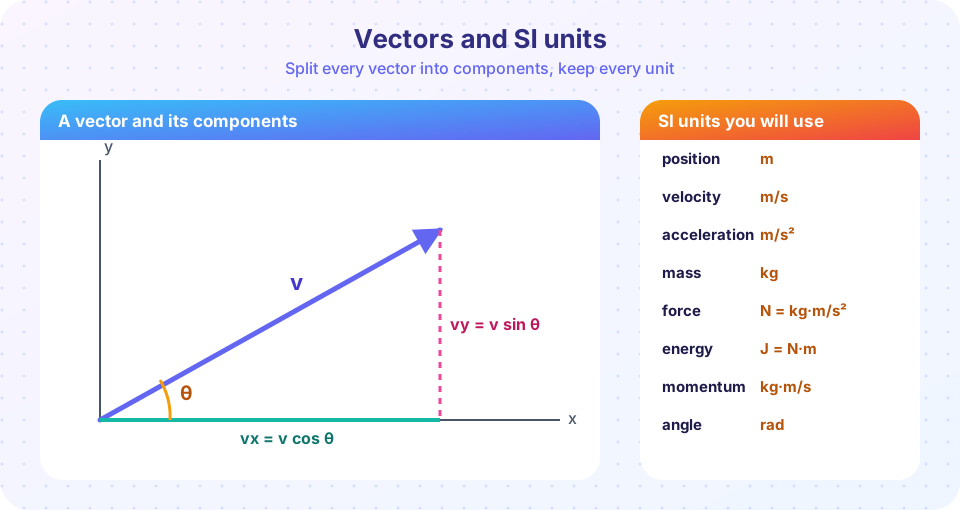
SI units in dynamics
Everything in this course uses three base units: meter (m), kilogram (kg) and second (s). All other units are built from them.
| Quantity | Unit | In base units |
|---|---|---|
| velocity | m/s | m·s⁻¹ |
| acceleration | m/s² | m·s⁻² |
| force | newton, N | kg·m·s⁻² |
| energy, work | joule, J | N·m = kg·m²·s⁻² |
| power | watt, W | J/s |
| momentum, impulse | N·s | kg·m·s⁻¹ |
| angle (measure) | radian | dimensionless |
A newton is the force that gives a 1 kg mass an acceleration of 1 m/s². Weight on Earth is W = m g, so a 1 kg mass weighs about 9.81 N. Mass is measured in kilograms and never changes with location; weight is a force, in newtons.
Converting units
Multiply by conversion factors that equal 1. For example, to convert 90 km/h to m/s:
90 km/h × (1000 m / 1 km) × (1 h / 3600 s) = 25 m/s
A useful shortcut: divide km/h by 3.6 to get m/s. Always cancel the units on paper; the cancellations prove the conversion.
Dimensional analysis as a check
Every term in a correct equation has the same dimensions. Test d = v² / (2a): the dimensions of v²/a are (L/T)² / (L/T²) = L. A length. The formula passes. If someone gives you d = v / (2a), the dimensions are T, which is not a length, so the formula is wrong before you try a number.
Vectors and components
A vector v of magnitude v at an angle θ above the +x axis has components
vx = v cos θvy = v sin θ
To rebuild it: v = √(vx² + vy²) and θ = atan2(vy, vx). Use atan2 (or check the quadrant) because atan(vy/vx) cannot tell the difference between up-right and down-left.
Worked example. A ball leaves a bat at 30 m/s, 40° above the horizontal. Then
vx = 30 cos 40° = 22.98 m/svy = 30 sin 40° = 19.28 m/s
Check: √(22.98² + 19.28²) = 30.0 m/s. ✓.
Choosing the axes
You are free to choose the axes. On a ramp it is much easier to put one axis along the slope and one perpendicular to it: then the normal force has no component along the slope and the motion is one-dimensional. Pick axes that line up with the acceleration.
The dot product
A·B = Ax Bx + Ay By = |A||B| cos θ. It is a scalar. In Chapter 4 the work done by a force is the dot product of the force and the displacement. It also gives the angle between two vectors: cos θ = A·B / (|A||B|).
Common misconceptions
"Weight and mass are the same." Mass (kg) is how much matter and inertia a body has; weight (N) is the gravitational force on it. An astronaut's mass is the same on the Moon, but their weight is about one sixth.
"I can add magnitudes of vectors." 3 N + 4 N is 7 N only if both point the same way. At a right angle the result is 5 N.
"Degrees and radians do not matter to my calculator." They do. Check the mode; sin(40) in radians is not sin(40°).
Try it
A small vector toolbox in Python. Change the speed and angle at the top, and see the components, the rebuilt magnitude and the angle with a second vector.
Press Run (or Ctrl + Enter) to see the result here.
Program input · what you'd type while the program runs
Type the answers before you press Run, one per line. Each time the program reads a line (with input()), it gets the next line from this box.
Next, a unit-aware converter. The pattern, converting everything to SI at the start, is the habit that prevents Mars Climate Orbiter-type errors.
Press Run (or Ctrl + Enter) to see the console output here.
No output.
Check your understanding
Quick check · 5 questions
of 5 answered You scored / 5 · perfect!
-
1. A speed of 72 km/h equals
72 / 3.6 = 20 m/s. -
2. Which expression has the dimensions of a force?
Force = mass × acceleration = kg·m/s². The first is momentum, the third is energy. -
3. A vector has components 6 and 8. Its magnitude is
√(6² + 8²) = √100 = 10. -
4. What does a dot product of zero tell you about two non-zero vectors?
A·B = |A||B| cos θ is zero when cos θ = 0, i.e. θ = 90°. -
5. A 70 kg person stands on the Moon (g ≈ 1.62 m/s²). Their mass is
Mass does not depend on location. Their weight is about 113 N.
Summary
- Work in SI units (m, kg, s) and convert at the very start.
- Check every formula with dimensional analysis; every term must share the same dimensions.
- Resolve vectors into components with cos and sin, rebuild with
√(x² + y²)andatan2. - The dot product
A·B = |A||B| cos θgives work and angles.
Track your progress
Create a free account to tick off lessons and pick up where you left off on any device.
of Engineering Dynamics lessons completed