


















Lesson 43 of 47 · Projects and Practice
Project: vibration isolation for a machine
Design spring mounts for a 200 kg machine: choose the frequency ratio, compute stiffness and static deflection, and test the run-up through resonance by simulation.
A compressor, a generator or a washing machine shakes whatever it stands on. Left on a rigid floor, the vibration travels through the building as noise and fatigue. The standard cure is to mount the machine on soft springs so that the machine can shake without shaking the floor. This project walks through the design of such mounts, from the formula to a simulation.
What you will learn
- Define transmissibility and the isolation condition
r > √2. - Choose a mount stiffness for a target isolation.
- Predict the trade-off between damping and isolation.
- Simulate the run-up through resonance.
Key terms
Transmissibility TR: the ratio of the force passed to the floor to the force produced by the machine.
Isolation: the region r > √2, where TR < 1.
Run-up: the period when a machine accelerates through the natural frequency on its way to full speed.
Static deflection δ_st = m g / k: how much the mounts compress under the machine's weight.
The theory
A machine of mass m on springs k and dampers c produces a harmonic force F₀ on the mounts. The force transmitted to the floor is the spring plus damper force, and the transmissibility is
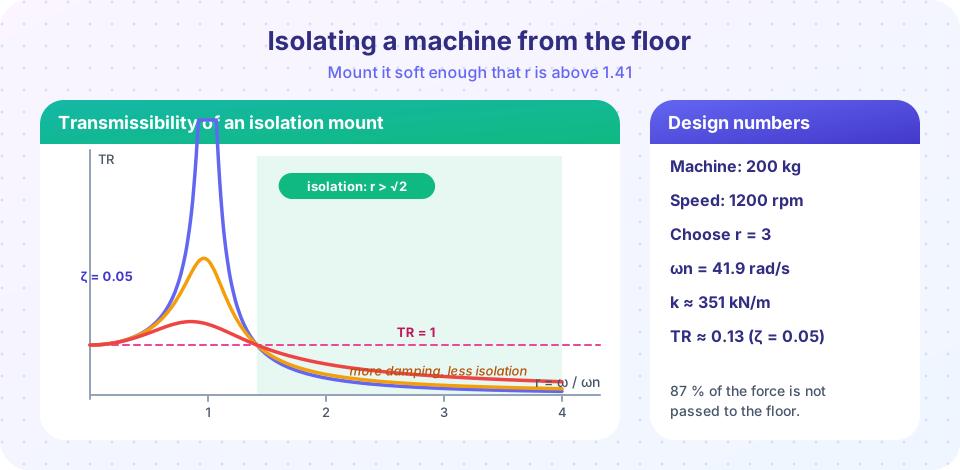
TR = F_T/F₀ = √(1 + (2ζr)²) / √((1 − r²)² + (2ζr)²) r = ω/ωn
Three facts follow from the curve:
TR = 1for allζatr = √2 = 1.414.- Below
r = √2, mounts amplify (worst nearr = 1). - Above
r = √2, the mounts isolate, and the more so with largerr. For light damping,TR ≈ 1/(r² − 1). Damping hurts isolation at highr(the damper conducts force), but is needed to limit the resonance peak during run-up.
The design
Requirement: a 200 kg machine runs at 1200 rpm; the maximum acceptable transmitted force is 15 % of the machine force.
- Pick
TR = 0.15. For light damping,1/(r² − 1) = 0.15givesr² = 7.67, sor ≈ 2.77. We chooser = 3for margin. ω = 1200 × 2π/60 = 125.7 rad/s, soωn = ω/r = 41.9 rad/s.k = m ωn² = 200 × 41.9² = 351 kN/m(total, over all mounts).δ_st = m g/k = 1962/351,000 = 5.6 mm.- With
ζ = 0.05, the exactTR = √(1 + 0.09)/√(64 + 0.09) = 0.130: the design meets the goal.
The design also shows something worth noticing: a softer mount (lower k) raises r and improves isolation, but makes the machine sag more under its own weight and sway more under disturbances. A static deflection of a few millimeters is typical for machinery; for sensitive instruments, mounts with a sag of centimeters are used.
The run-up problem
A machine that must reach 1200 rpm has to pass through ωn (about 400 rpm here). If it lingers near resonance the vibration builds up. Two remedies: run up quickly, or add damping. The simulation below lets you test both: it ramps the speed linearly and records the amplitude of the response.
Common misconceptions
"Stiffer mounts isolate better." Stiffer mounts raise ωn and lower r; isolation only works when r > √2.
"More damping is always better." Damping reduces the resonance peak but increases transmitted force at high r.
"Isolation works at any speed." At speeds below √2 ωn the mounts make things worse, including when the machine slows down at shut-down.
"Static deflection is irrelevant." It is a quick measure of ωn: fn ≈ 0.498/√δ_st.
Try it
This program evaluates the design and plots TR against speed for several damping ratios. Change the machine mass, speed or the target ratio to try your own design.
Press Run (or Ctrl + Enter) to see the result here.
Program input · what you'd type while the program runs
Type the answers before you press Run, one per line. Each time the program reads a line (with input()), it gets the next line from this box.
Now simulate the run-up. The machine's speed ramps linearly from zero to 1200 rpm in T_ramp seconds, and the unbalance force grows with the square of the speed. We compare light and heavy damping and print the peak displacement.
Press Run (or Ctrl + Enter) to see the result here.
Program input · what you'd type while the program runs
Type the answers before you press Run, one per line. Each time the program reads a line (with input()), it gets the next line from this box.
Extend the project
- Add a second machine speed (900 rpm) and find a stiffness that works for both.
- Compute the force transmitted to the floor over time,
F_T = k x + c ẋ, and compare its peak withTR × F₀. - Replace the spring with a hardening one (see the nonlinear spring in the simulation overview) and see how the run-up changes.
Check your understanding
Quick check · 4 questions
of 4 answered You scored / 4 · perfect!
-
1. At what frequency ratio does TR equal 1 for all damping ratios?
All TR curves cross 1 at r = √2 = 1.414. -
2. A machine of 100 kg runs at 600 rpm. For r = 3, what is ωn?
ω = 62.8 rad/s; ωn = ω/3 = 20.9 rad/s. -
3. How does increasing damping change TR for r = 3?
Above √2 the damper transmits force, so TR rises with ζ. -
4. What is the main reason to keep some damping in a mount?
The machine must pass through resonance, where damping limits the amplitude.
Summary
TR = √(1 + (2ζr)²)/√((1 − r²)² + (2ζr)²); isolation needsr > √2.- Design: pick
r(usually 2.5 to 4), computeωn,k = mωn²and the static deflection. - Damping trades isolation at speed against peak response at resonance.
- Simulate the run-up to check the transient.
Track your progress
Create a free account to tick off lessons and pick up where you left off on any device.
of Engineering Dynamics lessons completed