


















Lesson 9 of 47 · Kinematics of Particles
Normal-Tangential and Polar Components
Describe curved motion with moving axes: tangential and normal acceleration (v²/ρ), polar velocity and acceleration components, with worked numbers and code.
Cartesian axes are fixed. That is perfect for a projectile, but awkward for a car on a bend or a bead on a spinning rod. For those, engineers use axes that travel with the particle. Two systems do most of the work: normal-tangential (n-t) axes for motion along a known path, and polar axes for motion described by a distance and an angle from a fixed point.
What you will learn
- How to resolve acceleration into tangential and normal parts, and why
a_n = v²/ρ. - How to find the radius of curvature for a simple path.
- The polar velocity and acceleration components, including the Coriolis-type term.
- How to choose between Cartesian, n-t and polar axes.
Key terms
Tangential unit vector e_t: points along the velocity, tangent to the path.
Normal unit vector e_n: perpendicular to e_t, pointing toward the center of curvature.
Radius of curvature ρ: the radius of the circle that best fits the path at that point.
Radial and transverse components: along the line from the origin to the particle (e_r) and perpendicular to it (e_θ).
Angular velocity ω = dθ/dt, angular acceleration α = dω/dt.
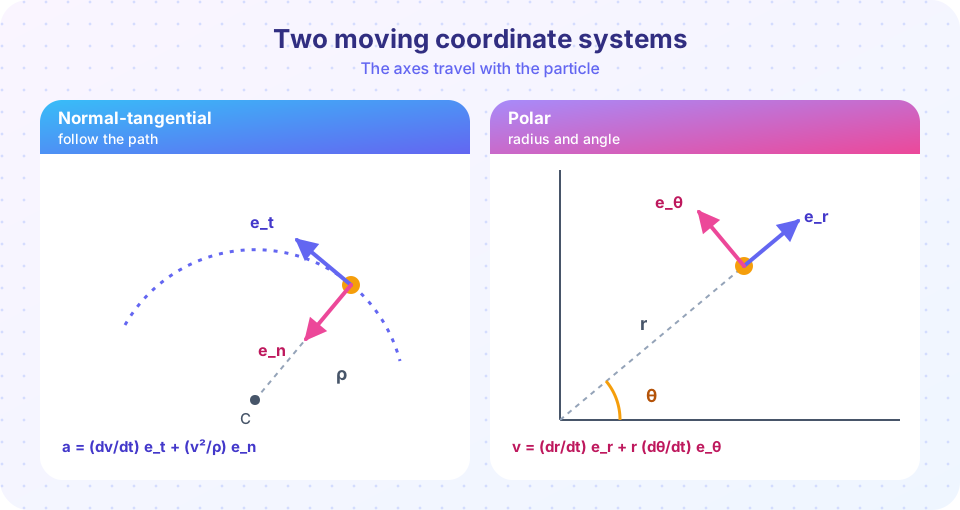
Normal and tangential components
The velocity always points along the path: v = v e_t. Differentiating, the acceleration has two parts:
a = (dv/dt) e_t + (v²/ρ) e_n
- The tangential part
a_t = dv/dtchanges the speed. - The normal part
a_n = v²/ρchanges the direction. It always points to the concave side of the path, toward the center of curvature.
On a circle of radius r, ρ = r. On a straight road, ρ = ∞, so a_n = 0. For a path given as y(x), ρ = (1 + y′²)^(3/2) / |y″|; for example y = x² at x = 0 has y′ = 0 and y″ = 2, so ρ = 0.5.
Worked example. A car is on a curve of radius 80 m. At the instant of interest it travels at 20 m/s and is speeding up at 3 m/s².
a_t = 3 m/s²a_n = v²/ρ = 400 / 80 = 5 m/s²|a| = √(3² + 5²) = 5.83 m/s², atatan(5/3) = 59.0°from the tangent, tilted toward the center.
Since ΣF = m a, a 1,200 kg car needs a sideways (inward) force of 1200 × 5 = 6,000 N from the tires. That sets the limit of cornering, which we explore in Chapter 3.
Polar components
When a particle is described by r(t) and θ(t):
v_r = dr/dt,v_θ = r ωa_r = d²r/dt² − r ω²a_θ = r α + 2 (dr/dt) ω
The term −r ω² is the familiar inward (centripetal) acceleration. The term 2 (dr/dt) ω appears whenever something moves radially while the line rotates; it is the same effect that makes a skater spin faster when pulling the arms in.
Worked example. A collar slides outward along an arm that rotates at constant ω = 2 rad/s. At r = 0.6 m the collar moves outward at 0.3 m/s with a steady radial speed.
v_r = 0.3 m/s,v_θ = 0.6 × 2 = 1.2 m/s, speed= √(0.09 + 1.44) = 1.24 m/s.a_r = 0 − 0.6 × 4 = −2.4 m/s²(inward).a_θ = 0 + 2 × 0.3 × 2 = 1.2 m/s².
Choosing coordinates
| Situation | Best system |
|---|---|
| Projectile, ramp, anything under constant force | Cartesian |
| Car on a road, train on a track, bead on a wire | Normal-tangential |
| Rotating arm, orbit, radar tracking | Polar |
Common misconceptions
"Normal acceleration only exists when the speed changes." It exists whenever the path bends, even at constant speed.
"Centripetal force is a new kind of force." It is just the name for the net inward force that produces v²/ρ. It is never drawn on the free-body diagram as an extra arrow.
"In polar coordinates a_r is just d²r/dt²." The −r ω² term is just as important, and it is what remains if r is constant.
Try it
The first script makes a car follow a circle of radius 50 m while the speed ramps up at 1.5 m/s². It plots the tangential and normal parts and shows how a_n grows with v².
Press Run (or Ctrl + Enter) to see the result here.
Program input · what you'd type while the program runs
Type the answers before you press Run, one per line. Each time the program reads a line (with input()), it gets the next line from this box.
The second script checks the polar formulas against numerical differentiation of Cartesian coordinates. A good formula should agree with brute force.
Press Run (or Ctrl + Enter) to see the result here.
Program input · what you'd type while the program runs
Type the answers before you press Run, one per line. Each time the program reads a line (with input()), it gets the next line from this box.
Check your understanding
Quick check · 5 questions
of 5 answered You scored / 5 · perfect!
-
1. A car travels at a constant 15 m/s around a bend of radius 45 m. Its acceleration is
a_n = v²/ρ = 225/45 = 5 m/s² toward the center; a_t = 0 at constant speed. -
2. Which component of acceleration changes the speed?
a_t = dv/dt changes the speed; a_n only turns the velocity vector. -
3. A particle moves on a straight line. Its normal acceleration is
a_n = v²/ρ → 0 as ρ → ∞. -
4. In polar coordinates with r constant and ω = 3 rad/s at r = 2 m, the radial acceleration is
a_r = −r ω² = −2 × 9 = −18 m/s², directed inward. -
5. The term 2 (dr/dt) ω in a_θ arises because
Radial speed combined with rotation changes the direction of the transverse velocity and the radial direction.
Summary
- n-t axes follow the path:
a = (dv/dt) e_t + (v²/ρ) e_n. ρis the radius of curvature; on a circle it is the radius.- Polar:
v_r = ṙ,v_θ = r ω,a_r = r̈ − r ω²,a_θ = r α + 2 ṙ ω. - Choose the system that makes the unknown acceleration components easy to write.
Next: Relative Motion
Track your progress
Create a free account to tick off lessons and pick up where you left off on any device.
of Engineering Dynamics lessons completed