


















Lesson 16 of 47 · Kinetics: Force and Acceleration
Chapter 3 Review: Force and Acceleration
Review Newton's second law in Cartesian, normal-tangential and polar axes, with a recap table, a ramp-to-drag toolbox and a ten-question mixed quiz.
Chapter 3 gave you the second law as a working tool: draw, write, solve, check. You applied it to crates, pulleys, curves and falling objects. This review gathers the formulas and tests your recall.
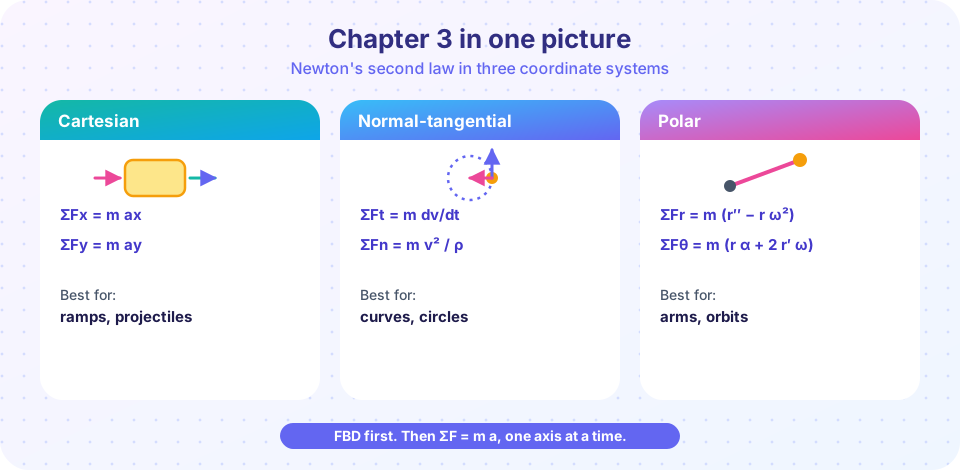
What you will learn
- The key results of Chapter 3 on one page.
- How to pick the equation form that fits each problem.
- A mixed self-test.
Key terms
Equation of motion: ΣF = m a along an axis.
Centripetal force: net inward force m v²/r.
Terminal velocity: speed at which drag equals weight.
Constraint equation: links the accelerations of connected bodies.
Recap table
| Topic | Result |
|---|---|
| Elevator | N = m (g + a) (up positive) |
| Crate pulled at angle θ | N = m g − F sin θ, best angle tan θ = μ |
| Atwood machine | a = (m1 − m2) g/(m1 + m2), T = 2 m1 m2 g/(m1 + m2) |
| Flat curve | v_max = √(μs g r) |
| Banked curve (no friction) | tan θ = v²/(r g) |
| Hill crest | N = m (g − v²/r) |
| Vertical circle top | v_min = √(g r) |
| Linear drag | v_t = m g/k, τ = m/k |
| Quadratic drag | v_t = √(m g/k) |
Common misconceptions
"Centrifugal force is real in the ground frame." It is a feeling caused by inertia.
"Terminal velocity is constant for every object." It depends on mass and drag area.
Try it
A toolbox of Chapter 3 formulas. Change the inputs to check your own answers.
Press Run (or Ctrl + Enter) to see the console output here.
No output.
A second simulation puts curve and drag together: a car brakes on a flat circular curve, and the program finds the speed at which it starts to slide.
Press Run (or Ctrl + Enter) to see the result here.
Program input · what you'd type while the program runs
Type the answers before you press Run, one per line. Each time the program reads a line (with input()), it gets the next line from this box.
Check your understanding
Quick check · 10 questions
of 10 answered You scored / 10 · perfect!
-
1. A 70 kg person in an elevator accelerating upward at 2 m/s² feels a normal force of (g = 9.81 m/s²)
N = 70 × 11.81 = 827 N. -
2. Two masses of 5 kg and 3 kg hang over a pulley. The acceleration is
a = (5 − 3) × 9.81 / 8 = 2.45 m/s². -
3. A car's maximum speed on a flat curve of radius 60 m with μs = 0.6 is about
√(0.6 × 9.81 × 60) = 18.8 m/s. -
4. Doubling a car's speed on the same curve requires the friction force to be
Required friction = m v²/r grows with v². -
5. A frictionless banked road is designed for 20 m/s on a radius of 80 m. tan θ =
tan θ = v²/(r g) = 400/784.8 = 0.51, θ ≈ 27°. -
6. A hill crest of radius 40 m: the car loses contact with the road at about
v = √(g r) = √392 = 19.8 m/s. -
7. A parachutist (m = 80 kg, k = 15 kg/m, quadratic drag) lands at about
v_t = √(80 × 9.81 / 15) = 7.2 m/s. -
8. In an Atwood machine the tension is always
The heavy mass accelerates down (T < m1 g) and the light mass accelerates up (T > m2 g). -
9. Which statement about centripetal force is correct?
It is the net inward force from real contacts and fields. -
10. The time constant of linear drag is
τ = m/k; the terminal speed is m g/k.
Summary
- Newton's second law is the engine of kinetics, whichever axes you pick.
- Curved motion needs a net inward force
m v²/ρ; friction and banking supply it. - Speed-dependent forces make
avary; solve by calculus or numerically.
Track your progress
Create a free account to tick off lessons and pick up where you left off on any device.
of Engineering Dynamics lessons completed