


















Lesson 49 of 49 · Projects and Practice
Further study: where to go after electrodynamics
A roadmap of next steps after electrodynamics: relativity, quantum theory, antennas and RF engineering, numerical methods and advanced mathematics, with links to related tracks.
You have covered the machinery of classical electrodynamics, from fields and Maxwell's equations to radiation and relativity. The subject is a doorway: many other areas build directly on it. This page maps the main paths and says what each one adds.
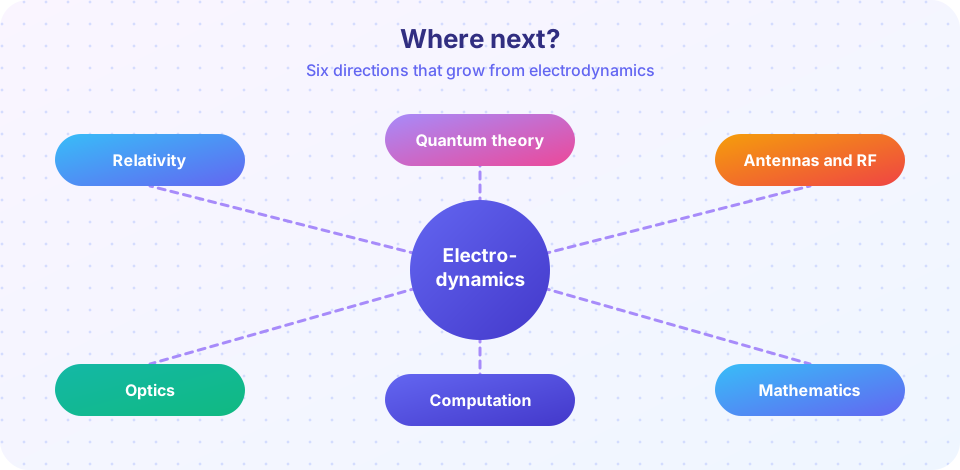
Paths from here
- Relativity. Electromagnetism was the origin of special relativity. Continue with the relativity track for spacetime, four-vectors and general relativity.
- Quantum theory. Light is quantized into photons, atoms absorb and emit radiation, and the vector potential enters the Schrödinger equation. See quantum mechanics and advanced quantum mechanics.
- Antennas and RF. Turn the dipole and Friis formulas into designs for transmission lines, matching and wireless systems in RF and antennas.
- Optics and waves. Interference, diffraction and optical instruments extend Chapter 6: see waves and optics.
- Computation. FDTD, finite elements and particle-in-cell codes in computational physics and numerical methods.
- Mathematics. Tensors, differential forms and Lagrangian field theory appear in differential geometry, multivariable calculus and Lagrangian mechanics.
- Circuits. Lumped-circuit theory is electrodynamics in the limit of small sizes; see circuit analysis.
What each path adds
Relativity. You have already met four-vectors, boosts and the field tensor. A full relativity course adds spacetime diagrams, relativistic dynamics (E² = (pc)² + (mc²)²) and then general relativity, where gravity becomes curvature. A first exercise: derive the Doppler factor √((1−β)/(1+β)) from the plane-wave transformation of this chapter and check it against β = 0.8 giving a factor of 1/3.
Quantum theory. The vector potential A, which looked like a mathematical convenience, becomes physical: a charged particle's phase changes by q∮A·dl/ħ, so the Aharonov-Bohm experiment (proposed 1959) shows effects in regions where B = 0. Light itself is quantized into photons of energy hf, and radiation from atoms is described by quantum transitions rather than by the Larmor formula. A first exercise: compute the photon energy at 2.4 GHz (about 10⁻⁵ eV) and compare with visible light (about 2 eV).
Antennas and RF. The half-wave dipole (R_rad ≈ 73 Ω, D = 1.64) and the Friis formula are the entry point to transmission lines, impedance matching, arrays and link budgets. A first exercise: design a half-wave dipole for 100 MHz (about 1.5 m long) and compute the free-space loss over 10 km.
Optics and waves. Chapter 6 gave reflection and refraction; interference, diffraction and coherence follow from superposition of the same waves. Thomas Young's double slit (1801) and Fresnel's wave theory predate Maxwell, and Hertz's 1887-88 experiments with spark-gap transmitters, which showed radio waves reflecting, refracting and polarizing like light, completed the picture.
Computation. FDTD, introduced for Maxwell's equations by Kane Yee in 1966, is one of several methods; finite elements handle complex geometry, and particle-in-cell codes follow charged particles and fields together in plasmas. A first exercise: extend the 1D project to two dimensions and watch a wave pass a slit.
Mathematics. Differential forms write F = dA and dF = 0, d⋆F = J, the compact form of everything in this course; gauge theory generalizes the idea to the weak and strong forces (Yang and Mills, 1954).
Reading list
Standard textbooks at different levels: David Griffiths, Introduction to Electrodynamics (the usual first university text and the model for this course's conventions); Edward Purcell and David Morin, Electricity and Magnetism (strong physical intuition and relativity); Richard Feynman, The Feynman Lectures on Physics, Volume II (free to read online, conceptual); John David Jackson, Classical Electrodynamics (graduate level, the standard reference); Landau and Lifshitz, The Classical Theory of Fields (compact and mathematical). Read a different text on the topic you found hardest: a second explanation often unlocks what the first could not.
How to study from here
- Re-derive, do not re-read. Take a result from the cheat sheet and rebuild it on paper. If you get stuck, note exactly where.
- Do problems in sets. Ten problems on one idea in a sitting teach more than one problem each day on ten ideas.
- Check limits and units. Habitual dimensional analysis catches most algebra errors, and limiting cases (
v ≪ c,r ≫ λ) catch the rest. - Simulate. A short script that reproduces a textbook figure proves you understand the formula.
- Teach it. Explaining the displacement current or the Poynting vector to someone else exposes gaps quickly.
Common misconceptions about what comes next
"Classical electrodynamics is finished physics." It is complete as a theory of classical fields, and engineers use it daily, but its limits (radiation reaction, point charges, the interior of atoms) are exactly where quantum electrodynamics begins.
"I must finish all the advanced maths first." Pick up differential forms and tensors when a problem needs them; Griffiths-level vector calculus carried you through this whole course.
"Quantum mechanics replaces Maxwell." In quantum electrodynamics the Maxwell equations survive as the equations for the quantum field operators and as the classical limit of many photons.
A good next step. Pick one path and one project: for example, extend the FDTD project to two dimensions, or derive the Larmor formula from the Liénard-Wiechert fields. Projects force you to fill gaps that reading hides.
Try it
Press Run (or Ctrl + Enter) to see the result here.
Program input · what you'd type while the program runs
Type the answers before you press Run, one per line. Each time the program reads a line (with input()), it gets the next line from this box.
Check your understanding
Quick check · 3 questions
of 3 answered You scored / 3 · perfect!
-
1. Which subject grew directly out of the constancy of the speed of light in Maxwell's equations?
Einstein's 1905 paper was titled 'On the Electrodynamics of Moving Bodies'. -
2. Where does the vector potential play a central role beyond classical theory?
Phases of quantum states depend on A even where B = 0. -
3. Which method is the numerical technique from the FDTD project?
FDTD alternately updates E and H on the Yee grid.
Summary
- Electrodynamics connects to relativity, quantum theory, RF engineering, optics, computation and advanced maths.
- Choose one path, and build one project in it.
- Return to the track page any time to review the whole course.
Next: back to the track page
Track your progress
Create a free account to tick off lessons and pick up where you left off on any device.
of Electrodynamics lessons completed