


















Lesson 42 of 49 · Relativity and Electrodynamics
Chapter review: relativity and electrodynamics
Review field transformations, invariants, the field tensor and the fields of moving charges with a recap table and ten mixed questions.
This chapter showed that electromagnetism and special relativity are one subject. The review collects the transformation rules, the invariants and the moving-charge field in a single picture.
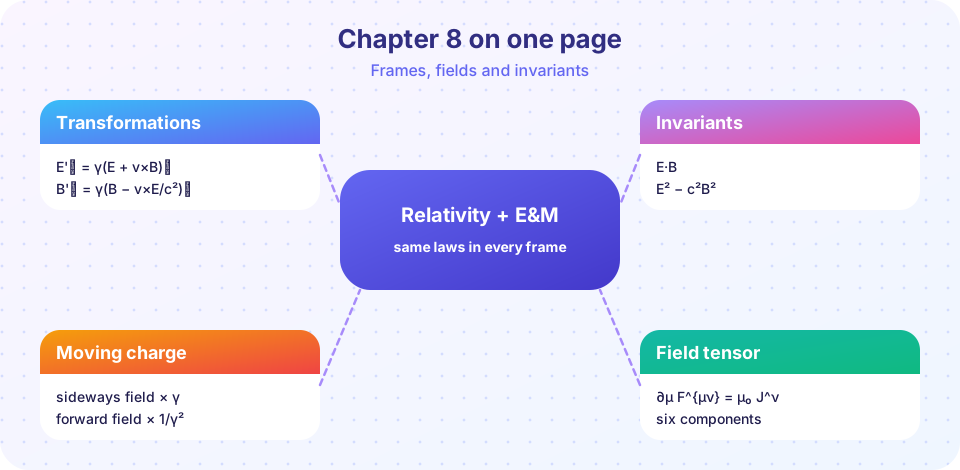
Recap table
| Idea | Formula | Remember |
|---|---|---|
| Lorentz factor | γ = 1/√(1 − β²) |
0.6c gives 1.25 |
| Perpendicular E | E'_⊥ = γ(E + v×B)_⊥ |
Parallel parts unchanged |
| Perpendicular B | B'_⊥ = γ(B − v×E/c²)_⊥ |
1/c² is tiny |
| Invariants | E·B, E² − c²B² |
Plane waves stay plane waves |
| Moving charge | E = q(1−β²)R̂ / [4πε₀R²(1−β²sin²θ)^{3/2}] |
Sideways ×γ |
| Tensor | ∂_μF^{μν} = μ₀J^ν |
6 components |
The chapter's story in five steps
- The clash. Maxwell's equations fix
c = 1/√(μ₀ε₀)with no reference frame; Michelson and Morley (1887) found no ether wind. Einstein (1905) kept the equations and changed mechanics. - The rule. Boost to a frame moving at
v: parallel components of E and B stay, perpendicular ones mix withγ,vandv/c². At low speed this isE' ≈ E + v×B. - The payoff. Magnetism is the relativistic remainder of electricity (the wire example:
B = 10⁻⁴ TandE' = γvB = 100 V/mgive the same force). A fast charge's field is squeezed into a pancake,γtimes Coulomb sideways. - The invariants.
E·BandE² − c²B²survive every boost. They tell you which simplifications are possible: ifE ⊥ BandE > cB, a frame exists withB' = 0; ifE < cB, one withE' = 0; plane waves (both zero) never simplify. - The packaging.
F^{μν}has six independent entries;∂_μF^{μν} = μ₀J^νand∂_μG^{μν} = 0are all four Maxwell equations, and charge conservation drops out for free.
Worked review problems
Problem 1. In S, E = 0 and B = 2 T ẑ. Find E' and B' for a frame moving at 0.6c along x. Solution. γ = 1.25. E'_y = −γ v B_z = −1.25 × 0.6 × 2.998×10⁸ × 2 ≈ −4.5×10⁸ V/m, B'_z = γB_z = 2.5 T. Check the invariant: E'² = (1.5c)² = 2.25c² and c²B'² = 6.25c² (with T understood), so E'² − c²B'² = −4c², the same as the original 0 − c²(2)² = −4c².
Problem 2. A charge moves at β = 0.6. Compare the field at the same distance directly ahead and directly to the side with the Coulomb value. Solution. Ahead (θ = 0) the factor is 1 − β² = 0.64; to the side (θ = 90°) it is (1 − β²)/(1 − β²)^{3/2} = 1/√(1 − β²) = γ = 1.25.
Problem 3. Two plane-wave facts follow at once from the invariants: E = cB and E ⊥ B in every frame, and the Doppler factor √((1−β)/(1+β)) rescales the amplitude when the observer moves along the propagation direction.
Common mistakes to avoid
Mixing up whose velocity. In E' = γ(E + v×B) the vector v is the velocity of the new frame relative to the old. Reversing it flips the sign of the mixed terms.
Forgetting c. E (V/m) and cB (V/m) have equal units; B and E/c (tesla) do. In the formula B'_y = γ(B_y + vE_z/c²) the c² is not optional.
Applying γ to parallel components. Components along the boost direction are unchanged.
Try it
Press Run (or Ctrl + Enter) to see the result here.
Program input · what you'd type while the program runs
Type the answers before you press Run, one per line. Each time the program reads a line (with input()), it gets the next line from this box.
Press Run (or Ctrl + Enter) to see the result here.
Program input · what you'd type while the program runs
Type the answers before you press Run, one per line. Each time the program reads a line (with input()), it gets the next line from this box.
Where this chapter connects
Chapter 5 gave motional emf BLv: it is the v×B term of the transformation, now derived rather than assumed. Chapter 6's plane waves are the null fields of the invariants, which is why their E = cB structure holds for every observer. Chapter 7's radiation fields come from accelerated charges, and the Larmor formula looks simplest in the charge's instantaneous rest frame before being transformed. Chapter 9's projects put the formulas to numerical use.
Check your understanding
Quick check · 10 questions
of 10 answered You scored / 10 · perfect!
-
1. A frame moves along x. Which field components are unchanged?
Components parallel to the boost direction do not change. -
2. E and B in one frame are parallel. The invariant E·B is
E·B is invariant, so it is the same nonzero value everywhere. -
3. A charge moves at β = 0.6. Directly ahead of it, the field relative to Coulomb is
At θ = 0 the factor is 1 − β² = 0.64. -
4. Which statement is correct about a plane electromagnetic wave seen from a moving frame?
Both invariants vanish, so E = cB with E ⊥ B in every frame. -
5. How many independent components does the field tensor have?
It is antisymmetric 4×4: six independent entries. -
6. In S the field is B = 2 T ẑ, E = 0. What is B'_z in a frame moving at 0.6c along x?
B'_z = γB_z = 1.25 × 2 = 2.5 T. -
7. For small speeds, E' ≈
That reproduces the magnetic force in the moving frame as an electric one. -
8. The sideways field of a charge at β = 0.99 compared with Coulomb is about
γ ≈ 7.09 at β = 0.99. -
9. The continuity equation follows from
∂_ν∂_μF^{μν} = 0 gives ∂_νJ^ν = 0. -
10. In S there is E = E₀ ŷ and B = 0. Then in the boosted frame the invariant E² − c²B² equals
The invariant keeps its value E₀² in every frame.
Summary
- E and B mix under boosts;
E·BandE² − c²B²are invariant. - The field of a moving charge is flattened by
γsideways. F^{μν}and∂_μF^{μν} = μ₀J^νare Maxwell's equations in a frame-independent form.- Chapter 9 applies everything in projects and practice problems.
Track your progress
Create a free account to tick off lessons and pick up where you left off on any device.
of Electrodynamics lessons completed