


















Lesson 39 of 49 · Relativity and Electrodynamics
Chapter overview: relativity and electrodynamics
How Maxwell's equations led to special relativity: the same speed of light for everyone, fields that mix under changes of frame, and what this chapter covers.
Maxwell's equations contain a number, c = 1/√(μ₀ε₀), with no mention of who measures it. Newton's mechanics, with its rule that velocities simply add, says the equations (and c) must look different to observers in relative motion. Experiments (Michelson and Morley, 1887) found nothing of the sort. Einstein's 1905 paper "On the Electrodynamics of Moving Bodies" resolved the tension by changing mechanics, not electromagnetism: Maxwell's equations are already correct in every inertial frame, and it is Newton's laws and the Galilean transformation that need repairing.
What you will learn
- Explain why Maxwell's equations clashed with Galilean relativity and how Einstein resolved it.
- Use the Lorentz factor for time dilation, length contraction and velocity addition with real numbers.
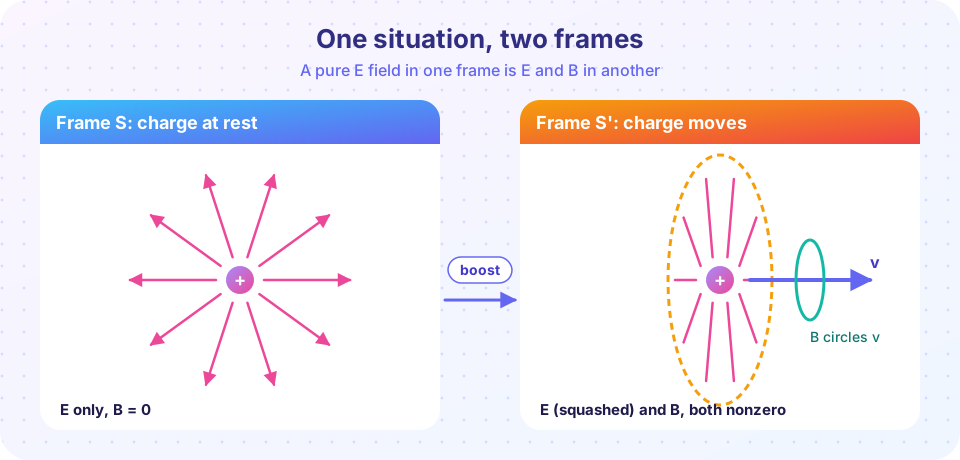
- Describe, in words, why electric and magnetic fields are two views of one field.
- Know what the next two lessons deliver.
A problem hiding in Maxwell's equations
Maxwell's equations predict waves that travel at c = 1/√(μ₀ε₀) ≈ 2.998 × 10⁸ m/s. In 1865 James Clerk Maxwell noticed this matched the measured speed of light and concluded that light is an electromagnetic wave. But a speed has to be measured relative to something. For water waves it is the water, for sound it is the air. Nineteenth-century physicists therefore assumed a "luminiferous ether" filled space, and that c was the speed of light relative to it. An observer moving through the ether should then measure a different light speed, just as a swimmer moving against a current measures a different wave speed.
In 1887 Albert Michelson and Edward Morley split a beam of light into two perpendicular paths and recombined it, looking for a shift in the interference fringes as the apparatus turned with the Earth. If the Earth moved through the ether at about 30 km/s, the shift should have been a sizeable fraction of a fringe. They saw nothing close to it. Other explanations followed: George FitzGerald and Hendrik Lorentz suggested that bodies contract along their motion, and Henri Poincaré developed the mathematics of the transformation that bears Lorentz's name. Einstein's 1905 contribution was to drop the ether altogether and make two clean postulates.
There was a second, more mundane hint. Move a magnet toward a coil and a current flows; move the coil toward the magnet and the same current flows. The textbook explanations of 1900 were different: in one case the changing magnetic field makes an electric field, in the other the magnetic force pushes the charges. Einstein opened his paper by calling this asymmetry "not inherent in the phenomena". The answer, developed in this chapter, is that a single physical field looks partly electric and partly magnetic depending on who is looking.
Worked example: how much does relativity matter?
The Lorentz factor γ = 1/√(1 − β²), with β = v/c, controls every effect.
- Time dilation. A clock moving at
0.6cruns slow byγ = 1.25: a 10 µs interval on the moving clock is 12.5 µs in the lab. - Length contraction. A 100 m rod moving along its length at
0.6chas length100/1.25 = 80 min the lab. - Event coordinates. An event at
x = 100 m,t = 0in frameShasx' = γ(x − vt) = 125 mandct' = γ(ct − βx) = −75 min a frame moving at0.6c: it happens "before"t' = 0there. Simultaneity is relative. - Velocity addition. Two things each moving at
0.8ctowards the same direction do not make1.6c. The ruleu' = (u + v)/(1 + uv/c²)gives1.6c/1.64 = 0.9756c. At0.99c + 0.99cyou get0.99995c. Nothing reachescby addition.
Everyday speeds are different: a jet at 250 m/s has β ≈ 8 × 10⁻⁷ and γ − 1 ≈ 3.5 × 10⁻¹³. That is why Galilean mechanics worked so well. In electrodynamics the effect hides in plain sight: the magnetic force on a moving charge is smaller than a comparable electric force by a factor of order v²/c², but a wire is electrically neutral, so the electric forces cancel and the tiny relativistic remainder is all that is left. Every magnet and every transformer relies on it.
The big picture
- Postulates. The laws of physics take the same form in all inertial frames, and light travels at
cin all of them. - Consequences. Lorentz transformations replace Galilean ones: time dilates, lengths contract, simultaneity is relative.
- Fields mix. What one observer calls an electric field another sees partly as a magnetic field. E and B are two faces of one object, the electromagnetic field tensor.
- Magnetism from electricity. The magnetic force between parallel currents can be derived as a relativistic effect of the electric force.
Key terms. Inertial frame: one in which free particles move in straight lines at constant speed. Lorentz factor γ = 1/√(1 − v²/c²). Invariant: a quantity all inertial observers agree on. Four-vector: a quantity with four components that transforms like (ct, x, y, z).
Press Run (or Ctrl + Enter) to see the result here.
Program input · what you'd type while the program runs
Type the answers before you press Run, one per line. Each time the program reads a line (with input()), it gets the next line from this box.
Chapter 8 roadmap
The toolkit
Payoffs
Common misconceptions
"Relativity was invented because the Michelson-Morley experiment failed." The null result mattered, but Einstein was driven mainly by the structure of Maxwell's equations and the magnet-and-coil asymmetry. The postulates came first, the ether's absence followed.
"Relativity says everything is relative." Its core is what is not relative: the speed of light, the form of the laws, and invariants such as E² − c²B².
"Relativistic effects only matter near the speed of light." They scale as v²/c², and some are huge in practice because many charges are involved: every magnet and every transformer relies on the effect that the next lesson derives.
Press Run (or Ctrl + Enter) to see the result here.
Program input · what you'd type while the program runs
Type the answers before you press Run, one per line. Each time the program reads a line (with input()), it gets the next line from this box.
What each lesson covers
- Transforming fields and moving charges: how E and B change between frames, and the field of a uniformly moving charge.
- The field tensor and invariants: Maxwell's equations as one four-dimensional equation.
- Chapter review.
Check your understanding
Quick check · 6 questions
of 6 answered You scored / 6 · perfect!
-
1. What does the Michelson-Morley experiment's null result suggest?
It found no motion-dependent change in light speed, consistent with relativity. -
2. What is γ for v = 0.6c?
γ = 1/√(1 − 0.36) = 1/0.8 = 1.25. -
3. Which statement about E and B under a change of inertial frame is correct?
E and B are components of one field tensor, so they transform into each other. -
4. Two spacecraft each move at 0.8c in the same direction relative to a station, measured from the station. A probe fired forward from the first craft at 0.8c relative to it moves, relative to the station, at
u' = (0.8c + 0.8c)/(1 + 0.64) = 0.9756c, below c. -
5. A 100 m rod passes you lengthwise at 0.6c. Its length in your frame is
Length contraction divides by γ = 1.25. -
6. Which pair of postulates did Einstein use in 1905?
These two postulates give the Lorentz transformation.
Summary
- Maxwell's equations hold in all inertial frames; mechanics had to change.
- γ measures how strongly relativity matters; for everyday speeds it is almost exactly 1.
- E and B are not independent: a change of frame mixes them.
Track your progress
Create a free account to tick off lessons and pick up where you left off on any device.
of Electrodynamics lessons completed