


















Lesson 10 of 49 · Vector Calculus and Electrostatics
Conductors and energy
Why charge sits on the surface of a conductor, how shielding and induced charge work, the method of images, and how to compute the energy stored in an electric field.
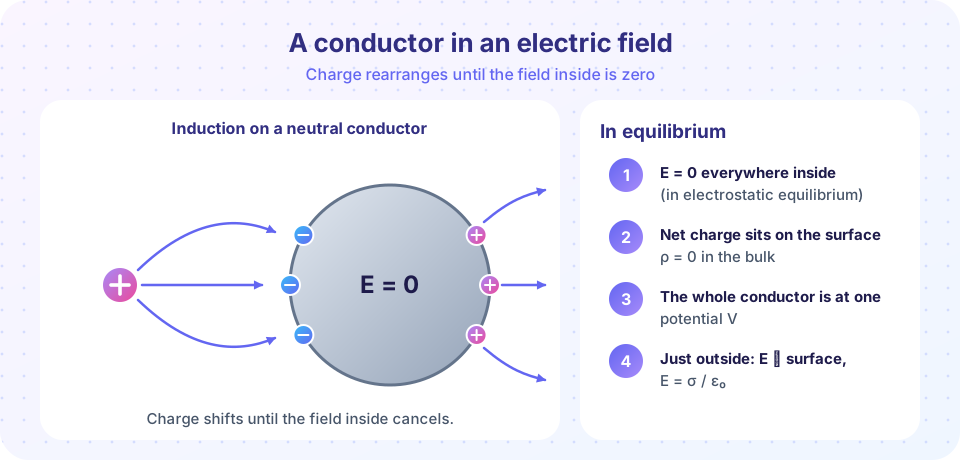
A conductor is a material with charges free to move, like the electrons in a metal. That one property leads to remarkably strong rules: no field inside, charge only on the surface, one potential everywhere. They explain why a car protects you in a lightning storm, why a coaxial cable does not pick up noise, and why a sharp metal point sparks. The same chapter closes with a different question: how much energy is stored in an arrangement of charges, and where is it?
What you will learn
- The four properties of a conductor in electrostatic equilibrium and why each follows from the one before.
- How induced charge, cavities and shielding work.
- How to use the method of images for a charge near a grounded plane.
- The energy of a charge distribution and the energy density
u = ½ ε₀ E².
Key terms
- Electrostatic equilibrium: no net motion of free charge.
- Induced charge: charge that shifts in a conductor in response to an external field.
- Faraday cage: a closed conductor that shields its interior from external static fields.
- Method of images: replacing a conductor by fictitious charges that give the same boundary potential.
- Energy density u: electric energy per unit volume, in J/m³.
Four properties of a conductor
- E = 0 inside. If there were a field, free charges would feel a force and move. Equilibrium means they have stopped, so the field is zero in the bulk. When you place a conductor in an external field, charges shift until their own field exactly cancels the external one inside.
- ρ = 0 inside; the net charge lies on the surface. Gauss's law with
E = 0gives zero enclosed charge for any Gaussian surface inside the metal. - The conductor is an equipotential. Since
E = −∇V = 0inside, V is constant throughout the metal, and its surface is an equipotential too. - E is perpendicular to the surface, with magnitude σ/ε₀ just outside. A parallel component would drive surface charge. A small pillbox straddling the surface has flux only through the outer face:
E A = σ A/ε₀. Notice the field right outside a conductor is twice that of an isolated sheet with the same σ, because the other half of the field is created by the rest of the charge.
Cavities and shielding
A cavity inside a conductor, with no charge in it, has no field either: any field line would have to start and end on the cavity wall at different potentials, which is impossible because the wall is an equipotential. That is the Faraday cage: the interior is shielded from outside static fields. If you put a charge +q inside the cavity, the cavity wall acquires −q (so Gauss's law holds for a surface in the metal) and the outer surface gets +q. Inside the cavity the field depends on the cavity shape and q, but outside it depends only on the outer shape and the total charge.
Sharp points
On a conductor with a curved surface, the charge density is highest where the radius of curvature is smallest. Two spheres of radii R₁ and R₂ connected by a long wire are at the same potential, so kQ₁/R₁ = kQ₂/R₂ and σ₁/σ₂ = R₂/R₁. Smaller sphere, larger σ and larger field σ/ε₀. That is why lightning rods are pointed and why sharp points leak charge by corona discharge.
The method of images
A point charge +q at a distance d above an infinite grounded conducting plane induces a surface charge. Finding it directly is hard, but there is a trick. The potential in the region above the plane equals that of +q at height d and a fictitious image charge −q at depth d below the plane, because by symmetry V = 0 on the plane. The uniqueness theorem then guarantees this is the right potential.
Consequences:
- Force on the real charge:
F = k q² / (2d)²toward the plane. For q = 1 nC and d = 5 cm that is about 0.9 μN. The charge is attracted although the plane is neutral overall. - Induced surface density:
σ(ρ) = −q d / [2π (ρ² + d²)^{3/2}], where ρ is the distance from the point below the charge. Its integral over the plane is exactly −q. - The field below the plane is zero; the image charge exists only in the mathematics of the upper region.
Energy of a charge distribution
The work needed to assemble charges is stored as electric potential energy. For point charges, W = ½ Σ qᵢ Vᵢ, where Vᵢ is the potential at charge i due to all the others. For a continuous distribution
W = ½ ∫ ρ V dV
Substituting ρ = ε₀ ∇·E, integrating by parts and using E = −∇V gives a neater form:
W = (ε₀ / 2) ∫ E² dV over all space
So we can say the energy is stored in the field, with energy density
u = ½ ε₀ E²
Applications:
- Thin shell of radius R and charge Q: all energy lies outside,
W = kQ²/(2R). - Uniform solid sphere:
W = 3kQ²/(5R), larger because there is also field inside. - Classical electron radius: setting
kQ²/Requal to the rest energym c²for Q = e givesr_e = k e²/(m c²) = 2.82 × 10⁻¹⁵ m, a scale at which the classical picture of a charged ball must fail.
The energy is not additive: for two sources, E² = E₁² + E₂² + 2 E₁·E₂. The cross term is the interaction energy between them.
Common misconceptions
- "Charge inside a conductor can sit anywhere." In equilibrium it all sits on the surface (or on a cavity wall if there is a charge in the cavity).
- "A conductor screens all fields." It screens static electric fields. Magnetic fields and fast-changing fields need other arguments (Chapters 5 and 6).
- "The energy
½ qVfor a single charge uses the full potential."U = qVis the energy of a charge in an external potential. For the self-energy of a distribution there is the factor ½, otherwise each pair is counted twice. - "A negative energy means something is wrong." The energy of a bound pair of opposite charges is negative: it takes work to separate them.
Try it
The first example confirms numerically that the induced charge on a grounded plane totals −q. The second computes the energy of a sphere and a shell by integrating the energy density.
Press Run (or Ctrl + Enter) to see the result here.
Program input · what you'd type while the program runs
Type the answers before you press Run, one per line. Each time the program reads a line (with input()), it gets the next line from this box.
Press Run (or Ctrl + Enter) to see the result here.
Program input · what you'd type while the program runs
Type the answers before you press Run, one per line. Each time the program reads a line (with input()), it gets the next line from this box.
Check your understanding
Quick check · 6 questions
of 6 answered You scored / 6 · perfect!
-
1. A conductor in electrostatic equilibrium has which property?
The field is zero inside, so V is constant, and E is perpendicular to the surface. -
2. The field just outside a conductor with surface density σ is
A pillbox with one face inside the metal (zero field) gives E = σ/ε₀. -
3. A charge +q is placed inside a cavity of an isolated neutral conductor. The outer surface carries
The cavity wall gets −q, so the outer surface must carry +q to keep the conductor neutral. -
4. In the method of images, the force on a charge q at height d above a grounded plane is
The image charge −q sits at distance 2d from the real charge. -
5. The energy density of an electric field is
u = ½ε₀E², and the total energy is its integral over space. -
6. Why are lightning rods pointed?
At a sharp point σ and E = σ/ε₀ are large, which promotes discharge in a controlled place.
Summary
- In equilibrium a conductor has
E = 0inside, charge only on the surface, one constant potential, andE = σ/ε₀perpendicular to the surface. - Cavities are shielded from outside static fields (Faraday cage); charge in a cavity induces opposite charge on the wall.
- A charge near a grounded plane behaves as if it had an opposite image charge behind the plane.
- Energy of a distribution:
W = ½ ∫ ρ V dV = (ε₀/2) ∫ E² dV, with densityu = ½ ε₀ E². - Energy is not additive: the cross term is the interaction energy.
Next: Chapter 2 review
Track your progress
Create a free account to tick off lessons and pick up where you left off on any device.
of Electrodynamics lessons completed