


















Lesson 41 of 49 · Relativity and Electrodynamics
The field tensor and covariant Maxwell equations
Package E and B into the antisymmetric field tensor, write Maxwell's equations as one four-dimensional equation and check the boost law and invariants.
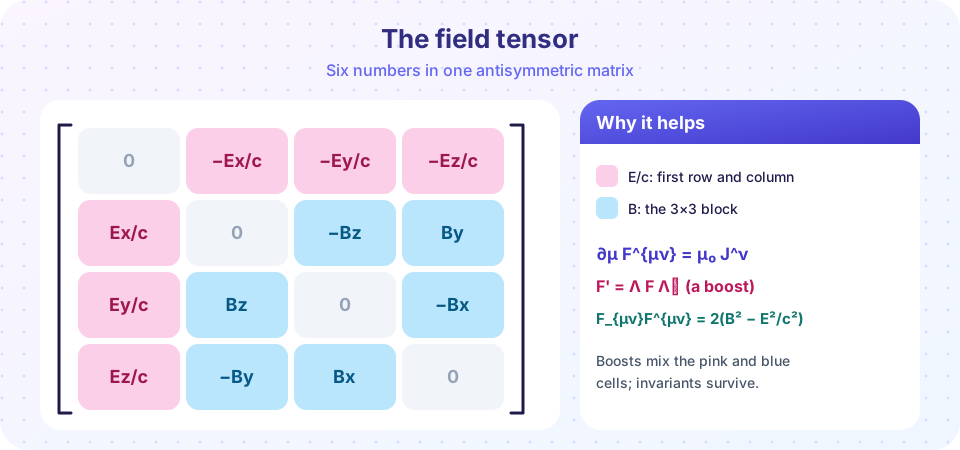
The transformation rules of the last lesson look messy, but they hide a simple structure. E and B together make six numbers, exactly the number of independent entries in a 4×4 antisymmetric matrix. This matrix, the electromagnetic field tensor F^{μν}, transforms with the same rule as any rank-two tensor, and Maxwell's four equations collapse into two compact ones.
What you will learn
- Write
F^{μν}in terms of E and B. - State the two covariant Maxwell equations.
- Transform the tensor with a Lorentz boost and recover the field transformation rules.
- Compute the invariant
F_{μν}F^{μν}.
Key terms
Four-vector: x^μ = (ct, x, y, z). Metric η = diag(+1, −1, −1, −1). Four-current J^μ = (cρ, J). Four-potential A^μ = (V/c, A). Antisymmetric: F^{μν} = −F^{νμ}. Covariant: written in a form that keeps the same appearance in every inertial frame.
The tensor
In one common convention (metric signature + − − −, as in Griffiths) the field tensor is
          |  0    −Ex/c  −Ey/c  −Ez/c |
F^{μν} =  | Ex/c    0    −Bz     By   |
          | Ey/c    Bz     0    −Bx   |
          | Ez/c   −By    Bx     0    |
Other books place the signs differently; always check the convention. It follows from the four-potential: F^{μν} = ∂^μ A^ν − ∂^ν A^μ. Since each entry is a derivative of A, the definitions B = ∇×A, E = −∇V − ∂A/∂t are included automatically.
Maxwell's equations in two lines
With J^μ = (cρ, J):
∂_μ F^{μν} = μ₀ J^ν            (Gauss and Ampere-Maxwell)
∂_μ G^{μν} = 0                 (no monopoles and Faraday; G is the dual tensor)
Check the first equation. For ν = 0 it reads ∂_x(E_x/c) + ∂_y(E_y/c) + ∂_z(E_z/c) = μ₀ c ρ, i.e. ∇·E = μ₀c² ρ = ρ/ε₀. For ν = 1: (1/c)∂_t(−E_x/c) + ∂_y B_z − ∂_z B_y = μ₀J_x, i.e. (∇×B)_x − (1/c²)∂E_x/∂t = μ₀J_x. The dual tensor G is obtained by swapping E/c → B and B → −E/c.
Taking the four-divergence of ∂_μ F^{μν} = μ₀ J^ν gives ∂_ν J^ν = 0, since ∂_ν∂_μ F^{μν} = 0 by antisymmetry. That is the continuity equation ∂ρ/∂t + ∇·J = 0.
The second equation uses the dual tensor G^{μν}, which is F^{μν} with the replacement E/c → B, B → −E/c. Its ν = 0 component is ∇·B = 0. For ν = 1, ∂_μG^{μ1} = −(1/c)[∂_tB_x + (∇×E)_x] = 0, which is the x-component of Faraday's law ∇×E = −∂B/∂t. So the four Maxwell equations split into two groups: two sourced equations (Gauss, Ampere-Maxwell) and two source-free equations (no monopoles, Faraday). Hermann Minkowski saw this structure in 1908, in a lecture that began with the famous claim that space and time separately "are doomed to fade away into mere shadows". If magnetic monopoles existed, the second equation would acquire a magnetic four-current, a symmetry first explored by Paul Dirac in 1931.
Why six numbers and not sixteen
A general 4×4 array has 16 entries. Antisymmetry sets the four diagonal entries to zero and ties each pair (μ, ν), (ν, μ), leaving 4·3/2 = 6. Those six split naturally: three entries F^{0i} (the time-space part) carry E/c, three entries F^{ij} (the space-space part) carry B. A boost mixes time and space, so it mixes the two groups; a rotation of the axes only shuffles within each group and turns E and B into rotated vectors. That is the deepest answer to "why do E and B mix": they are different pieces of one antisymmetric object, just as x and ct are different pieces of one event.
Worked example: numbers in the tensor
Take E = 10⁷ V/m ŷ and B = 0.01 T ẑ again. The entries are F^{02} = −E_y/c = −0.0334 T and F^{12} = −B_z = −0.01 T: in these units E/c and B are the same kind of quantity, and E/c is the larger. The invariant is F_{μν}F^{μν} = 2(B² − E²/c²) = 2(10⁻⁴ − 1.113×10⁻³) T² = −2.03×10⁻³ T². It is negative, which tells you "more electric than magnetic" in every frame. For a plane wave E = cB the invariant is exactly zero, and so is E·B: such fields are called null fields, and they cannot be turned into a pure E or pure B by any boost.
Transformations and invariants
Under a boost along x, F'^{μν} = Λ^μ{}_α Λ^ν{}_β F^{αβ}, with
Λ = |  γ    −γβ   0   0 |
    | −γβ    γ    0   0 |
    |  0     0    1   0 |
    |  0     0    0   1 |
Carrying out the multiplication reproduces E'_y = γ(E_y − vB_z) and the rest of the last lesson's table. The full contraction is a scalar:
F_{μν} F^{μν} = 2 (B² − E²/c²)
so E² − c²B² is invariant. The other invariant, E·B, comes from contracting F with its dual: F_{μν}G^{μν} = −4 E·B/c in the convention used here.
A boost of a plane wave shows the null-field idea at work. With E = 1000 V/m ŷ and B = E/c ẑ, a boost at β = 0.8 gives fields of 333 V/m and 1.11 µT: still E' = cB', but the amplitude is multiplied by γ(1 − β) = √((1 − β)/(1 + β)) = 1/3. That factor is the relativistic Doppler shift: the same factor multiplies the frequency, so photon energy and field amplitude change together.
Force law
The Lorentz force becomes dp^μ/dτ = q F^{μν} u_ν (up to sign conventions), where u^μ = γ(c, v) is the four-velocity. In a frame where the particle is at rest, u = (c, 0), only the first column of F matters: the force is q E. In another frame the same equation produces q(E + v×B). Magnetic forces are the electric force seen in a moving frame.
"A tensor is a matrix." Not quite: it is a matrix plus a transformation rule. Writing the numbers in a grid is only bookkeeping.
"The tensor equations are a different theory." They are the same four equations, now manifestly valid in every inertial frame.
"The signs are universal." Several sign and factor conventions are in use (SI vs Gaussian units, +−−− vs −+++); results for physical quantities agree.
Try it
Press Run (or Ctrl + Enter) to see the result here.
Program input · what you'd type while the program runs
Type the answers before you press Run, one per line. Each time the program reads a line (with input()), it gets the next line from this box.
Press Run (or Ctrl + Enter) to see the result here.
Program input · what you'd type while the program runs
Type the answers before you press Run, one per line. Each time the program reads a line (with input()), it gets the next line from this box.
Press Run (or Ctrl + Enter) to see the result here.
Program input · what you'd type while the program runs
Type the answers before you press Run, one per line. Each time the program reads a line (with input()), it gets the next line from this box.
Check your understanding
Quick check · 6 questions
of 6 answered You scored / 6 · perfect!
-
1. How many independent components does an antisymmetric 4×4 tensor have?
An antisymmetric tensor has 4·3/2 = 6 independent entries: the three components of E and the three of B. -
2. Which tensor equation gives Gauss's law and the Ampere-Maxwell law?
The ν = 0 component is Gauss's law; the spatial components are Ampere-Maxwell. -
3. Which scalar built from F is Lorentz invariant?
F_{μν}F^{μν} = 2(B² − E²/c²). -
4. Charge conservation follows from the covariant equation because
A symmetric derivative operator contracted with an antisymmetric tensor vanishes, giving ∂_νJ^ν = 0. -
5. A plane wave has E = cB. In any boosted frame, the invariants F_{μν}F^{μν} and E·B are
E² − c²B² = 0 and E·B = 0, and invariants keep their values; only the amplitude (Doppler factor) changes. -
6. Which pair of tensor entries belongs to E and which to B?
The time-space entries carry E/c; the space-space block carries B.
Summary
F^{μν}holds E and B in one antisymmetric tensor; boosts mix its entries.- Maxwell's equations become
∂_μF^{μν} = μ₀J^νand the homogeneous partner. - Invariants:
F_{μν}F^{μν} = 2(B² − E²/c²)andE·B. - Conservation of charge and the Lorentz force fit the same framework.
Next: Chapter review
Track your progress
Create a free account to tick off lessons and pick up where you left off on any device.
of Electrodynamics lessons completed