


















Lesson 23 of 49 · Maxwell's Equations
Chapter overview: Maxwell's equations
See how Gauss, Faraday and Ampere-Maxwell laws fit together into one theory of light, and what each lesson in this chapter adds.
Up to now you have met electricity and magnetism as separate subjects. Electrostatics gave you Gauss's law and the idea of an electric field. Magnetostatics gave you the Biot-Savart law and Ampere's law. In this chapter the two halves merge. Time-varying fields turn out to create each other, and the result is a single, compact theory: Maxwell's equations.
James Clerk Maxwell published the finished set in the 1860s. Its most surprising prediction was that disturbances in the fields travel through empty space at a speed fixed by two constants you can measure with a capacitor and a coil. That speed matched the measured speed of light, and light was recognized as an electromagnetic wave.
What you will learn
- Name the four Maxwell equations and say in one sentence what each one means.
- Explain the difference between the integral and the differential form.
- Describe how the equations were assembled historically, from Oersted to Hertz.
- See why the pair of constants
μ₀andε₀fixes the speed of light.
A short history
The pieces arrived one at a time, and each came from an experiment. In 1820 Hans Christian Oersted noticed that a current deflects a compass needle: electricity makes magnetism. Andre-Marie Ampere quickly turned this into a mathematical law for the force between currents. In 1831 Michael Faraday (and, independently, Joseph Henry in the United States) showed the reverse: a changing magnetic field makes an electric field. Faraday never used advanced mathematics, but he thought in terms of lines of force filling space, and that picture is what Maxwell translated into equations.
In 1856 Wilhelm Weber and Rudolf Kohlrausch measured the ratio between the electrostatic and the electromagnetic unit of charge. The ratio was a speed, close to 3.1 × 10⁸ m/s, startlingly near the speed of light that Hippolyte Fizeau had measured in 1849. Maxwell noticed the coincidence, repaired Ampere's law with the displacement-current term (around 1861-1865), and proved that the fields can travel as waves at exactly that speed. In 1887 Heinrich Hertz generated and detected radio waves in his laboratory, confirming the theory. The compact vector form you see today was written by Oliver Heaviside and Josiah Willard Gibbs in the 1880s; Maxwell's original paper used twenty equations.
Integral and differential form
Every law can be written in two equivalent ways. The integral form talks about a whole surface or loop; it is closer to experiments. The differential form is a statement at a single point; it is what you use to derive waves. Two theorems of vector calculus translate between them: the divergence theorem turns a flux through a closed surface into a volume integral, and Stokes' theorem turns a loop integral into a surface integral.
| Law | Integral form | Differential form |
|---|---|---|
| Gauss | ∮E·dA = Q_enc/ε₀ |
∇·E = ρ/ε₀ |
| Gauss for magnetism | ∮B·dA = 0 |
∇·B = 0 |
| Faraday | ∮E·dl = −dΦ_B/dt |
∇×E = −∂B/∂t |
| Ampere-Maxwell | ∮B·dl = μ₀(I_enc + ε₀ dΦ_E/dt) |
∇×B = μ₀J + μ₀ε₀ ∂E/∂t |
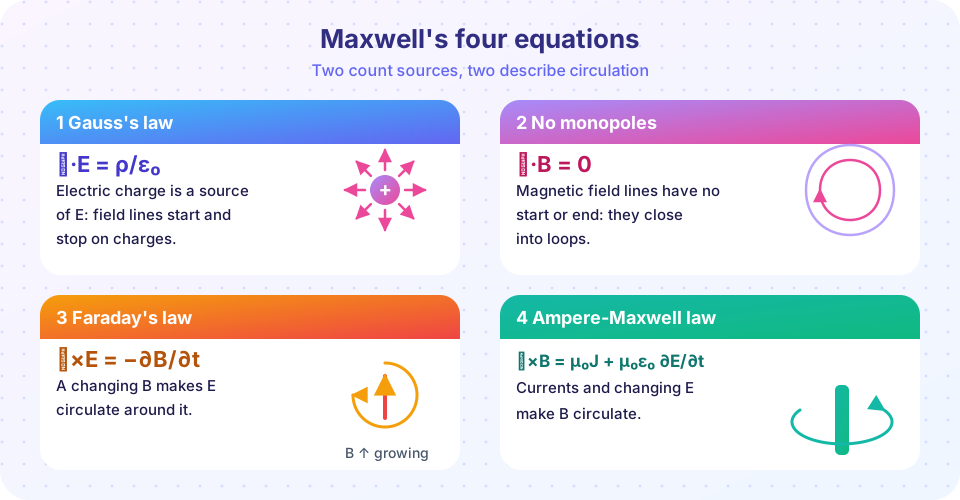
Notice the symmetry. The first two equations are about flux through closed surfaces: they say what the field lines do (start on charges, never start for B). The last two are about circulation around loops: they say how the fields curl.
Worked example: Gauss's law in numbers
A charge of 1.0 nC sits at the center of a sphere. The flux of E through the sphere is Q/ε₀ = 1.0×10⁻⁹ / 8.854×10⁻¹² ≈ 113 V·m. If you double the sphere radius, the field at the surface drops by a factor of four but the area grows by four, so the flux is the same 113 V·m. Gauss's law is the statement that the flux counts enclosed charge and nothing else.
The big picture
Each equation answers one plain question. The table gives the differential form (a statement at a point).
| Name | Differential form | What it says |
|---|---|---|
| Gauss's law | ∇·E = ρ / ε₀ |
Electric charge is a source of E. |
| Gauss's law for magnetism | ∇·B = 0 |
No magnetic monopoles: B lines never start or stop. |
| Faraday's law | ∇×E = −∂B/∂t |
A changing B creates a curling E. |
| Ampere-Maxwell law | ∇×B = μ₀J + μ₀ε₀ ∂E/∂t |
Currents and a changing E create a curling B. |
Together with the Lorentz force law F = q(E + v×B) they contain all of classical electromagnetism.
Key terms. Source: charge density ρ or current density J. Field: E and B, defined at every point and time. Curl: how much a field circulates around a point. Divergence: how much a field spreads out from a point. Displacement current: the term ε₀ ∂E/∂t, which acts like a current.
Where the speed of light comes from
Combine the last two laws in empty space (ρ = 0, J = 0). A changing E makes B, and a changing B makes E, so the pair can sustain itself. Eliminating one field gives a wave equation whose speed is c = 1/√(μ₀ε₀). The next chapter does this properly; the TryIt below only checks the arithmetic.
Press Run (or Ctrl + Enter) to see the result here.
Program input · what you'd type while the program runs
Type the answers before you press Run, one per line. Each time the program reads a line (with input()), it gets the next line from this box.
Press Run (or Ctrl + Enter) to see the result here.
Program input · what you'd type while the program runs
Type the answers before you press Run, one per line. Each time the program reads a line (with input()), it gets the next line from this box.
Common misconceptions
"There are two separate forces, electric and magnetic." They are two faces of one field. What one observer calls a pure E field, another observer moving past it sees partly as B (Chapter 8).
"Maxwell discovered all four equations." Gauss, Faraday and Ampere had the three older laws. Maxwell's own contribution was the displacement-current term and the realization that the full set predicts waves.
"The equations are only about waves." They also contain statics: a steady charge gives Coulomb's law, a steady current gives the Biot-Savart law.
Chapter 5 in four steps
Energy on the move
Potentials
The payoff
What each lesson covers
- Faraday's law: induced emf, Lenz's law and the curling electric field.
- Displacement current: the missing term that rescues Ampere's law.
- Energy and the Poynting vector: where the energy of a field lives and how it flows.
- Potentials and gauges: rewriting the theory with V and A.
- Chapter review: a one-page picture, a recap table and ten questions.
Check your understanding
Quick check · 6 questions
of 6 answered You scored / 6 · perfect!
-
1. Which equation says there are no magnetic monopoles?
Zero divergence means magnetic field lines never begin or end on a source. -
2. Which term did Maxwell add to Ampere's law?
The displacement-current term lets a changing electric field create a magnetic field. -
3. In empty space, what combination of constants gives the wave speed?
The wave equation has speed c = 1/√(μ₀ε₀), about 3.0 × 10⁸ m/s. -
4. Faraday's law connects which two ideas?
∇×E = −∂B/∂t says that a time-varying B is accompanied by a circulating E. -
5. A 2.0 nC charge sits inside a closed surface. What is the net electric flux through the surface?
Flux = Q/ε₀ = 2.0×10⁻⁹ / 8.854×10⁻¹² ≈ 226 V·m, for any shape enclosing the charge. -
6. Which pair of laws is about circulation of the fields around loops?
Those two have a curl on the left-hand side; the Gauss laws have a divergence.
Summary
- Maxwell's four equations plus the Lorentz force describe all classical electromagnetism.
- Oersted, Ampere and Faraday supplied three laws; Maxwell added the missing term and found waves; Hertz confirmed them in 1887.
- Integral forms describe whole surfaces and loops; differential forms describe points; Stokes and the divergence theorem connect them.
- Two equations constrain divergence (sources), two describe curl (circulation).
- Time-varying fields create each other, which allows self-sustaining waves.
- The wave speed
1/√(μ₀ε₀)equals the speed of light.
Next: Faraday's law
Track your progress
Create a free account to tick off lessons and pick up where you left off on any device.
of Electrodynamics lessons completed