


















Lesson 9 of 49 · Vector Calculus and Electrostatics
Electric potential
Learn why electrostatic fields have a potential, how to compute V for points, rings and spheres, how E follows from V, and how Laplace's equation shapes fields.
Vectors are hard to add. A scalar is easy. The electric potential V turns the problem of adding three components of E from many sources into the much simpler problem of adding numbers. It is also what a voltmeter reads. This lesson shows why the potential exists (because the field has no curl), how to calculate it, how to get E back from it, and how it connects to energy.
What you will learn
- Why
∇×E = 0implies that a potential exists and that work depends only on the endpoints. - How to compute V for point charges, rings and spheres, and how to superpose potentials.
- How to find E from V with
E = −∇V, and why equipotentials are perpendicular to field lines. - The meaning of the volt and the electron-volt, and a first look at Laplace's equation.
Key terms
- Potential V: potential energy per unit charge; units of volts (1 V = 1 J/C).
- Potential difference:
V(b) − V(a) = −∫ₐᵇ E · dl, the quantity that matters physically. - Equipotential: a surface on which V is constant.
- Electron-volt (eV): the energy gained by an electron crossing 1 V;
1 eV = 1.602 × 10⁻¹⁹ J. - Laplace's equation:
∇²V = 0in a region with no charge.
Why a potential exists
Because ∇×E = 0, Stokes' theorem gives ∮ E · dl = 0 around every closed loop. So the line integral of E between two points does not depend on the path. Pick a reference point (usually infinity or ground) and define
V(r) = −∫ from ref to r of E · dl
Then the work done by the field on a charge q moving from a to b is W = q [V(a) − V(b)], and the potential energy is U = qV. The minus sign is chosen so that positive charges move from high V to low V, like a ball rolling downhill.
Only differences of V are physically meaningful: adding a constant to V changes nothing. A bird sitting on a high-voltage wire is at a high potential but feels no field across its body.
From V to E, and back
The fundamental theorem for gradients gives the inverse relation:
E = −∇V
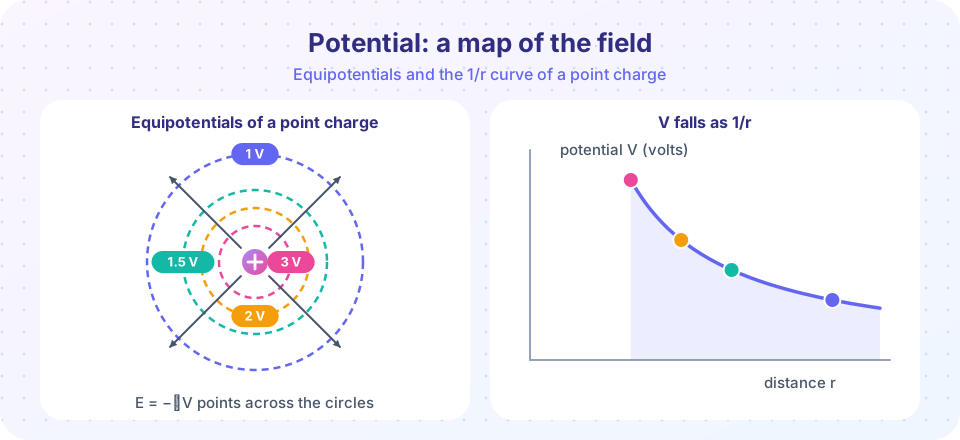
The field points downhill: in the direction in which V decreases fastest, and its magnitude is the steepness. Hence field lines cross equipotentials at right angles, and the equipotentials are closely spaced where the field is strong.
Point charge. V = kq / r (zero at infinity). Check: −dV/dr = kq/r² ✓.
Superposition. For many charges, V = Σ kqᵢ / rᵢ. For continuous charge, V = k ∫ dq / r. This is a scalar sum, no components to track.
Worked example: a ring
For a ring of radius R and charge Q, every element is the same distance √(z² + R²) from the point on the axis, so
V(z) = kQ / √(z² + R²)
and E_z = −dV/dz = kQ z / (z² + R²)^{3/2}, which matches the result found by adding vectors earlier. The potential method did in one line what the vector integral did in several.
Worked example: sphere and shell
A thin shell of radius R and charge Q has V = kQ/r outside and constant V = kQ/R inside (since E = 0 inside). A uniformly charged solid sphere has V = kQ/r outside and V = (kQ / 2R) (3 − r²/R²) inside, with the maximum value 3kQ/2R at the center.
The dipole
For charges +q at distance r₊ and −q at r₋, V = kq (1/r₊ − 1/r₋). Far away, with dipole moment p = qd, this becomes
V = k p cosθ / r²
where θ is measured from p. It falls off as 1/r² (one power faster than a point charge).
Energy and the electron-volt
Moving a charge q through a potential difference ΔV changes its energy by qΔV. An electron accelerated through 1000 V gains 1000 eV = 1.6 × 10⁻¹⁶ J, giving a speed of about 1.9 × 10⁷ m/s (non-relativistic estimate: v = √(2eΔV/m)). The hydrogen atom's potential at the Bohr radius is k e / a₀ ≈ 27.2 V, so the electron's potential energy there is −27.2 eV (twice the 13.6 eV binding energy, as the virial theorem predicts).
Poisson's and Laplace's equations
Combine E = −∇V with ∇·E = ρ/ε₀:
∇²V = −ρ / ε₀ (Poisson's equation)
In charge-free regions, ∇²V = 0 (Laplace's equation). Solutions of Laplace's equation have a remarkable property: the value at any point is the average of the values on a sphere around it. So V has no local maximum or minimum in empty space, and you cannot trap a charge in stable equilibrium using electrostatic forces alone (Earnshaw's theorem). The uniqueness theorem adds that once V is specified on the boundaries of a region, the solution inside is unique. This is the basis for computer solvers and for the method of images.
Common misconceptions
- "Zero potential means zero field." V = 0 can occur where E is large (the midpoint of a dipole has V = 0 but E ≠ 0).
- "Zero field means zero potential." Inside a charged shell, E = 0 but V is a nonzero constant.
- "Potential is a property of one charge." It is a property of the system: potential energy per unit test charge.
- "Voltage flows through a circuit." Charge flows; voltage is a difference between two points.
Try it
The first example draws equipotentials and field lines of a dipole from numerically computed V. The second checks E = −dV/dz for a ring. The third solves Laplace's equation on a grid by repeated averaging.
Press Run (or Ctrl + Enter) to see the result here.
Program input · what you'd type while the program runs
Type the answers before you press Run, one per line. Each time the program reads a line (with input()), it gets the next line from this box.
Press Run (or Ctrl + Enter) to see the result here.
Program input · what you'd type while the program runs
Type the answers before you press Run, one per line. Each time the program reads a line (with input()), it gets the next line from this box.
Press Run (or Ctrl + Enter) to see the result here.
Program input · what you'd type while the program runs
Type the answers before you press Run, one per line. Each time the program reads a line (with input()), it gets the next line from this box.
Check your understanding
Quick check · 5 questions
of 5 answered You scored / 5 · perfect!
-
1. A proton moves through a potential difference of 500 V. Its kinetic energy gain is
Energy gained equals qΔV = e × 500 V = 500 eV. -
2. The potential of a point charge Q at distance r (zero at infinity) is
V = kQ/r. Its negative gradient gives the field kQ/r². -
3. Which statement is correct?
E = −∇V: the field points downhill in potential. -
4. Inside a thin charged spherical shell, the potential is
E = 0 inside, so V does not change and equals its value at the surface, kQ/R. -
5. Why does ∇×E = 0 guarantee that V exists?
By Stokes' theorem the circulation is zero, so the integral depends only on the endpoints.
Summary
∇×E = 0means the work done by the field depends only on endpoints, so a potential V exists withE = −∇V.- Point charge:
V = kq/r; potentials of several charges simply add as numbers. - Equipotentials are perpendicular to field lines; the field is strongest where they bunch together.
U = qV, 1 eV = 1.602 × 10⁻¹⁹ J; V obeys Poisson's equation∇²V = −ρ/ε₀.- In empty space V has no maxima or minima; the boundary values fix the solution.
Next: Conductors and energy
Track your progress
Create a free account to tick off lessons and pick up where you left off on any device.
of Electrodynamics lessons completed