


















Lesson 47 of 49 · Projects and Practice
Glossary of electrodynamics
A searchable glossary of about 90 electrodynamics terms from fields and Maxwell's equations to waves, radiation and relativity, each with a precise one-line definition.
Electrodynamics has a lot of vocabulary, and many words (polarization, potential, gauge, field) mean slightly different things in different chapters. This glossary lists the terms of the whole course, grouped by theme and then alphabetical within each group, with a searchable box and a self-test to help the definitions stick. Formulas use SI units.
How to use the glossary
Read one group at a time rather than hunting for single words. Each group matches a block of the course, and the entries inside it depend on each other: for example "gauge", "Lorenz gauge" and "retarded potential" only make sense together. When a term has two meanings, both are given. After each group, say the definitions aloud without looking and check yourself; terms you cannot restate in your own words are the ones to revisit.
Two words with two meanings. Polarization means the dipole moment per volume of a dielectric (P) in Chapters 3 and 4, and the direction of E in a wave in Chapter 6. Potential can mean the scalar potential V or, with a qualifier, the vector potential A. The context and the symbol tell you which.
Fields, sources and statics
| Term | Meaning |
|---|---|
| Bound charge | Charge displaced inside atoms of a dielectric, with density ρ_b = −∇·P and surface density σ_b = P·n̂. |
| Biot-Savart law | B = (μ₀/4π) ∫ I dl × R̂ / R²: the magnetic field of a steady current. |
| Capacitance | C = Q/V: charge stored per volt, in farads. |
| Charge density | Charge per unit volume ρ (C/m³), per area σ or per length λ. |
| Coulomb's law | F = q₁q₂ / (4πε₀r²): the force between two point charges. |
| Current density | J, charge flow per unit area per unit time (A/m²). |
| Curl | A vector derivative measuring local circulation: ∇×F. |
| Dielectric | An insulating material that polarizes in an electric field. |
| Dipole moment | p = qd: strength of a charge separation (electric); m = IA for a current loop (magnetic). |
| Displacement field | D = ε₀E + P; its divergence equals the free charge density. |
| Divergence | A scalar derivative measuring local outflow: ∇·F. |
| Electric field | E = F/q: force per unit test charge (V/m or N/C). |
| Electric potential | V with E = −∇V in statics; work per unit charge. |
| Flux | Surface integral of a field, such as ∫ B·dA (weber) or ∮ E·dA. |
| Gauss's law | ∮ E·dA = Q_enc/ε₀, in differential form ∇·E = ρ/ε₀. |
| Gradient | A vector derivative pointing uphill in a scalar: ∇V. |
| Magnetic field | B, the field that exerts a force qv×B on moving charge (tesla). |
| Magnetization | M, magnetic dipole moment per unit volume. |
| Permeability | μ = μ₀(1 + χ_m): how strongly a material is magnetized; μ₀ = 4π × 10⁻⁷ N/A² in vacuum (approximately). |
| Permittivity | ε = ε₀(1 + χ_e): how strongly a material polarizes; ε₀ ≈ 8.854 × 10⁻¹² F/m. |
| Polarization (material) | P, electric dipole moment per unit volume. |
| Superposition | The total field is the vector sum of the fields of all sources. |
| Vector potential | A with B = ∇×A. |
Maxwell's equations, potentials and energy
| Term | Meaning |
|---|---|
| Ampere-Maxwell law | ∇×B = μ₀J + μ₀ε₀ ∂E/∂t: currents and changing E create B. |
| Continuity equation | ∂ρ/∂t + ∇·J = 0: local charge conservation. |
| Coulomb gauge | Gauge condition ∇·A = 0. |
| Displacement current | ε₀ ∂E/∂t: the changing-E term in Ampere's law. |
| Eddy current | Circulating current induced in a conductor by a changing flux. |
| Electromotive force (emf) | Line integral of the electric force per charge around a loop; volts. |
| Energy density | u = ½ε₀E² + B²/(2μ₀): field energy per unit volume. |
| Faraday's law | ∇×E = −∂B/∂t; in integral form emf = −dΦ/dt. |
| Gauge | A choice among equivalent potentials describing the same E and B. |
| Gauge transformation | A → A + ∇λ, V → V − ∂λ/∂t; leaves E and B unchanged. |
| Inductance | L = Φ/I: flux linkage per ampere (henry). |
| Lenz's law | Induced effects oppose the change that causes them. |
| Lorentz force | F = q(E + v×B). |
| Lorenz gauge | ∇·A = −μ₀ε₀ ∂V/∂t; gives wave equations for V and A. |
| Maxwell stress tensor | Momentum flux of the field; its divergence gives the force on charges. |
| Motional emf | emf from a conductor moving in a magnetic field, BLv. |
| Poynting vector | S = E×B/μ₀: energy flux in W/m². |
| Poynting's theorem | ∂u/∂t + ∇·S = −J·E: energy conservation for fields and charges. |
| Scalar potential | V with E = −∇V − ∂A/∂t. |
Waves
| Term | Meaning |
|---|---|
| Angular frequency | ω = 2πf (rad/s). |
| Brewster angle | The incidence angle with zero reflection of p-polarized light, tan θ = n₂/n₁. |
| Circular polarization | E rotates at constant magnitude; two equal linear components 90° out of phase. |
| Dispersion | Dependence of wave speed on frequency, ω(k) not a straight line. |
| Evanescent wave | A field that decays exponentially with distance instead of propagating, as beyond total internal reflection. |
| Intensity | Time-averaged Poynting flux, W/m²; I = ½cε₀E₀² for a vacuum plane wave. |
| Linear polarization | E oscillates along a fixed line. |
| Malus's law | I = I₀cos²θ for a polarizer. |
| Phase velocity | ω/k: speed of a wave crest. |
| Plane wave | A wave whose fields are constant on planes perpendicular to k. |
| Polarization (wave) | Direction (and rotation) of E in a wave. |
| Radiation pressure | Momentum flux of light, I/c for absorption and 2I/c for perfect reflection. |
| Refractive index | n = c/v. |
| Skin depth | δ = √(2/(μσω)): penetration depth in a good conductor. |
| Standing wave | Superposition of counter-propagating waves with fixed nodes. |
| Total internal reflection | Complete reflection beyond the critical angle sin θ_c = n₂/n₁ (for n₁ > n₂). |
| Wave equation | ∇²E = (1/c²) ∂²E/∂t²: Maxwell's equations in vacuum. |
| Wave impedance | Z = E/H; vacuum Z₀ ≈ 376.7 Ω. |
| Wave number | k = 2π/λ. |
Radiation and antennas
| Term | Meaning |
|---|---|
| Antenna gain | Directivity times efficiency; power focused in a direction relative to isotropic. |
| Directivity | Peak radiation intensity divided by its average over all directions. |
| Far field | Region where r ≫ λ and r ≫ d²/λ; fields fall as 1/r and carry power outward. |
| Friis formula | P_r/P_t = G_tG_r(λ/4πd)²: received power in free space. |
| Hertzian dipole | An oscillating point dipole, the simplest radiator. |
| Larmor formula | P = q²a²/(6πε₀c³): power radiated by an accelerated charge. |
| Liénard-Wiechert potentials | The potentials of a point charge in arbitrary motion, evaluated at the retarded time. |
| Near field | Region close to the source where reactive terms dominate and little energy leaves. |
| Radiation resistance | Resistance equivalent to the power radiated by an antenna. |
| Retarded potentials | V(r,t) and A(r,t) built from the sources at the earlier time t_r = t − R/c. |
| Retarded time | t_r = t − R/c: when the signal left the source. |
Relativity and electrodynamics
| Term | Meaning |
|---|---|
| Boost | A change to an inertial frame moving at constant velocity. |
| Covariant | Written in a form that keeps the same appearance in every inertial frame. |
| Field tensor | Antisymmetric 4×4 object F^{μν} combining E and B. |
| Four-current | J^μ = (cρ, J). |
| Four-potential | A^μ = (V/c, A). |
| Four-vector | A quantity with four components transforming like (ct, x, y, z). |
| Four-velocity | u^μ = γ(c, v). |
| Inertial frame | A frame in which free particles move in straight lines at constant speed. |
| Invariant | A quantity all inertial observers agree on, such as E·B and E² − c²B². |
| Lorentz factor | γ = 1/√(1 − v²/c²). |
| Null field | A field with both invariants zero, such as a plane wave. |
| Yee grid | Staggered E and H grid used in FDTD. |
Particles in fields
| Term | Meaning |
|---|---|
| Cyclotron frequency | ω_c = qB/m (q = charge magnitude): angular frequency of a charge circling in a magnetic field. |
| E×B drift | Velocity E×B/B² of charged particles in crossed fields. |
| Gyroradius | r = mv_⊥/(qB): radius of circular motion in a magnetic field. |
| Aharonov-Bohm effect | The quantum phase of a charge depends on A even where B = 0. |
Try it
Press Run (or Ctrl + Enter) to see the console output here.
No output.
Common mix-ups between terms
Gauge vs gauge condition. A gauge transformation is a change of potentials; a gauge condition (Coulomb, Lorenz) picks one convenient member of the family. Physical fields never depend on it.
Lorenz vs Lorentz. Ludvig Lorenz (Danish) proposed the Lorenz gauge; Hendrik Lorentz (Dutch) gave the force law, the transformation and the factor γ. The spellings are different people.
Radiation vs field. Every charge has a field; only accelerated charges radiate, and radiation means energy that leaves to infinity, with a 1/r field.
Displacement field vs displacement current. D = ε₀E + P is a field; ε₀∂E/∂t is a current density. Maxwell's "displacement" refers to the polarization of the ether, a historical name that stuck.
Check your understanding
Quick check · 6 questions
of 6 answered You scored / 6 · perfect!
-
1. Which term means 'the time at which a signal left the source'?
t_r = t − R/c. -
2. The Poynting vector has units of
It is power per unit area. -
3. Which condition defines the Coulomb gauge?
The Coulomb gauge sets the divergence of A to zero. -
4. Which law gives the angle with no reflection of p-polarized light?
At Brewster's angle tan θ = n₂/n₁ the p reflection vanishes. -
5. A field with E·B = 0 and E² − c²B² = 0 is called
Plane waves are null fields: both invariants vanish. -
6. The region where radiated fields fall off as 1/r is the
In the far field, fields scale as 1/r and carry power to infinity.
Summary
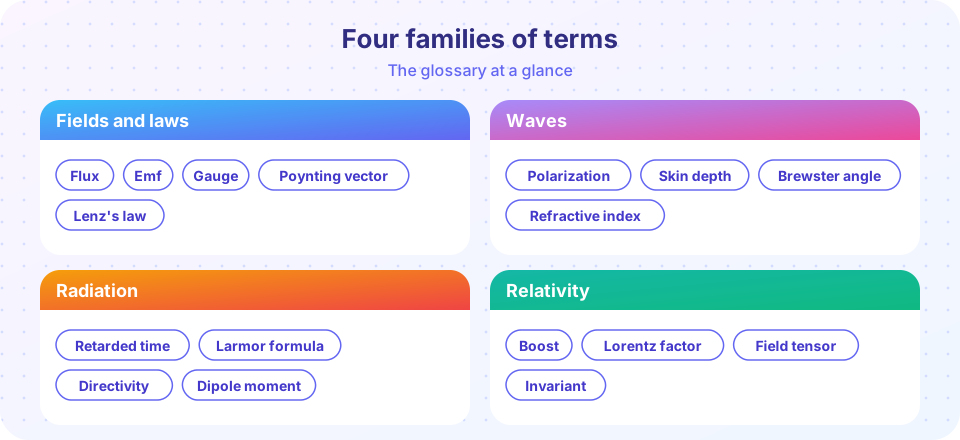
- The glossary groups five themes: fields and statics, Maxwell's equations and energy, waves, radiation, relativity (plus particles in fields).
- Some words have two meanings (polarization, potential); context tells you which.
- Use the search box and flashcards for quick revision.
Next: Cheat sheet
Track your progress
Create a free account to tick off lessons and pick up where you left off on any device.
of Electrodynamics lessons completed