


















Lesson 40 of 49 · Relativity and Electrodynamics
Transforming fields and moving charges
Learn how E and B transform between inertial frames, check the invariants, and find the flattened field of a uniformly moving charge.
Suppose you stand next to a stationary charge: you measure an electric field and no magnetic field. A friend flies past at high speed. In her frame the charge moves, so it makes a current and a magnetic field. Both of you are right. The Lorentz transformation tells you exactly how to translate your fields into hers, and it explains why the field of a fast charge is squashed into a "pancake" perpendicular to its motion.
What you will learn
- Write the transformation of E and B between two inertial frames.
- Use the invariants
E·BandE² − c²B². - Find the field of a uniformly moving point charge.
- Explain why a "pure magnetic" field can appear as an electric field.
Key terms
Boost: change to a frame moving at constant velocity v (along x here). β = v/c, γ = 1/√(1 − β²). Parallel/perpendicular components: relative to the boost direction. Invariant: a quantity with the same value in every inertial frame.
Field transformations
Frame S' moves with velocity v = v x̂ relative to frame S. The fields in S' are
E'_x = E_x                       B'_x = B_x
E'_y = γ (E_y − v B_z)           B'_y = γ (B_y + v E_z / c²)
E'_z = γ (E_z + v B_y)           B'_z = γ (B_z − v E_y / c²)
Components along the motion are unchanged; perpendicular components mix. For small v/c the transformed electric field E' ≈ E + v × B (with v the velocity of S') turns the magnetic force q v × B felt in one frame into an electric force in the other. This is the "motional" part of Faraday's law in Chapter 5, now explained.
Worked example: a pure magnetic field
In S there is B = 1.0 T ẑ, E = 0. A frame moves at v = 0.6c along x, so γ = 1.25. Then
E'_y = γ(0 − v B_z) = −1.25 × 0.6 × 2.998×10⁸ × 1.0 ≈ −2.25 × 10⁸ V/m
B'_z = γ B_z = 1.25 T
Electric field strengths of 10⁸ V/m are enormous, but remember that cB = 3 × 10⁸ V/m for one tesla, so a one-tesla magnetic field is "equivalent" to a huge electric field once the observer moves fast.
Why the transformation looks like this
Start from something you already know. In frame S a charge q moves with velocity v through a magnetic field B and feels F = q v × B. Ride along with the charge, in frame S'. There the charge is at rest, so the magnetic force on it is zero, yet its acceleration is the same (at low speeds). The only force left that can act on a resting charge is electric, so the field in S' must contain an electric part E' = v × B. That is the low-speed limit of the table above. The factors of γ and the v/c² terms in B' are what you need so that the same argument works at every speed and so that Maxwell's equations keep their form in S'. Lorentz (1904) and Einstein (1905) found these rules; Minkowski (1908) later showed that they are the components of one four-dimensional object, the subject of the next lesson.
Worked example: magnetism is electricity seen from a moving frame
A long straight wire carries I = 10 A. At r = 2.0 cm a test charge q = e travels parallel to the wire at v = 10⁶ m/s. In the lab the wire is neutral, so only the magnetic field acts:
B = μ₀I / (2πr) = 2×10⁻⁷ × 10 / 0.02 = 1.0×10⁻⁴ T
F = q v B = 1.602×10⁻¹⁹ × 10⁶ × 10⁻⁴ ≈ 1.6×10⁻¹⁷ N
Now hop into the charge's frame. There B' ≈ B and the charge is at rest, so the force must be electric. The transformation gives E'_⊥ = γ v B ≈ 100 V/m (γ is 1 + 5×10⁻⁶, essentially 1) and F' = qE' ≈ 1.6×10⁻¹⁷ N: the same force. Where does this electric field come from? In the new frame the electrons in the wire move at a different speed from the positive ions, and length contraction changes their spacing differently, so the wire is no longer neutral. Its net line charge has magnitude |λ'| = γ v I / c² ≈ 1.1×10⁻¹⁰ C/m, which makes an electric field λ'/(2πε₀r) ≈ 100 V/m at the charge. A force that looked "magnetic" is "electric" a frame later. (For a particle moving fast, the transverse force differs by exactly the factor γ between frames, and the numbers above are consistent with that rule.)
Invariants
Two combinations do not change under any boost:
E · B               (a scalar)
E² − c² B²          (a scalar)
Check with the example: E·B = 0 before and after (E' is along y, B' along z), and E'² − c²B'² = (0.5625 − 1.5625) c²B² = −c²B², equal to the original 0 − c²B². Consequences: a pure electric field in one frame can never be turned into a pure magnetic field by a boost if E² − c²B² > 0, and a plane electromagnetic wave (where both invariants are zero) has E = cB and E ⊥ B in every frame, only its amplitude Doppler-shifts.
Worked example: finding the frame where B disappears
If E ⊥ B and E > cB, there is a frame in which the magnetic field vanishes. Take E = 10⁷ V/m ŷ and B = 0.01 T ẑ. Then cB = 3.0×10⁶ V/m, so E > cB and E² − c²B² = 9.1×10¹³ V²/m² > 0. Boost along x (the direction of E×B). Setting B'_z = γ(B − vE/c²) = 0 gives v = c²B/E, i.e. β = cB/E = 0.2998, γ = 1.048. Then E'_y = γ(E − vB) = 9.54×10⁶ V/m, which equals √(E² − c²B²), exactly what the invariant requires. This is how a velocity filter works: crossed E and B fields let particles with v = E/B pass undeflected, and the drift speed of charges in crossed fields is E/B as long as E < cB. If instead E < cB, the opposite trick removes E.
Field of a uniformly moving charge
In its rest frame, a charge q has E' = q r̂'/(4πε₀r'²). Transform to the lab frame, where it moves at v. At the present position of the charge, with R the vector from it to the field point and θ the angle between R and v, the result is
E = q / (4πε₀) × (1 − β²) / (1 − β² sin²θ)^(3/2) × R̂ / R²
B = (1/c²) v × E
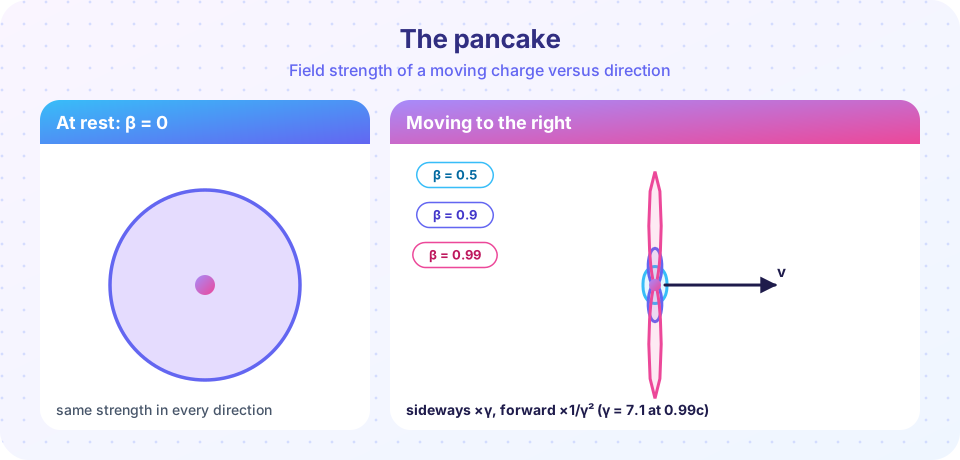
Along the motion (θ = 0) the field is E = (1−β²) × Coulomb (reduced by 1/γ²); perpendicular (θ = 90°) it is E = γ × Coulomb (enhanced by γ). The field direction still points away from the present position, not the retarded one. At β = 0.99, γ = 7.1: the perpendicular field is 7 times the Coulomb value and the forward value is only 2% of it, a thin pancake of width of order 1/γ. This is why a relativistic beam passing a detector delivers a short, intense transverse pulse.
Numbers. A single proton passing 1 mm from a detector has a Coulomb field of 1.44×10⁻³ V/m there. At β = 0.99 the peak transverse field is γ times that, 1.0×10⁻² V/m, and the pulse lasts about 2b/(γv) ≈ 1×10⁻¹² s. At β = 0.999 (γ = 22.4) the peak rises to 3.2×10⁻² V/m and the pulse shortens to about 3×10⁻¹³ s. The pulse also carries a magnetic field B = vE/c², which is why such a beam looks like a (very short) plane-wave pulse and can be treated as a "bundle of virtual photons", an idea Enrico Fermi and later Weizsäcker and Williams exploited. The total flux through a plane is unchanged: the field is squeezed, not weakened, which is why Gauss's law still holds.
"E and B are separate fields so each should be invariant." Only combinations like E·B and E² − c²B² are; E and B alone depend on the frame.
"The field of a moving charge points to where the charge was." For uniform motion it points away from the present position; with acceleration the radiation field is added on top.
"A magnetic field is just a weaker electric field." Compare cB with E: they have the same units after multiplying by c, and neither is more fundamental.
Try it
Press Run (or Ctrl + Enter) to see the result here.
Program input · what you'd type while the program runs
Type the answers before you press Run, one per line. Each time the program reads a line (with input()), it gets the next line from this box.
Press Run (or Ctrl + Enter) to see the result here.
Program input · what you'd type while the program runs
Type the answers before you press Run, one per line. Each time the program reads a line (with input()), it gets the next line from this box.
Press Run (or Ctrl + Enter) to see the result here.
Program input · what you'd type while the program runs
Type the answers before you press Run, one per line. Each time the program reads a line (with input()), it gets the next line from this box.
Check your understanding
Quick check · 6 questions
of 6 answered You scored / 6 · perfect!
-
1. In S there is only E = E₀ ŷ. A frame S' moves along x. Which field appears in S'?
B'_z = −γ v E_y / c², nonzero for v ≠ 0. -
2. Which quantity is Lorentz invariant?
E² − c²B² and E·B are the two invariants. -
3. A plane wave has E = cB with E ⊥ B in one frame. In another frame, it
Both invariants are zero for a plane wave, so this holds in every frame (only the amplitude changes). -
4. A charge moves at β = 0.8 (γ = 1.67). The sideways field compared with the Coulomb value is
At θ = 90°, E = γ × (Coulomb value). -
5. The field of a uniformly moving charge points away from its
For uniform motion the field lines are radial from the present position. -
6. In S, B = 2 T ẑ and E = 0. In a frame moving at 0.6c along x, the electric field magnitude is about
|E'_y| = γ v B_z = 1.25 × 0.6 × 3.0×10⁸ × 2 ≈ 4.5×10⁸ V/m. The one-tesla value in the lesson is half of that.
Summary
- Parallel components of E and B are unchanged; perpendicular ones mix with factors
γ,v, andv/c². - Invariants:
E·BandE² − c²B²; plane waves remain plane waves. - A moving charge has a flattened field:
γtimes Coulomb sideways,1/γ²forward.
Track your progress
Create a free account to tick off lessons and pick up where you left off on any device.
of Electrodynamics lessons completed