


















Lesson 5 of 49 · Getting Started
Chapter 1 review: Getting started
Review Coulomb's law, the electric field, superposition, SI units and constants with a one-page poster, a recap table, a field-versus-distance plot and a 9-question quiz.
You now have the foundation of electrodynamics: charges push on charges, the push is summarized by a field, fields add as vectors, and everything is measured in SI units whose constants hide the speed of light. This review puts the key formulas on one page, shows how the three basic field geometries differ, and tests your recall.
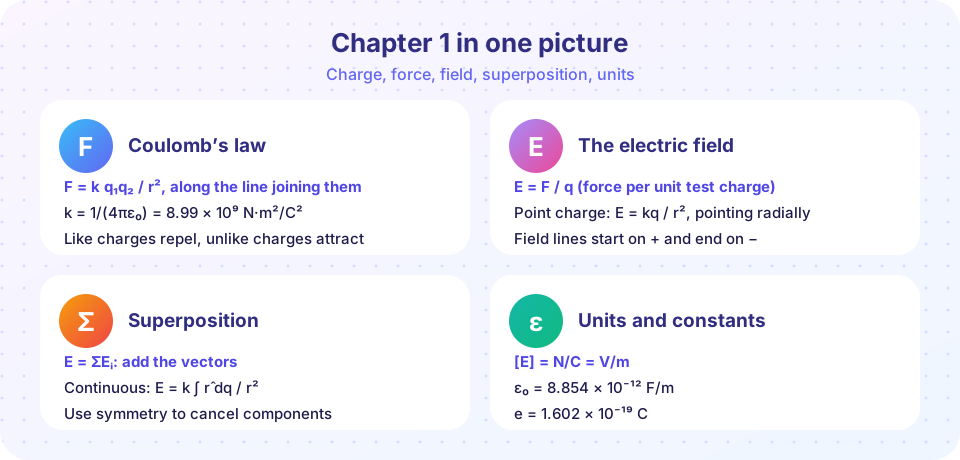
The chapter in a table
| Idea | Formula | Where to use it |
|---|---|---|
| Coulomb's law | F = k q₁q₂ / r² |
Force between point charges at rest |
| Constants | k = 1/(4πε₀) = 8.99 × 10⁹ N·m²/C² |
Convert charge and distance to force |
| Field definition | E = F / q |
Force on any charge is F = qE |
| Point charge field | E = kQ / r² |
Radial, away from + |
| Superposition | E = Σ Eᵢ |
Any set of charges |
| Continuous charge | E = k ∫ r̂ dq / r² |
Rods, rings, disks |
| Infinite line | E = 2kλ / s |
Long wire, symmetry |
| Infinite plane | E = σ / 2ε₀ |
Large sheet, symmetry |
| Dipole (far field) | E ∼ kp / r³ |
Atoms and molecules |
| Light | c² = 1/(μ₀ε₀) |
Unit check, Chapter 6 |
Three field geometries, three power laws
The decay of the field with distance depends only on the dimension of the source:
- A point spreads its field over a sphere of area
4πr², soE ∝ 1/r². - An infinite line spreads over a cylinder of area
2πs L, soE ∝ 1/s. - An infinite plane spreads over a constant area, so
Eis constant.
Gauss's law (next chapter) turns this counting argument into an exact tool.
Study checklist
- Can you state which quantity is a vector and which is a scalar?
- Can you write the force on charge 2 due to charge 1 with the sign convention for
r̂? - Can you find the component that survives by symmetry before integrating?
- Can you check any answer by units?
Common misconceptions
- "Field strength always falls as 1/r²." Only for a point charge (or a spherical distribution seen from outside). Lines fall as 1/s, planes not at all.
- "If two charges are equal and opposite, the field is zero everywhere between them." Between them the fields point in the same direction and add. Only far away do they nearly cancel.
Try it
Press Run (or Ctrl + Enter) to see the result here.
Program input · what you'd type while the program runs
Type the answers before you press Run, one per line. Each time the program reads a line (with input()), it gets the next line from this box.
Press Run (or Ctrl + Enter) to see the result here.
Program input · what you'd type while the program runs
Type the answers before you press Run, one per line. Each time the program reads a line (with input()), it gets the next line from this box.
Check your understanding
Quick check · 9 questions
of 9 answered You scored / 9 · perfect!
-
1. Two charges are 3 times farther apart. By what factor does the force between them change?
F ∝ 1/r², so tripling r divides F by 9. -
2. Which is the correct unit of the electric field?
E = F/q has units newtons per coulomb, equal to volts per meter. -
3. The field of an infinite uniformly charged plane at distance d is
The flux spreads over a constant area, so the field is constant: σ/2ε₀. -
4. An electron is in a field of 1000 N/C directed to the right. The force on the electron is
F = qE with q = −e gives 1.6e-19 × 1000 = 1.6e-16 N, opposite to E because the charge is negative. -
5. Superposition means that the field of two charges is
Fields add as vectors: directions matter. -
6. A line of charge with λ = 2 nC/m is doubled in density. The field at fixed s
E = 2kλ/s is proportional to λ. -
7. The product μ₀ε₀ is equal to
c² = 1/(μ₀ε₀). -
8. Which source gives a field that falls as 1/r³ at large distance?
A dipole's two opposite charges nearly cancel, leaving a 1/r³ field. -
9. Which statement about field lines is correct?
Lines begin on positive and end on negative charges; the number drawn is a convention.
Summary
- Coulomb's law gives the force between point charges; the field
E = F/qrecords the force per unit charge. - Fields add as vectors, and symmetry lets you cancel components before integrating.
- Point, line and plane sources give
1/r²,1/sand constant fields. - SI units rest on the ampere;
ε₀andμ₀combine to give1/c².
Next: Chapter 2 overview: vector calculus and electrostatics
Track your progress
Create a free account to tick off lessons and pick up where you left off on any device.
of Electrodynamics lessons completed