


















Lesson 18 of 49 · Magnetostatics
The Lorentz force
Learn the Lorentz force law, the right-hand rule, circular and helical motion, cyclotrons, mass spectrometers, the Hall effect and forces on wires with worked examples.
Electric fields push charges along the field. Magnetic fields push them sideways. A charge at rest feels no magnetic force; a charge moving along a magnetic field feels none either; only motion across the field matters, and the push is perpendicular to both velocity and field. This odd rule is responsible for particle accelerators, mass spectrometers, electric motors, the aurora and the Hall sensor in your phone.
What you will learn
- The Lorentz force
F = q(E + v × B)and the right-hand rule. - Why magnetic forces do no work, and what that implies for speed and kinetic energy.
- The radius, frequency and pitch of circular and helical motion.
- Applications: velocity selector, mass spectrometer, cyclotron, Hall effect, force on a current-carrying wire.
Key terms
- Lorentz force: the total electromagnetic force on a charge,
F = q(E + v × B). - Cross product:
v × Bhas magnitudevB sinθand is perpendicular to both. - Tesla (T): the unit of B; 1 T = 1 N/(A·m).
- Cyclotron frequency: the circulation frequency
ω = |q|B/m, independent of speed. - Hall voltage: the transverse voltage created across a current-carrying conductor in a magnetic field.
The force law
A charge q with velocity v in electric field E and magnetic field B feels
F = q (E + v × B)
The magnetic part has magnitude q v B sinθ, where θ is the angle between v and B, and its direction follows the right-hand rule: point the fingers of your right hand along v, curl them toward B, and your thumb points along v × B. For a negative charge, reverse the direction. The unit of B is the tesla: a 1 C charge moving at 1 m/s perpendicular to a 1 T field feels 1 N.
Typical fields. Earth: 25 to 65 μT. A refrigerator magnet: about 5 mT. A neodymium magnet surface: about 0.3 to 0.5 T. A hospital MRI: 1.5 to 3 T. The strongest steady lab magnets: tens of tesla.
Magnetic forces do no work
Since F is perpendicular to v, the power F · v is zero. A magnetic field cannot change a particle's speed or kinetic energy, only its direction. Any change of energy in a magnetic device comes from electric fields (often induced ones, see Chapter 5). This is also why you can not "extract" energy from a static magnet.
Circular and helical motion
Take a charge q with velocity v perpendicular to a uniform B. The magnetic force supplies the centripetal force:
q v B = m v² / r so r = m v / (|q| B)
The angular frequency is
ω = v / r = |q| B / m
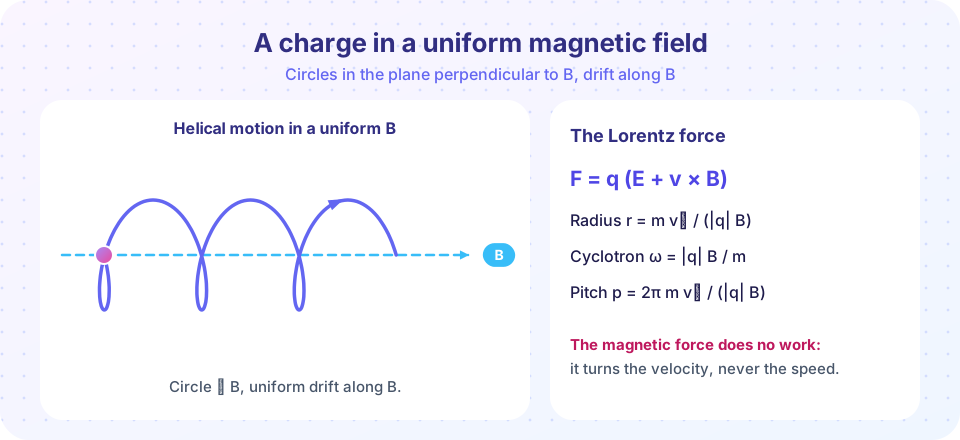
and does not depend on the speed or the radius. Fast particles go around in bigger circles but take the same time: the period is T = 2π m / (|q| B). If the velocity has a component v∥ along B, that part is unaffected, and the path is a helix of radius r = m v⊥ / (|q| B) and pitch 2π m v∥ / (|q| B).
Worked examples
An electron beam. An electron accelerated through 1000 V has v = √(2eV/m) = 1.88 × 10⁷ m/s. In B = 1.0 mT it moves on a circle of radius r = m v / (eB) = 0.107 m.
A proton in 1 T. ω = eB/m = 9.58 × 10⁷ rad/s, so f = 15.2 MHz, in the radio band. That equality of frequency and field is the principle of the cyclotron: an electric field switching at exactly this frequency gives the proton a push every half-turn, and the radius grows while the period stays fixed.
Combined E and B
- Velocity selector. Crossed fields E and B (perpendicular to each other and to v): the net force is zero when
qE = qvB, i.e.v = E/B. Only particles of that speed go straight through, whatever q and m are. - Mass spectrometer. Ions of charge q accelerated through voltage V enter a field B and move on a semicircle of radius
r = (1/B) √(2mV/q). Different masses land at different places, so r measures m. For singly charged ¹²C and ¹³C ions with V = 1000 V and B = 0.5 T, the radii are about 31.5 mm and 32.8 mm. - E × B drift. In crossed fields a charged particle drifts with velocity
v_d = E × B / B², independent of charge and mass; this matters in plasmas and in the ionosphere.
Forces on currents
A current element I dl in a field B feels dF = I dl × B. For a straight wire of length L at angle θ: F = I L B sinθ. A 2 A current in a 0.5 m wire perpendicular to a 0.1 T field feels 0.1 N: that is the force that turns the rotor of a motor. A current loop with magnetic moment m = I A (area vector A) feels a torque
τ = m × B
just as an electric dipole does in an electric field, and has energy U = −m · B. Torque on a loop is exactly what makes the needle of a galvanometer and the rotor of a motor turn.
The Hall effect
A strip of conductor of thickness t carries current I along its length while a field B is applied perpendicular to its face. Moving charge carriers are pushed to one side until a transverse electric field E_H = v_d B builds up that cancels the magnetic force. The resulting Hall voltage is
V_H = I B / (n q t)
where n is the carrier density. Its sign tells you whether carriers are positive or negative, and its size gives n. For copper (n ≈ 8.5 × 10²⁸ m⁻³) with t = 0.1 mm, I = 1 A and B = 1 T: V_H ≈ 0.73 μV, tiny; in semiconductors, n is thousands of times smaller and V_H is large, which is why Hall sensors use them.
Common misconceptions
- "The magnetic force acts along the field." It acts perpendicular to the field and to the velocity.
- "A static magnetic field can speed up a particle." It cannot; speed changes need an electric field.
- "A larger speed means a faster orbit." The cyclotron frequency does not depend on speed; the radius grows instead (in the non-relativistic regime).
- "A charge at rest in a magnetic field feels a force." No: the force is proportional to v. (A changing B would create an electric field, which does push, but that is another effect.)
Try it
The first example integrates the Lorentz force numerically with the Boris scheme (the standard method for plasma simulations) and checks the radius and speed. The second computes mass-spectrometer radii. The third is a toy visualization of the orbit radius.
Press Run (or Ctrl + Enter) to see the result here.
Program input · what you'd type while the program runs
Type the answers before you press Run, one per line. Each time the program reads a line (with input()), it gets the next line from this box.
Press Run (or Ctrl + Enter) to see the result here.
Program input · what you'd type while the program runs
Type the answers before you press Run, one per line. Each time the program reads a line (with input()), it gets the next line from this box.
Check your understanding
Quick check · 6 questions
of 6 answered You scored / 6 · perfect!
-
1. A proton moves at 2 × 10⁶ m/s perpendicular to a field of 0.2 T. What is the magnitude of the force on it?
F = qvB = 1.602e-19 × 2e6 × 0.2 = 6.4e-14 N. -
2. If the speed of a charged particle in a uniform B (perpendicular to v) is doubled, the radius of its orbit
r = mv/(qB) is proportional to v, while the period 2πm/(qB) stays fixed. -
3. A velocity selector has E = 5 × 10⁴ V/m and B = 0.1 T. Which speed passes undeflected?
v = E/B = 5e4 / 0.1 = 5e5 m/s. -
4. Why can a static magnetic field not change the kinetic energy of a charged particle?
P = F·v = 0 since F ⊥ v. -
5. A 0.4 m straight wire carries 5 A at right angles to a 0.25 T field. The force on the wire is
F = ILB = 5 × 0.4 × 0.25 = 0.5 N. -
6. A helical path means the velocity has
The perpendicular part circles; the parallel part drifts along B.
Summary
- Lorentz force:
F = q(E + v × B); the magnetic part is perpendicular to v and B and does no work. - Perpendicular motion is circular:
r = mv/(|q|B),ω = |q|B/m(independent of speed); with a parallel component the path is a helix. - Applications: velocity selector
v = E/B, mass spectrometerr = (1/B)√(2mV/q), cyclotron, Hall voltageV_H = IB/(nqt). - Forces on currents:
F = IL × B, torque on a loopτ = m × Bwithm = IA.
Next: The Biot–Savart law
Track your progress
Create a free account to tick off lessons and pick up where you left off on any device.
of Electrodynamics lessons completed