


















Lesson 6 of 49 · Vector Calculus and Electrostatics
Chapter 2 overview: vector calculus and electrostatics
Preview of the language of fields: gradient, divergence, curl, Gauss's law, potential and conductors, and how they combine into the two equations of electrostatics.
Chapter 1 gave you the electric field of simple charge distributions by adding up contributions. That works, but each new shape needs a new integral. Chapter 2 shows a better route: describe the field by what it does locally and globally. The tools are three derivatives of a field (gradient, divergence and curl), two big theorems that connect local and global (Gauss's and Stokes'), and the electric potential, a single scalar function from which the whole vector field follows.
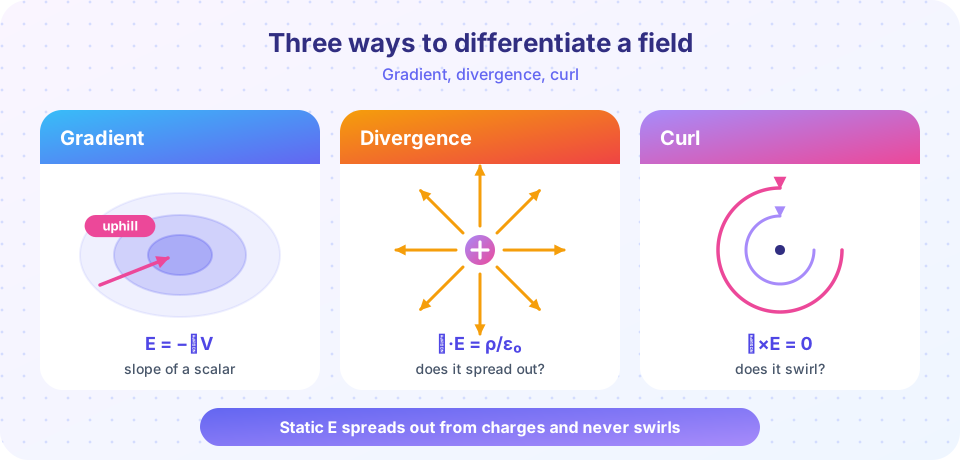
What you will learn
- Why electrostatics reduces to two equations:
∇·E = ρ/ε₀and∇×E = 0. - What each lesson of the chapter covers and how they connect.
- The one-minute meaning of gradient, divergence and curl.
Key terms
- Scalar field: a number at each point, such as potential V or temperature.
- Vector field: a vector at each point, such as E or B.
- Flux: the amount of a field passing through a surface.
- Circulation: the line integral of a field around a closed loop.
- Del (∇): the operator
(∂/∂x, ∂/∂y, ∂/∂z)used to build all three derivatives.
The big picture
Three derivatives
Two laws of electrostatics
From field to potential
One scalar function replaces three components
What is in this chapter
- Gradient, divergence and curl: the three derivatives of vector calculus, what each one measures, and how to compute them.
- Gauss's law: the flux of E through a closed surface equals the enclosed charge over ε₀, and how symmetry makes it an easy way to find fields.
- Electric potential: why the electric field has no curl, how to define potential, and how to find the field from it.
- Conductors and energy: why charge sits on surfaces, shielding, induced charge, and the energy stored in fields.
- Chapter 2 review: a one-page poster and a longer quiz.
Why two equations are enough
A vector field in 3D has three components, which seems like three unknown functions. But the electrostatic field is highly constrained. Its divergence is tied to the charge density, and its curl is zero. The Helmholtz theorem tells us that a field that vanishes at infinity is determined once you specify both its divergence and its curl everywhere. So these two equations contain everything about electrostatics:
∇·E = ρ / ε₀ (Gauss's law: charges are sources of E)
∇×E = 0 (E has no swirl, so it comes from a potential)
When you add magnetism and time dependence in Chapter 5, the curl equation will pick up a new term, and the story becomes Maxwell's equations.
Common misconceptions
- "Divergence is the same as the field getting stronger." Divergence measures net outflow from a point, not growth in magnitude. A uniform field has zero divergence even though it is everywhere nonzero.
- "Curl means the field lines are curved." A straight shear flow can have curl, and a field with curved lines can be curl-free. Curl is about rotation of a tiny paddle wheel placed in the field.
- "Potential is only an energy bookkeeping trick." It is a real, physical, measurable quantity: a voltmeter reads a potential difference.
Try it
The first example computes gradient, divergence and curl symbolically for sample fields. The second checks the claim that the field of a point charge has zero divergence away from the charge, numerically.
Press Run (or Ctrl + Enter) to see the result here.
Program input · what you'd type while the program runs
Type the answers before you press Run, one per line. Each time the program reads a line (with input()), it gets the next line from this box.
Press Run (or Ctrl + Enter) to see the result here.
Program input · what you'd type while the program runs
Type the answers before you press Run, one per line. Each time the program reads a line (with input()), it gets the next line from this box.
Check your understanding
Quick check · 4 questions
of 4 answered You scored / 4 · perfect!
-
1. Which pair of equations contains all of electrostatics?
Electrostatics is fixed by the divergence and curl of E: sources are charges and there is no curl. -
2. What does a nonzero divergence at a point tell you?
Divergence measures net outflow per unit volume, which is the source strength. -
3. A uniform field E = (5, 0, 0) has
All partial derivatives are zero, so both divergence and curl vanish. -
4. Which quantity is a scalar field?
V is a single number at each point; E and its curl are vector fields.
Summary
- Electrostatics is fully described by
∇·E = ρ/ε₀and∇×E = 0. - Gradient measures the slope of a scalar, divergence the outflow of a vector field, and curl its circulation.
- The potential V packs three field components into one scalar, with
E = −∇V. - Conductors, shielding and field energy follow from these equations.
Track your progress
Create a free account to tick off lessons and pick up where you left off on any device.
of Electrodynamics lessons completed