


















Lesson 38 of 49 · Radiation and Antennas
Chapter review: radiation and antennas
Recap retarded potentials, dipole radiation, Larmor's formula and antennas with a one-page picture, formula table and a ten-question quiz.
Chapter 7 followed the life of a radio wave from its birth at an accelerating charge to its capture by a receiving antenna. This page gathers the pieces and checks that they fit.
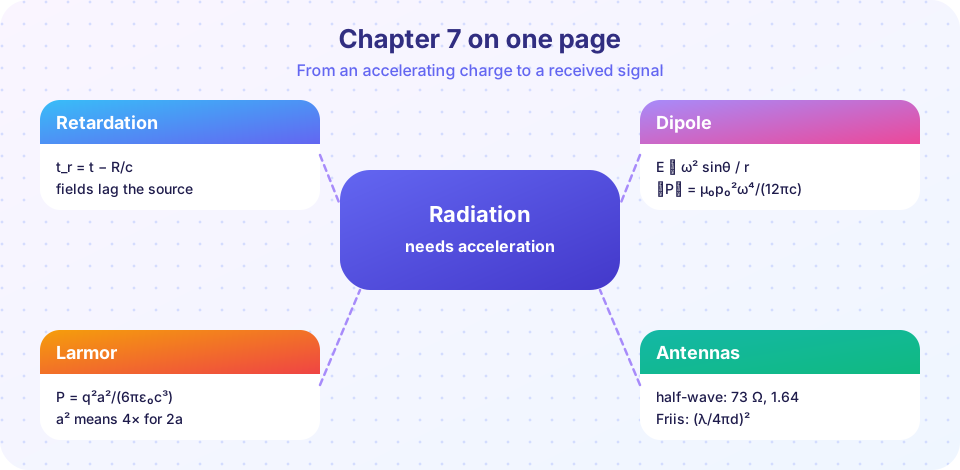
Recap table
| Topic | Result | Remember |
|---|---|---|
| Retardation | t_r = t − R/c (R = distance) |
Sun: 499 s away |
| Dipole fields | E ∝ ω² p₀ sinθ / r |
Power ∝ ω⁴ |
| Dipole power | ⟨P⟩ = μ₀p₀²ω⁴/(12πc) |
Pattern sin²θ |
| Larmor | P = q²a²/(6πε₀c³) |
Doubling a gives 4× |
| Half-wave dipole | R_rad ≈ 73 Ω, D = 1.64 |
Length ≈ 0.47 λ |
| Friis | P_r/P_t = G_tG_r(λ/4πd)² |
2.4 GHz, 10 m: −56 dB |
The chain of reasoning
Experts do not memorize these formulas as a list. They remember one story and rebuild the formulas from it:
- Acceleration bends field lines into a kink that runs outward at
c(overview). Therefore radiation needs acceleration and falls as1/r. - Retardation (retarded potentials) puts that story into equations: the potentials at
(r, t)come from sources att − R/c. Differentiating a retarded quantity brings in the source's time derivatives, so fields containp̈, not justp. - A small source is a dipole (dipole and Larmor):
E ∝ ω² p₀ sinθ/r, so power∝ ω⁴ sin²θ. A single charge gives Larmor'sP ∝ q²a². - A real antenna is a dipole with structure (antennas): add elements with their phases for the pattern, integrate for the power, and use
A_e = Gλ²/4πfor the link.
When you meet a new radiation problem, ask in order: what is accelerating, how fast does the source oscillate compared with c/size, in which direction do I want the power, and how far away is the receiver?
Worked review problems
Problem 1. A dipole with p₀ = 2 × 10⁻⁷ C·m oscillates at 3 MHz. Find the average power.
ω = 2π × 3 × 10⁶ = 1.885 × 10⁷ rad/s, ω⁴ = 1.263 × 10²⁹, so ⟨P⟩ = μ₀p₀²ω⁴/(12πc) = (1.257×10⁻⁶ × 4×10⁻¹⁴ × 1.263×10²⁹)/(12π × 2.998×10⁸) ≈ 0.56 W. (The TryIt below checks it.)
Problem 2. A proton and an electron get the same acceleration. Compare Larmor powers. The power depends on q²a², and both charges have magnitude e, so the powers are equal. The same force gives the electron an acceleration 1836 times larger, and its power 1836² ≈ 3.4 million times larger. That is why light particles radiate so much more in accelerators.
Problem 3. You triple the distance to a transmitter. By how many dB does the received power fall? Power ∝ 1/d², a factor of 9: 10 log₁₀ 9 = 9.5 dB.
Common mistakes to avoid
"Radiation and a static field are two names for the same thing." The 1/r² static field belongs to the charge; the 1/r radiation field belongs to its acceleration.
"Gain measures how much power an antenna makes." Gain is the redistribution of a fixed power: more in one direction means less in others, and G = ηD includes the efficiency η.
"Larmor's formula works at any speed." It is the non-relativistic limit (v ≪ c). Near c the relativistic form (Liénard) has extra factors of γ.
Orders of magnitude to carry with you
| Quantity | Value |
|---|---|
| Light-travel time, Earth to Moon | 1.28 s |
| Light-travel time, Earth to Sun | 499 s |
Free-space impedance Z₀ |
376.7 Ω |
Half-wave dipole R_rad, D |
73 Ω, 1.64 (2.15 dBi) |
| Near/far crossover | r ≈ λ/2π |
| Blue-to-red scattering ratio | about 6 |
Try it
Press Run (or Ctrl + Enter) to see the result here.
Program input · what you'd type while the program runs
Type the answers before you press Run, one per line. Each time the program reads a line (with input()), it gets the next line from this box.
Press Run (or Ctrl + Enter) to see the result here.
Program input · what you'd type while the program runs
Type the answers before you press Run, one per line. Each time the program reads a line (with input()), it gets the next line from this box.
Press Run (or Ctrl + Enter) to see the result here.
Program input · what you'd type while the program runs
Type the answers before you press Run, one per line. Each time the program reads a line (with input()), it gets the next line from this box.
Check your understanding
Quick check · 10 questions
of 10 answered You scored / 10 · perfect!
-
1. A charge moves at constant velocity. Does it radiate?
Larmor's formula gives zero power for a = 0. -
2. The radiation field of a source decreases with distance as
Only a 1/r field keeps the flux through a sphere constant. -
3. A transmitter on Mars (closest 5.5 × 10¹⁰ m) sends a pulse. About when does Earth receive it?
t = 5.5 × 10¹⁰ / 3 × 10⁸ ≈ 183 s ≈ 3 min. -
4. Doubling the dipole frequency (same p₀) changes the radiated power by a factor
P ∝ ω⁴. -
5. Where does a vertical dipole radiate the most?
sin²θ peaks at θ = 90°. -
6. The directivity of an ideal isotropic radiator is
By definition, the isotropic radiator is the reference: D = 1 (0 dBi). -
7. Larmor power for a given charge scales with acceleration as
P = q²a²/(6πε₀c³). -
8. At 100 MHz, a half-wave dipole is roughly
λ = 3 m, so λ/2 = 1.5 m. -
9. In the Friis equation, doubling the distance changes received power by
Power falls as 1/d², so ×1/4 = −6 dB. -
10. Why is the sky blue (qualitatively)?
Driven molecular dipoles radiate ∝ ω⁴, so blue is scattered about six times more than red.
Summary
- Retardation, acceleration and dipole structure make radiation.
- Larmor's formula and the dipole pattern give power and direction.
- Antennas turn those ideas into gain, resistance and link budgets.
- Next: how electromagnetism and special relativity fit together.
Track your progress
Create a free account to tick off lessons and pick up where you left off on any device.
of Electrodynamics lessons completed