


















Lesson 1 of 49 · Getting Started
Course map: electrodynamics from charge to light
A guided map of the whole electrodynamics course: who it is for, what you need, how to study it, and how nine chapters build from Coulomb's law to light.
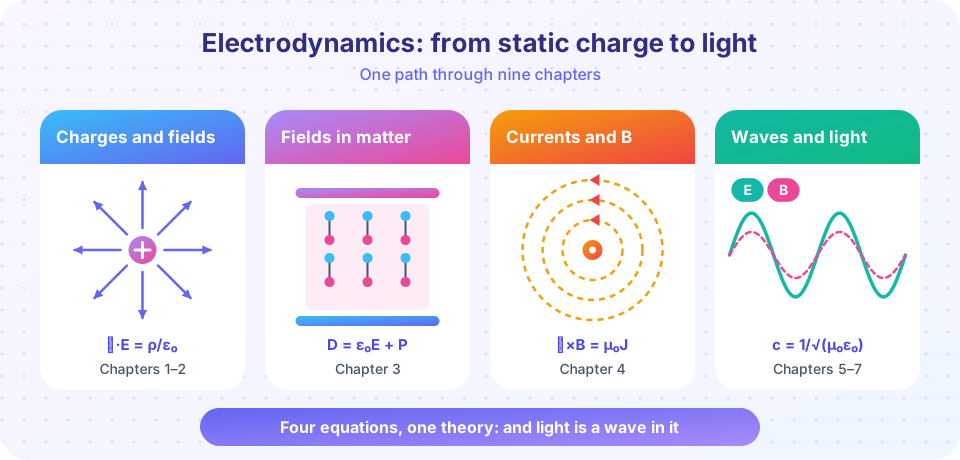
Electrodynamics is the study of electric and magnetic fields, the charges and currents that create them, and the way they push on matter. It is also the subject that explains light, radio, microwaves, X-rays and every wire in your house. Four short equations, called Maxwell's equations, hold almost the whole story. This course walks you from the first law of the subject, Coulomb's law, all the way to those four equations, to electromagnetic waves and to the surprising link with Einstein's relativity.
What you will learn
- What electrodynamics covers and why it matters for physics and engineering.
- Which math and physics you should already know, and which you will meet along the way.
- How the nine chapters build on each other, with a clear order of study.
- A study method that works for a subject full of vectors and integrals.
Who this course is for
The course is written for students of about 17 and up: advanced school physics (A Level, IB Higher Level, AP Physics C), first and second year university students, and adults who want to finally understand how fields work. It follows the level of a standard undergraduate course in electromagnetism, but explains every step and uses runnable code so that you can test ideas instead of only reading them.
You do not need to have seen Maxwell's equations before. You do need some calculus. Derivatives, ordinary integrals and the idea of a vector are assumed. Everything beyond that, such as the gradient, divergence, curl, line, surface and volume integrals, is taught from scratch in Chapter 2.
Key terms
- Charge: the property of matter that makes it feel electric forces; measured in coulombs (C).
- Field: a quantity defined at every point in space, such as the electric field E or magnetic field B.
- Source: a charge or current that creates a field.
- Maxwell's equations: four equations linking fields to their sources and to each other.
- Electromagnetic wave: a self-sustaining ripple of E and B that travels at the speed of light.
The big picture in one paragraph
Electric charges create electric fields. Moving charges (currents) also create magnetic fields. Both fields exert forces on other charges, summarized by the Lorentz force law. When fields change in time, they create each other: a changing B makes an E (Faraday's law) and a changing E makes a B (Maxwell's correction to Ampère's law). That mutual creation lets a disturbance travel through empty space, and the predicted speed matches the measured speed of light. Light is an electromagnetic wave.
The nine chapters
Foundations
- Getting Started
- Vector calculus
Fields meet matter
- Fields in matter
- Magnetostatics
The unified theory
- Maxwell's equations
- EM waves
Radiation and relativity
- Antennas
- Relativity
Put it to work
- Projects
Each chapter has an overview, content lessons and a review
The first four chapters (this part of the course) build the static world: charges that sit still and currents that flow steadily. Chapters 5 to 9 then let everything change with time, which is where waves, radiation and relativity appear.
How the lessons are built
Every content lesson has the same shape, so you always know where you are: learning goals, key terms, worked examples with real numbers, common misconceptions, interactive demonstrations, a short quiz and a summary. Chapter overviews give the big picture first; chapter reviews bring the formulas of the chapter onto one poster and test them with a longer quiz.
How to study electrodynamics
- Draw before you calculate. Almost every problem is easier once you sketch the charges, the field direction and the symmetry.
- Learn the units. Checking units catches most algebra errors. Lesson 4 gives you a tool for this.
- Run the code. Each lesson has interactive examples. Change a number, predict the result, then run it. Prediction before running is where learning happens.
- Re-derive one result per lesson on paper, without looking. If you can, you own it.
- Do not memorize four equations first. Maxwell's equations are the summary of the subject, not the starting point. By Chapter 5 you will recognize each one as an old friend.
Common misconceptions
- "Electricity and magnetism are separate subjects." They are two faces of one field. A magnetic field in one frame is partly an electric field in another (Chapter 8).
- "Fields are just a mathematical trick for calculating forces." Fields carry energy and momentum and travel through empty space. They are physically real.
- "I need to be great at vector calculus first." You need to be willing to learn it as you go. Chapter 2 is designed for exactly that.
Try it
The first example shows how strong the electric force is, compared with gravity, for an electron and a proton in a hydrogen atom. The second recovers the speed of light from two electrical constants, a first glimpse of the unity of the subject.
Press Run (or Ctrl + Enter) to see the result here.
Program input · what you'd type while the program runs
Type the answers before you press Run, one per line. Each time the program reads a line (with input()), it gets the next line from this box.
Press Run (or Ctrl + Enter) to see the result here.
Program input · what you'd type while the program runs
Type the answers before you press Run, one per line. Each time the program reads a line (with input()), it gets the next line from this box.
Check your understanding
Quick check · 4 questions
of 4 answered You scored / 4 · perfect!
-
1. Which pair of ideas does Maxwell's theory unite into a single picture?
Maxwell's equations describe electric fields, magnetic fields and their mutual creation, which turns out to be light. -
2. In the hydrogen-atom comparison, how does the ratio of electric to gravitational force change if the distance doubles?
Both forces follow an inverse-square law, so the factor of 1/r² cancels in the ratio. -
3. What is the best first step on almost any electrodynamics problem?
A sketch reveals symmetry that can turn a hard integral into an easy one. -
4. Which chapters of the course deal with static charges and steady currents?
Chapters 1 to 4 treat electrostatics and magnetostatics. Time dependence enters from Chapter 5.
Summary
- Electrodynamics covers electric and magnetic fields, their sources, and their effect on charges.
- Four equations (Maxwell) plus the Lorentz force law contain the whole classical theory.
- Chapters 1 to 4 handle static situations; chapters 5 to 9 add time dependence, waves, radiation and relativity.
- The speed of light follows from two electrical constants, which is the first hint that light is an electromagnetic wave.
- Study by sketching, checking units, running code and re-deriving one result per lesson.
Track your progress
Create a free account to tick off lessons and pick up where you left off on any device.
of Electrodynamics lessons completed