


















Lesson 25 of 49 · Maxwell's Equations
Displacement current and the Ampere-Maxwell law
Why Ampere's law fails for a charging capacitor, how Maxwell's displacement current repairs it, and how to compute the magnetic field between plates.
Ampere's law, ∇×B = μ₀J, works beautifully for steady currents. But it hides a flaw, and the flaw is mathematical before it is experimental. Take the divergence of both sides. The divergence of a curl is always zero, so Ampere's law forces ∇·J = 0. Yet charge conservation says ∇·J = −∂ρ/∂t, which is not zero when charge piles up somewhere, for example on the plates of a charging capacitor. Maxwell saw the contradiction and fixed it by adding one term.
What you will learn
- See why Ampere's law is inconsistent for a charging capacitor.
- State the Ampere-Maxwell law and define displacement current.
- Compute the magnetic field inside and outside a charging parallel-plate capacitor.
- Link the new term to charge conservation.
Key terms
Displacement current density J_d = ε₀ ∂E/∂t. Displacement current I_d = ε₀ dΦ_E/dt, where Φ_E is the electric flux. Continuity equation ∇·J + ∂ρ/∂t = 0, charge conservation in local form. Amperian loop: the closed path used to apply Ampere's law.
The paradox
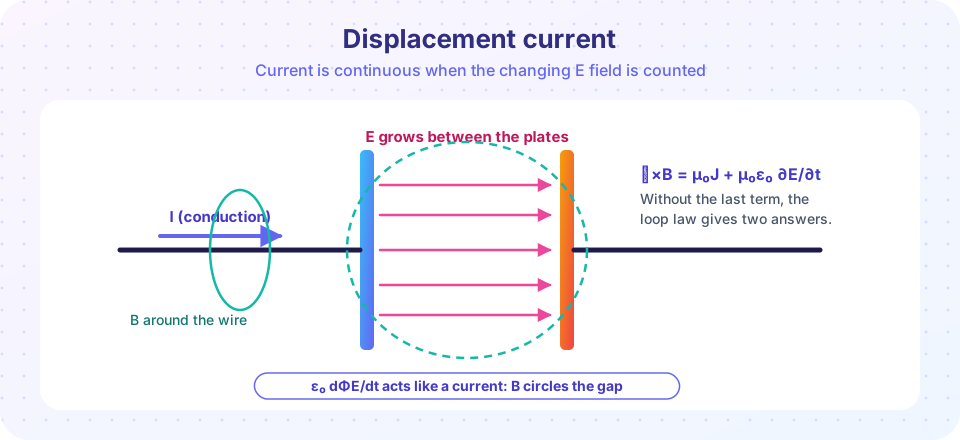
Charge a parallel-plate capacitor with a steady current I. Draw a circular Amperian loop around the wire. Two surfaces share this loop as their boundary. A flat disc cut by the wire gives ∮B·dl = μ₀I. A bulging surface that passes between the plates is crossed by no wire, so it would give zero. The same loop cannot have two answers.
The way out: between the plates, the electric field grows because charge accumulates. The plate charge is Q = ε₀ E A, so dQ/dt = ε₀ A dE/dt. The wire current I = dQ/dt matches ε₀ dΦ_E/dt through the gap exactly. Adding this to Ampere's law,
∇×B = μ₀J + μ₀ε₀ ∂E/∂t ∮B·dl = μ₀(I_enc + ε₀ dΦ_E/dt)
makes both surfaces agree. Taking the divergence now gives 0 = μ₀(∇·J + ε₀ ∂(∇·E)/∂t) = μ₀(∇·J + ∂ρ/∂t), which is the continuity equation. The extra term is not a patch; it is what charge conservation demands.
"Displacement current is a real flow of charge." It is not. Nothing crosses the gap. It is a changing electric field, and it creates a magnetic field in the same way a real current does. The name is historical.
"Maxwell's term is tiny and only matters in theory." At low frequency it is small, but it is the whole reason electromagnetic waves exist.
Maxwell's reasoning, and the experimental proof
Maxwell did not have the continuity argument in today's form. He pictured the vacuum as an elastic medium and imagined that a changing electric displacement made a small motion of that medium, a current of a new kind. We no longer believe in the medium, but his instinct was right and his mathematics survived. Notice what he did not have: any experiment that needed the term. Ordinary laboratory circuits in 1861 could not detect it, which is why the correction is hard to find from measurements and easy to find from consistency. The decisive test was Heinrich Hertz's 1887 experiment. His spark-gap transmitter radiated electromagnetic waves and a loop receiver several meters away sparked in sympathy, and the waves reflected, refracted and had a measurable wavelength, just as the theory said. Without the displacement-current term no such waves exist.
Why one term fixes both surfaces
Return to the Amperian loop of radius r around the wire. The flat disc gives μ₀ I because the wire pierces it. The bulging surface between the plates is pierced by no wire, but the electric flux through it is changing. With the new term, the bulging surface gives μ₀ ε₀ dΦ_E/dt = μ₀ I, the same number, because all the field lines that leave the positive plate and cross the gap also cross the bulging surface. The two answers agree, so the magnetic field around the loop is single-valued, as it must be.
Worked example: field between the plates
Round plates of radius R = 0.050 m carry a charging current I = 2.0 A. Assume the field between them is uniform and axial. The electric flux through a loop of radius r < R is E π r², and E = Q/(ε₀ π R²), so ε₀ dΦ_E/dt = I r²/R².
Apply the loop law: B (2π r) = μ₀ I r²/R², which gives
B = μ₀ I r / (2π R²)    (r < R)
B = μ₀ I / (2π r)       (r > R)
At r = 0.025 m, the inside field is 2×10⁻⁷ × 2.0 × 0.025 / (0.050)² = 4.0 × 10⁻⁶ T. The field grows linearly from zero on the axis to a maximum at the plate edge, then falls like 1/r, matching the field of the wire. The rate of change of the electric field needed is dE/dt = I/(ε₀ π R²) ≈ 2.9 × 10¹³ V/(m·s). A huge number: displacement current is only noticeable when fields change extremely fast, or the wire current is large.
Press Run (or Ctrl + Enter) to see the result here.
Program input · what you'd type while the program runs
Type the answers before you press Run, one per line. Each time the program reads a line (with input()), it gets the next line from this box.
Worked example: how big is displacement current in a conductor?
Inside a conductor with conductivity σ, the conduction current density is J = σE. If the field oscillates as E₀ cos ωt, the displacement current density is ε₀ ∂E/∂t, with amplitude ε₀ ω E₀. The ratio of the two is ωε₀/σ.
- Copper,
σ ≈ 5.96×10⁷ S/m, at1 GHz(ω = 6.28×10⁹ rad/s): ratio≈ 9.3×10⁻¹⁰. The displacement current is a billionth of the conduction current, which is why you can ignore it in ordinary wiring. - Sea water,
σ ≈ 4 S/m, at1 MHz: ratio≈ 1.4×10⁻⁵. At1 GHzit reaches about1.4×10⁻², a hundredth, and the two become comparable near72 GHz. - Copper again: the ratio reaches 1 near
10¹⁸ Hz, in the X-ray band, so metals behave as good conductors at every radio and microwave frequency.
In vacuum and in good insulators there is no conduction current at all, so the displacement term is the only thing that lets the magnetic field of a wave change in space. That is the answer to "does it matter?": in a wire, rarely; in light, always.
Press Run (or Ctrl + Enter) to see the result here.
Program input · what you'd type while the program runs
Type the answers before you press Run, one per line. Each time the program reads a line (with input()), it gets the next line from this box.
Press Run (or Ctrl + Enter) to see the result here.
Program input · what you'd type while the program runs
Type the answers before you press Run, one per line. Each time the program reads a line (with input()), it gets the next line from this box.
Check your understanding
Quick check · 7 questions
of 7 answered You scored / 7 · perfect!
-
1. Why does the original Ampere's law contradict charge conservation?
The divergence of a curl is zero, so ∇×B = μ₀J implies ∇·J = 0, which is false when charge density changes. -
2. In SI units, which expression is the displacement current density?
J_d = ε₀ ∂E/∂t has the units of current density (A/m²). -
3. A capacitor is charged by 3.0 A. What is the displacement current between its plates?
The displacement current equals the wire current, so the total current is continuous. -
4. Inside a charging circular capacitor of radius R, B grows with r as
B = μ₀ I r / (2π R²) for r < R, linear in r. -
5. Which describes displacement current correctly?
No charge crosses the gap; the changing E field plays the role of a current in Ampere's law. -
6. A 2.0 A current charges a circular capacitor of radius 5.0 cm. What is the displacement current density between the plates?
J_d = I/(π R²) = 2.0 / 7.85×10⁻³ ≈ 255 A/m². -
7. For which kind of medium is displacement current negligible compared with conduction current at radio frequencies?
J_d/J = ωε₀/σ is about 10⁻⁹ for copper at 1 GHz; vacuum and air have no conduction current at all.
Summary
∇×B = μ₀J + μ₀ε₀ ∂E/∂t; the extra term is the displacement current.- It is required by charge conservation,
∇·J = −∂ρ/∂t. - Between charging plates
I_d = I, givingB = μ₀ I r/(2π R²)inside. - Changing E makes B, and changing B makes E: the seed of waves.
- In copper
J_d/J = ωε₀/σ ≈ 10⁻⁹at 1 GHz, so the term hides in wires but rules in vacuum; Hertz's 1887 waves confirmed it.
Track your progress
Create a free account to tick off lessons and pick up where you left off on any device.
of Electrodynamics lessons completed