


















Lesson 15 of 49 · Electric Fields in Matter
Capacitors and field energy
Derive the capacitance of plate, coaxial and spherical capacitors, add dielectrics, compute stored energy and the force pulling a slab in, with worked numbers and code.
A capacitor is two conductors separated by an insulator. Put charge +Q on one and −Q on the other and a voltage V appears between them. The ratio C = Q/V depends only on geometry and on the material in the gap. Capacitors smooth power supplies, tune radios, store the flash of a camera and hold a bit in a memory cell. In this lesson you derive their capacitance from the field results of Chapters 2 and 3, and learn where the stored energy sits and what a dielectric does to it.
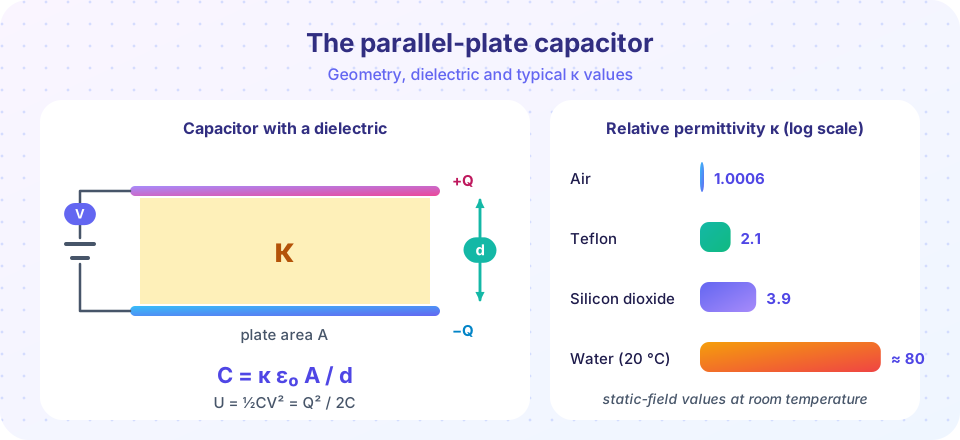
What you will learn
- The definition of capacitance and how to derive it for parallel-plate, coaxial and spherical geometries.
- How dielectrics raise capacitance by κ and how capacitors combine in series and parallel.
- The energy stored,
U = ½CV², and the energy densityu = ½εE². - Why a dielectric slab is pulled into a charged capacitor, and the force on it.
Key terms
- Capacitance C:
C = Q/V, in farads (1 F = 1 C/V). - Parallel-plate capacitor: two flat plates of area A separated by a gap d.
- Dielectric constant κ: the factor by which a filling dielectric multiplies C.
- Series and parallel: ways to combine capacitors; parallel adds C, series adds 1/C.
- Fringing field: the small field leaking beyond the plate edges, neglected in the ideal formula.
The recipe
To find C for any pair of conductors:
- Put charge +Q and −Q on the conductors.
- Find E between them (usually by Gauss's law for D).
- Integrate to get the voltage
V = −∫ E·dlfrom the − to the + conductor. - Divide:
C = Q/V.
Parallel plates
For large plates with area A and gap d, the surface charge density is σ = Q/A, so D = σ, E = σ/(κε₀) between them and V = E d = Q d / (κ ε₀ A). Therefore
C = κ ε₀ A / d
With A = 100 cm² = 0.01 m², d = 1 mm and κ = 1: C = 8.854 × 10⁻¹² × 0.01 / 0.001 = 88.5 pF. With κ = 4: 354 pF.
Coaxial cable
Inner radius a, outer radius b, length L. Gauss's law for D on a cylinder of radius s gives D = λ/(2πs) with λ = Q/L, so E = λ/(2π ε s). Then V = (λ / 2π ε) ln(b/a) and
C / L = 2π ε / ln(b/a)
For a = 0.5 mm, b = 2.5 mm and polyethylene (κ ≈ 2.25): about 78 pF per meter, which is why long cables have noticeable capacitance.
Spherical shells and an isolated sphere
For concentric spheres with radii a < b: C = 4π ε₀ a b / (b − a). Let b → ∞ and you get the capacitance of an isolated sphere, C = 4π ε₀ R. For the Earth, R = 6371 km, this gives about 710 μF: a "capacitor" so large in size but so small in capacitance, because farads are a huge unit.
Combining capacitors
- Parallel (same V): charges add,
C = C₁ + C₂ + … - Series (same Q): voltages add,
1/C = 1/C₁ + 1/C₂ + …
Energy stored
Charging a capacitor from 0 to Q, moving each increment dq against the existing voltage q/C, costs
U = ∫₀^Q (q/C) dq = Q²/(2C) = ½ C V² = ½ Q V
For a parallel-plate capacitor, U = ½ (κ ε₀ A/d)(E d)² = ½ κ ε₀ E² · A d, so the energy per unit volume is
u = ½ ε E² (linear dielectric, ε = κ ε₀)
which agrees with the vacuum result ½ ε₀ E². For our 88.5 pF example at 100 V, U = 0.44 μJ; with κ = 4 and the battery still connected, U = 1.77 μJ.
What a dielectric does: two cases
Insert a dielectric slab into a capacitor that is charged to V₀ with charge Q₀ = C₀V₀.
- Isolated (battery disconnected, Q fixed):
C → κ C₀,V → V₀/κ, and the energy falls toU₀/κ. - Connected (battery keeps V fixed):
C → κ C₀, the battery pushes in extra chargeQ = κ Q₀, and the energy rises toκ U₀.
In both cases the slab is pulled in. For a slab of width reaching distance x between square plates of side L, C(x) = ε₀ L (L + (κ − 1) x) / d. At constant V the force on the slab is F = ½ V² dC/dx = ½ V² ε₀ L (κ − 1) / d, independent of x. At constant Q the same formula holds with the instantaneous voltage, which falls as the slab enters. For L = 0.1 m, d = 1 mm, κ = 4 and V = 100 V that is 1.3 × 10⁻⁵ N. The pull comes from the fringing field at the slab edge, which polarizes the dielectric and draws it toward the stronger field.
Common misconceptions
- "A capacitor stores charge." It stores energy and separates charge; the total charge on the device is zero (+Q on one plate, −Q on the other).
- "Capacitance depends on the voltage or charge." It depends only on geometry and the dielectric (for a linear material). Double Q and V doubles.
- "Series capacitors add like resistors in series." The opposite: capacitors in parallel add directly.
- "Energy U = QV." The factor ½ is essential: the average voltage during charging is V/2.
Try it
The first example calculates capacitance for the standard geometries and combines capacitors. The second plots the energy of a partly inserted slab, for the isolated and connected cases, and the force on the slab. The third shows the geometry of the coaxial cable.
Press Run (or Ctrl + Enter) to see the result here.
Program input · what you'd type while the program runs
Type the answers before you press Run, one per line. Each time the program reads a line (with input()), it gets the next line from this box.
Press Run (or Ctrl + Enter) to see the result here.
Program input · what you'd type while the program runs
Type the answers before you press Run, one per line. Each time the program reads a line (with input()), it gets the next line from this box.
Press Run (or Ctrl + Enter) to see the result here.
Program input · what you'd type while the program runs
Type the answers before you press Run, one per line. Each time the program reads a line (with input()), it gets the next line from this box.
Check your understanding
Quick check · 5 questions
of 5 answered You scored / 5 · perfect!
-
1. The plate separation of a parallel-plate capacitor is doubled and the plate area is doubled. The capacitance
C ∝ A/d; both factors of 2 cancel. -
2. Capacitors of 4 μF and 12 μF are connected in series. The equivalent capacitance is
1/C = 1/4 + 1/12 = 1/3 μF⁻¹, so C = 3 μF. -
3. An isolated, charged capacitor has a dielectric (κ = 2) inserted. The stored energy
Q is fixed and C doubles, so U = Q²/2C halves. -
4. The energy stored in a 2 μF capacitor charged to 50 V is
U = ½CV² = 0.5 × 2e-6 × 2500 = 2.5e-3 J. -
5. Which expression is the energy density in a linear dielectric?
u = ½ε E² = ½ E·D.
Summary
- Capacitance
C = Q/Vdepends only on geometry and κ: platesκε₀A/d, coax2πε/ln(b/a)per length, sphere4πε₀R. - Parallel capacitors add; series capacitors add reciprocals.
- Stored energy
U = ½CV² = Q²/2C, with densityu = ½εE². - A dielectric slab is pulled into a charged capacitor; with a battery attached the energy rises and the battery does the work.
Next: Chapter 3 review
Track your progress
Create a free account to tick off lessons and pick up where you left off on any device.
of Electrodynamics lessons completed