


















Lesson 22 of 49 · Magnetostatics
Chapter 4 review: magnetostatics
Review the Lorentz force, Biot-Savart law, Ampère's law, the vector potential and magnetic materials with a one-page poster, a recap table, plots and a 9-question quiz.
You now have the full toolkit of magnetostatics: the force law (Lorentz), the source law (Biot–Savart), the symmetry shortcut (Ampère), the potential (A) and the response of matter (M and H). This review puts the formulas on one page and tests how well you can combine them.
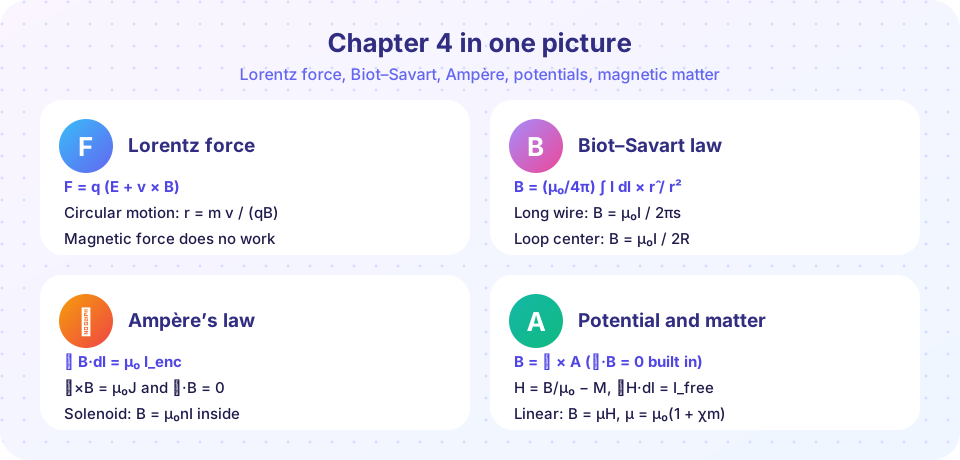
The chapter in a table
| Topic | Key result |
|---|---|
| Lorentz force | F = q(E + v × B); magnetic force does no work |
| Circular motion | `r = mv/( |
| Force on a wire | F = I L × B; loop torque τ = m × B |
| Biot–Savart | dB = (μ₀/4π) I dl × r̂/r² |
| Wire / loop center | μ₀I/(2πs) / μ₀I/(2R) |
| Ampère's law | ∮B·dl = μ₀I_enc; ∇×B = μ₀J |
| Solenoid / toroid | μ₀nI / μ₀NI/(2πs) |
| No monopoles | ∇·B = 0, so B = ∇×A |
| Magnetic matter | H = B/μ₀ − M, B = μH, ∇×H = J_f |
Electric versus magnetic statics
| Electrostatics | Magnetostatics | |
|---|---|---|
| Source | charge density ρ | current density J |
| Divergence | ∇·E = ρ/ε₀ |
∇·B = 0 |
| Curl | ∇×E = 0 |
∇×B = μ₀J |
| Potential | E = −∇V |
B = ∇×A |
| Symmetry tool | Gauss's law | Ampère's law |
| In matter | P, D, ∇·D = ρ_f |
M, H, ∇×H = J_f |
| Force on a charge | qE, does work |
qv×B, does no work |
Problem-solving guide
- Force or field? Forces use Lorentz; fields use Biot–Savart (general) or Ampère (symmetric).
- Draw the current and the symmetry. Right-hand rule for the direction of B.
- In matter: find H from free current (Ampère), then
B = μH. - Check units and limits. Tesla = N/(A·m); far from a loop, the field should be dipole-like.
Common misconceptions
- "A magnetic field can accelerate particles." Only electric fields change speed.
- "Ampère's law gives B at any point." Only with enough symmetry to pull B out of the integral.
Try it
Press Run (or Ctrl + Enter) to see the result here.
Program input · what you'd type while the program runs
Type the answers before you press Run, one per line. Each time the program reads a line (with input()), it gets the next line from this box.
Press Run (or Ctrl + Enter) to see the result here.
Program input · what you'd type while the program runs
Type the answers before you press Run, one per line. Each time the program reads a line (with input()), it gets the next line from this box.
Check your understanding
Quick check · 9 questions
of 9 answered You scored / 9 · perfect!
-
1. A proton and an alpha particle (twice the charge, four times the mass) enter a uniform B with the same speed, perpendicular to B. The ratio of the alpha's radius to the proton's is
r = mv/(qB), so the alpha has (4m)/(2q) = 2 times the radius. -
2. Which law gives the field of a long solenoid most directly?
A rectangular Amperian loop with one side inside gives B = μ₀nI. -
3. Two parallel wires carry 3 A and 5 A in opposite directions, 0.1 m apart. The force per meter is
F/L = μ₀I₁I₂/(2πd) = 2e-7 × 15 / 0.1 = 3e-5 N/m; opposite currents repel. -
4. ∇·B = 0 means
There are no magnetic charges, so field lines close on themselves. -
5. H is related to B and M by
B = μ₀(H + M). -
6. The magnetic field at the center of a loop of radius R carrying I is
From Biot–Savart, B = μ₀I/(2R). -
7. Which is true of the energy of a charged particle in a purely magnetic field?
The force does no work, so the kinetic energy is constant. -
8. Which material has a small, negative susceptibility?
Water is diamagnetic (χ_m ≈ −9 × 10⁻⁶); aluminum is paramagnetic; iron is ferromagnetic. -
9. Inside a toroid with iron core (μ_r = 500) the field is, compared with air core and the same current,
H is set by the free current; B = μ_r μ₀ H.
Summary
- Force: Lorentz; sources: Biot–Savart (always) and Ampère (symmetry); potential:
B = ∇×A. - Statics are symmetrical:
∇·E = ρ/ε₀,∇×E = 0versus∇·B = 0,∇×B = μ₀J. - Matter: M and H handle bound current;
B = μHin linear media; ferromagnets show hysteresis. - This completes the static part: Chapter 5 lets the fields change in time.
Track your progress
Create a free account to tick off lessons and pick up where you left off on any device.
of Electrodynamics lessons completed