


















Lesson 24 of 49 · Maxwell's Equations
Faraday's law and induction
Learn Faraday's law in integral and differential form, Lenz's law, motional emf and worked generator examples with runnable plots.
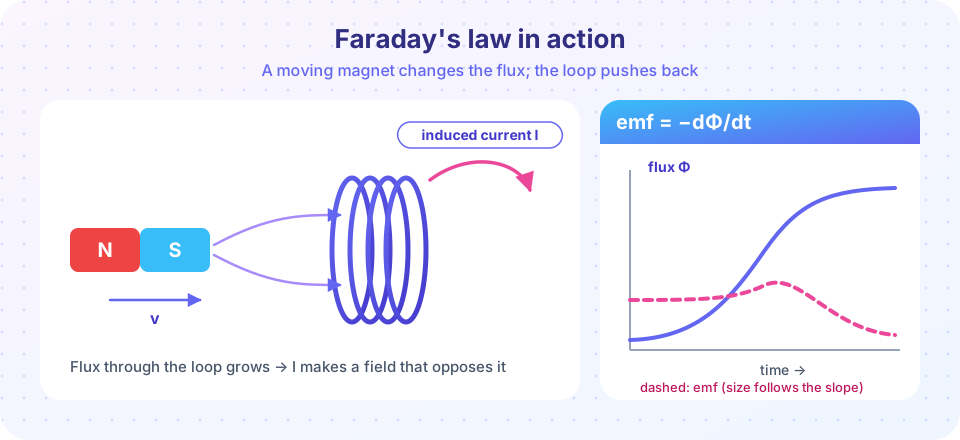
In 1831 Michael Faraday moved a magnet through a coil of wire and saw a current flow while the magnet moved, and only while it moved. A steady magnet did nothing. That observation is the doorway from statics to dynamics: a changing magnetic flux creates an electric field. Every generator, transformer, induction cooktop and wireless charger relies on it.
What you will learn
- State Faraday's law in integral and differential form.
- Use Lenz's law to find the direction of an induced current.
- Calculate motional emf and the emf of a rotating coil.
- Explain why induced electric fields are not conservative.
Key terms
Magnetic flux Φ = ∫ B·dA (unit weber, 1 Wb = 1 T·m²). Emf (electromotive force): the line integral of the electric force per unit charge around a loop, in volts. Lenz's law: the induced effect opposes the change that causes it. Motional emf: emf from a conductor moving through a magnetic field.
Faraday's experiments
Faraday's famous test in August 1831 used an iron ring with two separate coils of wire wound on opposite sides, the first prototype of a transformer. When he connected a battery to coil one, a galvanometer on coil two jumped, then settled back to zero even though the battery stayed connected. When he disconnected the battery it jumped the other way. Only the switching mattered. A few weeks later he pushed bar magnets in and out of coils and rotated a copper disc between the poles of a magnet, making the first continuous electric generator. Joseph Henry in Albany had seen similar effects, and the unit of inductance is named after him. Faraday's lesson was that a conductor needs a changing environment, not just a strong one.
The law
For a closed loop C bounding a surface S, the emf around the loop is
emf = ∮ E·dl = −dΦ/dt, Φ = ∫ B·dA
For a coil of N turns the flux linkage is NΦ, so emf = −N dΦ/dt. The minus sign is Lenz's law: if the flux through the loop grows, the induced current makes a magnetic field that points against the growth.
Turn the integral into a statement at a point with Stokes' theorem, ∮E·dl = ∫(∇×E)·dA. For a fixed loop the time derivative moves inside the integral, and since the surface is arbitrary,
∇×E = −∂B/∂t
This is the third Maxwell equation. In electrostatics ∇×E = 0, so E was conservative and had a potential. Here it is not: the line integral around a closed loop is nonzero, and E can no longer be written as −∇V alone.
Worked example: an alternator
A flat coil with N = 100 turns and area A = 0.010 m² rotates at f = 50 Hz in a uniform field B = 0.50 T. The angle between B and the coil normal is θ = ωt with ω = 2πf ≈ 314.16 rad/s, so Φ = B A cos ωt and
emf = −N dΦ/dt = N B A ω sin ωt
peak emf = 100 × 0.50 × 0.010 × 314.16 ≈ 157 V
The rms value is the peak divided by √2, about 111 V.
Motional emf
A straight rod of length L slides with speed v perpendicular to a uniform field B. Charges in the rod feel the magnetic force q v × B, giving emf = B L v. With B = 0.20 T, L = 0.50 m and v = 4.0 m/s the emf is 0.20 × 0.50 × 4.0 = 0.40 V. The flux-rule view agrees: the loop area grows at rate L v, so dΦ/dt = B L v.
Worked example: a transformer
A transformer links two coils through a shared iron core, so nearly the same flux Φ threads every turn of both. The primary has N₁ = 1000 turns and is driven by a 230 V alternating supply, which sets N₁ dΦ/dt ≈ 230 V (the induced back-emf balances the supply). The secondary has N₂ = 50 turns, so it feels N₂ dΦ/dt = (N₂/N₁) × 230 V = 11.5 V. If the ideal transformer delivers 10 W, the primary current is only 10 / 230 ≈ 0.043 A while the secondary carries 10 / 11.5 ≈ 0.87 A; power in equals power out. Transformers only work with alternating current: a steady current makes a steady flux and zero emf, exactly as Faraday found.
The induced field in a solenoid
Where is the electric field that drives the current? Consider a long solenoid of radius R = 5.0 cm whose field B along its axis grows at dB/dt = 0.20 T/s. By symmetry the induced E circles the axis. Take a circular loop of radius r.
- Inside (r < R): the flux through the loop is
B π r², soE (2π r) = π r² dB/dt, givingE = (r/2) dB/dt. - Outside (r > R): only the flux
B π R²is enclosed, soE = R² dB/dt / (2r).
At r = 3.0 cm inside, E = 0.5 × 0.030 × 0.20 = 3.0 mV/m. At r = 10 cm, outside the solenoid where B is essentially zero, E = 0.0025 × 0.20 / 0.20 = 2.5 mV/m. This is the point of the Maxwell equation: an electric field exists in a region with no magnetic field at all, because the curl of E at a point depends on ∂B/∂t inside the loop, not on B at the loop. A wire loop placed outside the solenoid still carries an emf.
Lenz's law and energy
Why the minus sign? Suppose the sign were reversed. Pushing a magnet toward a loop would induce a current that pulls the magnet further in, which would increase the current: free energy from nothing. The real sign makes you do work against the induced current, and that work is what appears as electrical energy. Lenz's law is energy conservation applied to induction.
Eddy currents are the same effect in a solid conductor. A magnet dropped through a copper tube falls slowly because the induced currents oppose its motion.
Common misconceptions
"A large flux produces a large emf." No. Only a change in flux produces emf. A strong, steady B through a stationary loop induces nothing.
"The induced current opposes the magnetic field." It opposes the change in flux. If the flux is decreasing, the induced field points the same way as the original one.
"Induced electric fields need charges." Not here. The curling E from a changing B has no source charges and its field lines close on themselves.
Try it
Press Run (or Ctrl + Enter) to see the result here.
Program input · what you'd type while the program runs
Type the answers before you press Run, one per line. Each time the program reads a line (with input()), it gets the next line from this box.
Press Run (or Ctrl + Enter) to see the result here.
Program input · what you'd type while the program runs
Type the answers before you press Run, one per line. Each time the program reads a line (with input()), it gets the next line from this box.
Press Run (or Ctrl + Enter) to see the result here.
Program input · what you'd type while the program runs
Type the answers before you press Run, one per line. Each time the program reads a line (with input()), it gets the next line from this box.
Check your understanding
Quick check · 7 questions
of 7 answered You scored / 7 · perfect!
-
1. A loop has a constant flux of 3 Wb through it. What is the emf?
emf = −dΦ/dt and the flux is not changing, so the emf is zero. -
2. The flux through a single loop drops from 0.60 Wb to 0.20 Wb in 0.10 s. What is the magnitude of the average emf?
|emf| = ΔΦ/Δt = 0.40 Wb / 0.10 s = 4 V. -
3. What does the minus sign in Faraday's law express?
That is Lenz's law, which is energy conservation applied to induction. -
4. A rod 0.30 m long moves at 2.0 m/s perpendicular to a 0.50 T field. What is the motional emf?
emf = B L v = 0.50 × 0.30 × 2.0 = 0.30 V. -
5. Which statement about the induced electric field is correct?
∇×E = −∂B/∂t is nonzero, so E circulates and has no single-valued potential. -
6. An ideal transformer has 200 primary turns and 20 secondary turns, with 120 V on the primary. What is the secondary voltage?
V₂ = V₁ N₂/N₁ = 120 × 20/200 = 12 V. -
7. Outside a long solenoid whose B is changing, the magnetic field is nearly zero. Is there an induced electric field there?
The loop encloses the changing flux in the solenoid, so ∮E·dl ≠ 0 and E ≈ R² (dB/dt)/(2r).
Summary
emf = ∮E·dl = −dΦ/dt; differential form∇×E = −∂B/∂t.- Only changing flux induces emf; Lenz's law fixes the direction.
- Motional emf is
B L v; a rotating coil givesN B A ω sin ωt. - Induced E fields circulate and are not conservative.
- Inside a solenoid
E = (r/2) dB/dt; outsideE = R² (dB/dt)/(2r), even where B itself is zero. - An ideal transformer scales voltage by
N₂/N₁and works only with changing flux.
Next: Displacement current
Track your progress
Create a free account to tick off lessons and pick up where you left off on any device.
of Electrodynamics lessons completed