


















Lesson 12 of 49 · Electric Fields in Matter
Chapter 3 overview: electric fields in matter
Preview how atoms polarize in an electric field, why bound charge reduces the field in a dielectric, and how this leads to the D field and to capacitors.
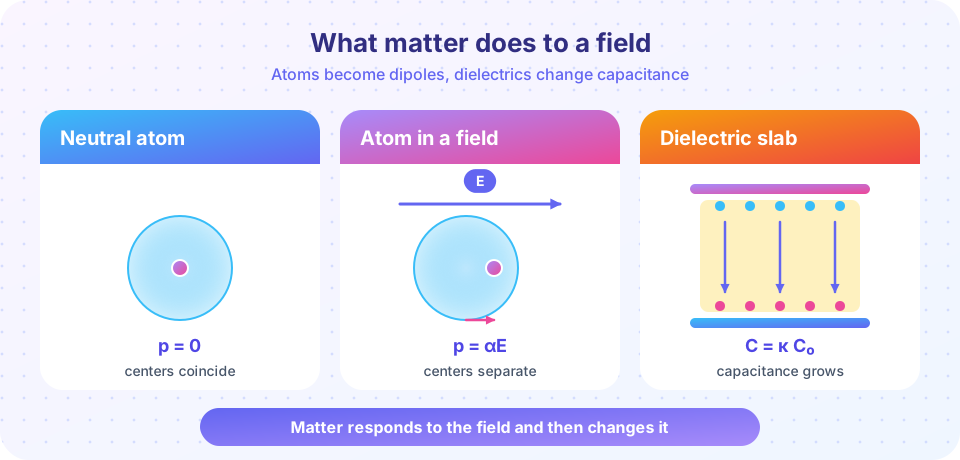
So far charges lived in vacuum. Real life is matter: glass, water, plastic, air, the insulation on wires and the dielectric inside every capacitor. Matter is made of charges too, but they are bound to atoms and molecules and cannot flow. Yet they still respond. Put an insulator in an electric field and its atoms stretch into tiny dipoles. Those dipoles produce their own field, which usually reduces the original. This chapter turns that picture into quantitative rules and ends with practical devices.
What you will learn
- The two ways matter polarizes and the idea of bound charge.
- Why a new field, D, is introduced and what it is good for.
- A map of the four lessons in this chapter.
Key terms
- Dielectric: an insulating material that polarizes in an electric field.
- Polarization P: dipole moment per unit volume, in C/m².
- Bound charge: charge tied to atoms that appears when matter is polarized.
- Free charge: charge we put on or take off a conductor ourselves.
- Relative permittivity κ: the factor by which a dielectric multiplies capacitance.
The big picture
Atoms in a field
Matter as dipoles
A field for free charge
Devices
Dielectrics store more charge for the same voltage
The four content lessons
- Polarization and bound charge: induced and permanent dipoles, the polarization vector, and the surface and volume charges it creates.
- The displacement field and linear dielectrics: why
D = ε₀E + P, Gauss's law in matter, susceptibility and permittivity, and boundary conditions. - Capacitors and field energy: capacitance of standard geometries, energy stored, and what happens when a dielectric slides in.
- Chapter 3 review: a poster and a longer quiz.
The key idea in one example
Charge a parallel-plate capacitor, then slide an insulating slab between the plates. The plate charge is the same. Yet the voltage between the plates drops. Why? The slab is polarized: negative bound charge builds up on the face next to the positive plate and positive charge on the other face. Those surface charges create a field opposite to the plates' field, so the net field and hence the voltage fall by the factor κ. The capacitance C = Q/V therefore grows by κ.
The trouble is that bound charge is not under your control: it depends on the field it creates. Bookkeeping it everywhere would be a nightmare. The way out is to separate the charge into free (which you place) and bound (which the material supplies), and define a field D whose divergence depends only on the free charge: ∇·D = ρ_free. That is the main idea of the chapter.
Common misconceptions
- "Insulators have no response to electric fields." They do not conduct, but they polarize, and this changes fields by factors of 2 to 80 or more.
- "A dielectric blocks the field." It reduces the field by screening, it does not remove it.
- "Bound charge is not real charge." It is real: it can be measured, creates fields and satisfies Gauss's law; it just cannot leave its atom.
Try it
The first example estimates how far an atom's charge cloud is displaced in a realistic field, using the polarizability of hydrogen. The second computes the capacitance of a small plate pair with and without a dielectric.
Press Run (or Ctrl + Enter) to see the result here.
Program input · what you'd type while the program runs
Type the answers before you press Run, one per line. Each time the program reads a line (with input()), it gets the next line from this box.
Press Run (or Ctrl + Enter) to see the result here.
Program input · what you'd type while the program runs
Type the answers before you press Run, one per line. Each time the program reads a line (with input()), it gets the next line from this box.
Check your understanding
Quick check · 4 questions
of 4 answered You scored / 4 · perfect!
-
1. What happens to a neutral atom placed in an electric field?
The field pulls positive and negative charge apart a tiny distance, creating a dipole moment p = αE. -
2. Why is the field D introduced?
∇·D = ρ_free lets us work with charge we control, without knowing the bound charge. -
3. A dielectric of constant κ = 3 is inserted into a charged, isolated capacitor. The voltage across it
Q is fixed and C increases by κ, so V = Q/C falls by κ. -
4. Bound charge is
It is real charge held in place, such as the displaced cloud at a surface.
Summary
- Matter polarizes in an electric field: atoms become dipoles, and bound charge appears on surfaces and in non-uniform regions.
- Bound charge usually reduces the field inside matter; for linear dielectrics, by the factor κ.
- The field D, with
∇·D = ρ_free, lets us treat matter by tracking only free charge. - The chapter builds toward capacitors:
C = κε₀A/d.
Track your progress
Create a free account to tick off lessons and pick up where you left off on any device.
of Electrodynamics lessons completed