


















Lesson 34 of 49 · Radiation and Antennas
Chapter overview: radiation and antennas
How accelerating charges radiate: finite signal speed, retarded potentials, dipole radiation, Larmor's formula and antennas, with a roadmap of the chapter.
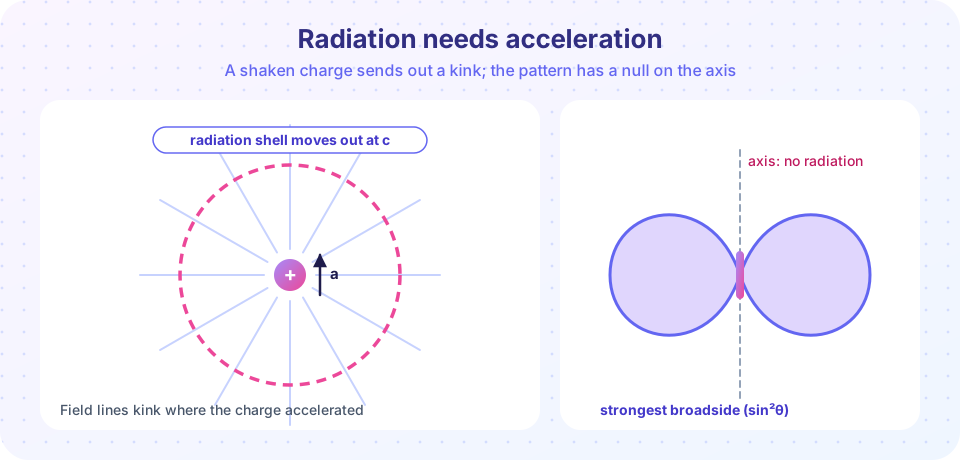
A charge sitting still has an electric field. A charge moving at steady speed has a field too, a flattened one that moves with it. Neither sends energy away. But shake a charge, make it accelerate, and something new happens: a disturbance leaves the charge and travels outward at the speed of light, carrying energy that never comes back. That is radiation, and it is how every radio transmitter, light bulb and star talks to the universe.
What you will learn
- Name the three signatures that separate radiation from static and steady-current fields.
- Explain, with a picture, why only acceleration produces a field that escapes to infinity.
- Locate the boundary between near field and far field for a real antenna.
- Say what each lesson of the chapter adds and how the pieces fit into one chain.
The big picture
Radiation has three signatures that distinguish it from ordinary Coulomb or Biot-Savart fields:
- It needs acceleration. The radiation field is proportional to the charge's acceleration.
- It falls like
1/r, not1/r², so the power through a sphere, which grows liker², stays constant: energy escapes to infinity. - It is transverse and delayed. The field at distance
rdepends on what the source did a timer/cago.
Chapter 6 showed that Maxwell's equations allow free waves. The question left open there is where such waves come from. Chapter 7 answers it: they come from charges that are being accelerated, and the rest of the chapter works out how much power, in which direction, and how an antenna turns a current into a beam.
The kink picture: why acceleration is special
Here is a way to see the answer without a single equation. Picture a charge that has been at rest for a long time and whose field lines point straight out like the spines of a sea urchin. At t = 0 the charge is kicked and then moves at a steady speed v. Far from the charge, the lines cannot know that anything has happened, because news travels at c. Out to a radius ct the lines are already arranged for the new motion, and beyond that radius they still point at where the charge used to be. The two sets of lines must join up, so each line carries a kink in the thin shell between r = ct and the region still ignorant of the kick.
That kink is the radiation pulse. The line is bent sideways, so the kink has an electric field perpendicular to the direction of travel. A longer kick (a bigger acceleration) bends the line more, and the sideways field grows in proportion to the acceleration. The shell has thickness c·Δt and radius ct: the sideways field gets diluted only by the circumference, as 1/r, while the radial Coulomb field is diluted by the whole area, as 1/r². Both signatures come out of one picture. This argument is due to J. J. Thomson, who used it around 1900.
A short history
James Clerk Maxwell predicted electromagnetic waves in 1865 and identified light as one. Nobody had made one on purpose. In 1887 the German physicist Heinrich Hertz built a spark-gap oscillator, two metal rods with a gap and a pair of end spheres, and detected the waves with a loop of wire that sparked across a tiny gap several meters away. He measured their wavelength (tens of centimeters), showed they reflect, refract and are polarized, and so confirmed Maxwell. In 1901 Guglielmo Marconi reported signals across the Atlantic, and the engineering of antennas began. The unit of frequency carries Hertz's name; the radiation formula you will meet in lesson 3 carries Joseph Larmor's (1897).
Near field and far field: where 1/r takes over
The full field of an oscillating dipole has three pieces, which fall off as 1/r, 1/r² and 1/r³. Writing k = 2π/λ, their sizes relative to the radiation term scale as 1, 1/(kr) and 1/(kr)². They are equal at kr = 1, that is
r = λ / 2π ≈ 0.16 λ
Inside that radius (the near field) the 1/r² and 1/r³ terms dominate: energy sloshes back and forth between the source and its surroundings, and a nearby metal object can steal power from the antenna. Well outside it (r ≫ λ, the far field) only the 1/r radiation term matters, and the wave looks locally like a plane wave with E = cB.
Worked example: how far is "far"?
| Source | Frequency | λ | Crossover λ/2π |
|---|---|---|---|
| AM radio | 1 MHz | 300 m | 48 m |
| FM radio | 100 MHz | 3.0 m | 0.48 m |
| Wi-Fi | 2.4 GHz | 12.5 cm | 2.0 cm |
| Mobile phone | 1.8 GHz | 16.7 cm | 2.7 cm |
So a phone held to your head is partly inside its own near field, where the simple 1/r picture fails and safety standards use field measurements instead of far-field formulas. A Wi-Fi router across the room, 3 m away, is firmly in the far field: 3 m is 24 wavelengths.
"Radiation means harmful ionizing rays." In physics, radiation just means energy carried away by a field. A radio wave's photons carry well under a millionth of an electron volt, far too little to break chemical bonds, unlike X-rays or gamma rays.
"Anything that moves makes waves." Steady motion makes a steady magnetic field and a Coulomb field that is merely carried along. Only a changing velocity (speed or direction) radiates.
"Static 1/r² fields would eventually become radiation if you wait." The radiation field is a separate piece with its own source (acceleration). It does not grow out of the static one.
Key terms. Retarded time t_r = t − r/c. Near field: the region close to a source where 1/r² and 1/r³ terms dominate. Far (radiation) zone: r ≫ λ, where only 1/r terms survive. Dipole moment p. Directivity: how strongly an antenna favors one direction. Kink: the bent segment of a field line that carries the radiation field. Velocity field: the Coulomb-like part that depends only on velocity.
Try it
Press Run (or Ctrl + Enter) to see the result here.
Program input · what you'd type while the program runs
Type the answers before you press Run, one per line. Each time the program reads a line (with input()), it gets the next line from this box.
Press Run (or Ctrl + Enter) to see the result here.
Program input · what you'd type while the program runs
Type the answers before you press Run, one per line. Each time the program reads a line (with input()), it gets the next line from this box.
Chapter 7 roadmap
How much power?
Real antennas
What each lesson covers
- Retarded potentials: solving the wave equations for V and A with finite signal speed.
- Dipole radiation and Larmor's formula: fields, patterns and power of an accelerating charge.
- Antennas: the half-wave dipole, gain and the Friis equation.
- Chapter review.
Check your understanding
Quick check · 6 questions
of 6 answered You scored / 6 · perfect!
-
1. Which charge motion does NOT produce radiation?
Radiation requires acceleration; a charge at constant velocity just carries its Coulomb field along. -
2. Why does the radiation field fall as 1/r?
Power ∝ E²·r² is independent of r only if E ∝ 1/r. -
3. How long does a radio signal take to travel from the Moon (3.84 × 10⁸ m) to Earth?
t = 3.84 × 10⁸ / 3.0 × 10⁸ ≈ 1.28 s. -
4. In the kink picture, why does the sideways radiation field fall only as 1/r?
The kink's transverse field is diluted like a circle's circumference (1/r), while the radial Coulomb field is diluted over the area (1/r²). -
5. For a 100 MHz FM transmitter, roughly where does the far field begin?
λ = 3 m, so the crossover λ/2π is about 0.48 m; several wavelengths out the radiation term dominates. -
6. Who first generated and detected radio waves in the laboratory in 1887?
Hertz used a spark-gap oscillator and a loop detector, confirming Maxwell's prediction.
Summary
- Radiation comes from accelerating charges and carries energy to infinity.
- Radiation fields fall as
1/rand depend on the source at the retarded time. - The chapter covers retarded potentials, dipole and Larmor radiation and antennas.
Next: Retarded potentials
Track your progress
Create a free account to tick off lessons and pick up where you left off on any device.
of Electrodynamics lessons completed