


















Lesson 21 of 49 · Magnetostatics
The vector potential and magnetic materials
Define the magnetic vector potential A with B = ∇×A, then learn magnetization, bound currents, the H field, susceptibility and hysteresis, with worked examples and plots.
Two last ideas complete magnetostatics. First, since ∇·B = 0, the magnetic field can be written as the curl of another field, the vector potential A. It plays the role of the electric potential V and becomes essential when fields change in time and when quantum mechanics enters. Second, magnetic materials respond to a field much as dielectrics do: their atoms act as tiny magnets and create bound currents. A new field, H, plays the role that D played in matter in Chapter 3.
What you will learn
- The vector potential A, gauge freedom, and the Poisson-type equation
∇²A = −μ₀J. - Magnetization M, bound currents
J_b = ∇×MandK_b = M × n̂. - The auxiliary field
H = B/μ₀ − Mand Ampère's law for free current. - Diamagnets, paramagnets and ferromagnets, susceptibility, permeability and hysteresis.
Key terms
- Vector potential A: a field with
B = ∇ × A(unit T·m). - Gauge: the freedom to add a gradient to A without changing B.
- Magnetization M: magnetic dipole moment per unit volume (A/m).
- H field:
H = B/μ₀ − M, sourced by free current only (A/m). - Susceptibility χ_m: for linear media
M = χ_m H.
The vector potential
Because ∇·(∇×A) = 0 is an identity, the condition ∇·B = 0 guarantees that B can be written as
B = ∇ × A
A is not unique. Adding the gradient of any function, A → A + ∇λ, leaves B unchanged since ∇×∇λ = 0. This is a gauge freedom. A convenient choice is the Coulomb gauge ∇·A = 0. Then Ampère's law ∇×B = μ₀J becomes, using the identity ∇×(∇×A) = ∇(∇·A) − ∇²A,
∇² A = −μ₀ J
This is Poisson's equation for each Cartesian component, exactly like ∇²V = −ρ/ε₀, so the solution is the analog of the Coulomb potential:
A(r) = (μ₀ / 4π) ∫ J(r') / |r − r'| dV'
Examples:
- Uniform field
B = B₀ ẑ: one valid choice isA = (B₀/2)(−y, x, 0). Then∇×A = (0, 0, B₀)and∇·A = 0. Another valid choice,A = (0, B₀ x, 0), gives the same B: that is gauge freedom. - Infinite solenoid of radius R: inside,
A_φ = B s/2; outside,A_φ = Φ / (2π s)whereΦ = B π R²is the flux. Outside, B = 0 yet A ≠ 0. In quantum mechanics, electrons passing outside a solenoid are affected by A even though B is zero there: the Aharonov–Bohm effect, which shows that A is more than a mathematical convenience. - Small loop with dipole moment m:
A = (μ₀/4π) m × r̂ / r², the field of a magnetic dipole.
Magnetization and bound currents
Atoms carry magnetic moments from electron orbits and spins. Define the magnetization M as the dipole moment per unit volume (A/m). It creates bound currents, which are real currents, just as polarization creates bound charge:
K_b = M × n̂ (surface) and J_b = ∇ × M (volume)
The idea: tiny current loops inside a uniformly magnetized material cancel neighbor against neighbor, except at the surface where a net current flows around the edge, like the current in a solenoid. In fact, a uniformly magnetized cylinder is equivalent to a solenoid with K = M and B_inside = μ₀ M (for a long cylinder).
The H field
The total current is free (what we control) plus bound. Ampère's law reads ∇×B = μ₀(J_f + ∇×M). Move the magnetization term over:
∇ × (B/μ₀ − M) = J_f
Define
H = B/μ₀ − M (or B = μ₀ (H + M))
so that
∇ × H = J_f and ∮ H · dl = I_f,enc
Now H can be found from free currents and symmetry, exactly as D was for free charge. A warning for the analogy: B, not H, is always divergence-free. In general ∇·H = −∇·M ≠ 0.
Linear materials
For many materials, M is proportional to H:
M = χ_m H, so B = μ₀ (1 + χ_m) H = μ H with μ = μ₀ (1 + χ_m)
The sign of χ_m sorts materials:
- Diamagnets:
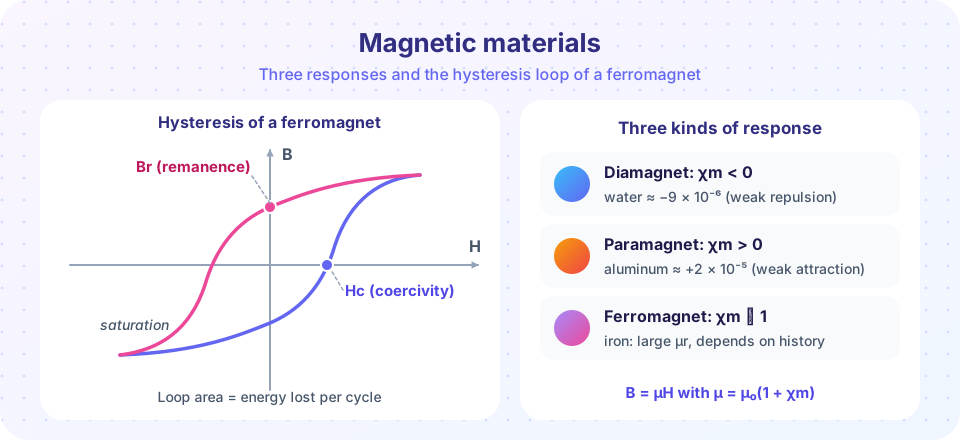
χ_m < 0and tiny (water about −9 × 10⁻⁶, copper about −1 × 10⁻⁵, bismuth about −1.7 × 10⁻⁴). The material develops a weak magnetization opposing the field, which is Lenz's law at the atomic scale. They are weakly repelled. A superconductor is a perfect diamagnet (χ_m = −1). - Paramagnets:
χ_m > 0and small (aluminum about +2 × 10⁻⁵, oxygen gas, many salts). Atomic moments partially align with the field and are weakly attracted. The alignment falls with temperature (Curie's law,χ_m ∝ 1/T). - Ferromagnets: iron, nickel, cobalt, and many alloys. Neighboring atomic moments are locked parallel in domains, giving very large effective permeability (relative permeability from hundreds to tens of thousands) and nonlinear, history-dependent behavior. Above the Curie temperature (1043 K for iron) the order disappears and the material becomes paramagnetic.
A solenoid with a core
Fill a toroid with a material of relative permeability μ_r. Ampère's law for H: H · 2π s = N I, so H = N I / (2π s) regardless of the core, but B = μ_r μ₀ H. A soft-iron core with μ_r = 1000 multiplies the field by 1000 for the same current, which is why coils for electromagnets and transformers have iron cores.
Boundary conditions
B⊥ is continuous across any interface (∇·B = 0), and H∥ is continuous when there is no free surface current (∇×H = J_f). They are the mirror image of the dielectric conditions for D⊥ and E∥.
Hysteresis
In a ferromagnet, the curve of B against H forms a loop. Increase H and B rises, saturating when all domains are aligned. Reduce H to zero and B stays at the remanence B_r (that is a permanent magnet). Apply a reverse field of magnitude H_c, the coercivity, to bring B back to zero. Repeating the cycle traces a closed loop. The loop's area, ∮ H dB, is the energy per unit volume converted into heat in each cycle: a major loss in transformer cores, so they use "soft" materials (narrow loops, low H_c, such as silicon steel), while permanent magnets use "hard" materials (wide loops, large B_r and H_c, such as neodymium-iron-boron).
Common misconceptions
- "H is just B divided by μ₀." Only in vacuum. In matter,
H = B/μ₀ − M. - "A is physically meaningless because of gauge freedom." Only gauge-dependent parts are unobservable; the flux
∮A·dlaround a loop is measurable and A matters in quantum mechanics. - "All metals are magnetic." Only a few elements are ferromagnetic; copper and aluminum are only very weakly magnetic.
- "A magnet has a north pole and a south pole that are separate magnetic charges." They are the ends of circulating currents; field lines of B close inside the magnet.
Try it
The first example checks symbolically that two different vector potentials give the same B and that A has zero divergence. The second draws a toy hysteresis model and computes the energy lost per cycle. The model is a stand-in with made-up parameters in the typical range of soft iron, not data for a real material.
Press Run (or Ctrl + Enter) to see the result here.
Program input · what you'd type while the program runs
Type the answers before you press Run, one per line. Each time the program reads a line (with input()), it gets the next line from this box.
Press Run (or Ctrl + Enter) to see the result here.
Program input · what you'd type while the program runs
Type the answers before you press Run, one per line. Each time the program reads a line (with input()), it gets the next line from this box.
Check your understanding
Quick check · 6 questions
of 6 answered You scored / 6 · perfect!
-
1. Two vector potentials A and A' = A + ∇λ describe
∇×(∇λ) = 0, so B = ∇×A is unchanged. That is gauge freedom. -
2. The H field is sourced by
∇×H = J_f. -
3. A material has χ_m = −9 × 10⁻⁶. It is
A small negative susceptibility marks a diamagnet, like water. -
4. A toroid with N = 500 turns, mean radius 5 cm and I = 0.2 A has an iron core with μ_r = 1000. What is H inside (at s = 5 cm)?
H = NI/(2πs) = 500 × 0.2 / (2π × 0.05) = 318 A/m, independent of the core; then B = μ_r μ₀ H = 0.4 T. -
5. The area of the B–H hysteresis loop represents
∮H dB is the energy per volume dissipated as heat in each cycle. -
6. Which condition always holds at an interface between two magnetic media?
∇·B = 0 forces the normal component of B to be continuous.
Summary
∇·B = 0lets us writeB = ∇×A;Ais defined up to a gradient (gauge), and in Coulomb gauge∇²A = −μ₀J.- Magnetization M creates bound currents
K_b = M × n̂,J_b = ∇×M. H = B/μ₀ − Mobeys∇×H = J_f; in linear mediaB = μH,μ = μ₀(1 + χ_m).- Diamagnets (χ_m < 0, tiny), paramagnets (χ_m > 0, small) and ferromagnets (large, hysteretic).
- Hysteresis loop area equals the energy lost per cycle per volume.
Next: Chapter 4 review
Track your progress
Create a free account to tick off lessons and pick up where you left off on any device.
of Electrodynamics lessons completed