


















Lesson 14 of 49 · Electric Fields in Matter
The displacement field and linear dielectrics
Introduce the displacement field D, Gauss's law in matter, susceptibility and permittivity, boundary conditions and field-line refraction, with worked numbers and code.
When you charge a capacitor with a dielectric, you control one thing: the free charge you put on the plates. You do not control the bound charge, which depends on the field, which in turn depends on the bound charge. That circularity makes direct calculations in matter awkward. The displacement field D breaks it: a single combination of E and P whose sources are the free charges alone.
What you will learn
- The definition of D and Gauss's law for free charge in matter.
- Linear dielectrics: susceptibility
χₑ, permittivityεand relative permittivityκ. - Boundary conditions for E and D at an interface and the refraction of field lines.
- Worked examples: a capacitor with a dielectric and a point charge in a dielectric.
Key terms
- Displacement field D:
D = ε₀E + P, with units of C/m². - Free charge: charge not part of the material's polarization (charge on conductors, injected charge).
- Susceptibility χₑ: the constant in
P = ε₀ χₑ Efor a linear dielectric. - Permittivity ε:
ε = ε₀ (1 + χₑ) = κ ε₀. - Relative permittivity (dielectric constant) κ:
κ = ε/ε₀ = 1 + χₑ.
Gauss's law in matter
Split the total charge into free and bound: ρ = ρ_f + ρ_b, with ρ_b = −∇·P. Gauss's law ε₀ ∇·E = ρ then reads
∇·(ε₀ E + P) = ρ_f
Define the displacement field
D = ε₀ E + P
and you get Gauss's law for D, in differential and integral forms:
∇·D = ρ_f and ∮ D · dA = Q_f,enc
Now the bound charge has vanished from the right-hand side. If you know the free charges and enough symmetry, you can find D exactly as you found E in vacuum, then convert to E using the material's response.
A caution: D is not simply E rescaled in general. The curl of D is ∇×D = ∇×P, which need not vanish. So the symmetry argument works only when a symmetric configuration also makes ∇×P = 0, for example for a slab with fields normal to its surface or for spheres and cylinders filled uniformly.
Linear dielectrics
For moderate fields, most insulators respond proportionally:
P = ε₀ χₑ E
with χₑ the electric susceptibility. Then
D = ε₀ (1 + χₑ) E = ε E
where ε = κ ε₀ and κ = 1 + χₑ is the relative permittivity, always at least 1 for a stable material. Some typical static values at room temperature: vacuum 1, air 1.0006, polyethylene about 2.3, silicon dioxide 3.9, glass 5 to 10 (depends on the type), water about 80, barium titanate ceramics of thousands.
A few consequences, all with free charge held fixed:
- All fields from free charges in a uniform dielectric that fills the space are divided by κ:
E = E_vacuum / κ. Coulomb's law becomesF = q₁ q₂ / (4π ε r²). - Bound charge adjacent to a free charge screens it. For a free point charge q in an infinite dielectric, the bound charge at the surface of the charge is
q_b = −q (1 − 1/κ), leaving a netq/κ. - A dielectric has a maximum field it can withstand, the dielectric strength: air about 3 × 10⁶ V/m, many plastics 10 to 50 × 10⁶ V/m. Above this the material breaks down and conducts.
Worked example: slab between capacitor plates
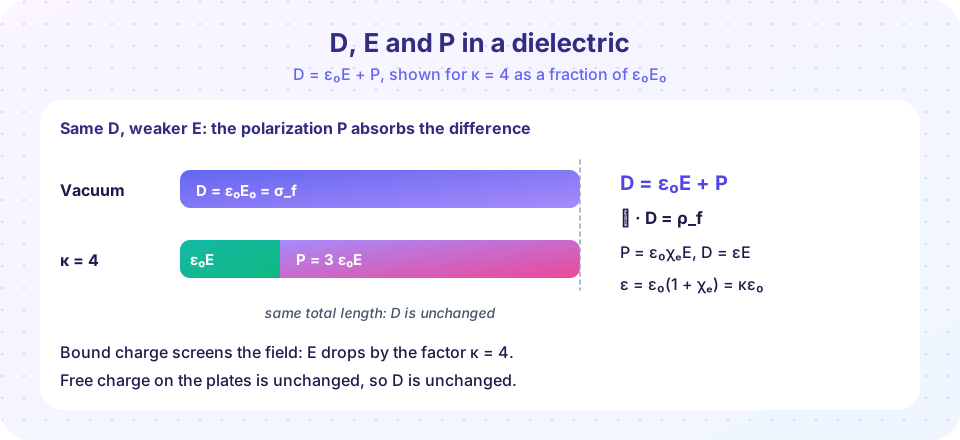
Free charge density on the plates: σ_f = 1.0 μC/m². With vacuum between plates, E₀ = σ_f / ε₀ = 1.13 × 10⁵ V/m. Now fill the gap with κ = 4. A Gaussian pillbox on one plate gives D = σ_f (independent of the material), so
E = D / ε = σ_f / (κ ε₀) = 2.8 × 10⁴ V/m,P = D − ε₀ E = σ_f (1 − 1/κ) = 0.75 μC/m²,- bound surface charge on the dielectric faces:
σ_b = ∓ P = ∓0.75 μC/m².
The field is a quarter of the vacuum value, and the bound charge on the faces cancels three quarters of the plate charge, which is exactly what the figure shows.
Boundary conditions
At an interface between two media:
- Normal D:
D₂⊥ − D₁⊥ = σ_f(surface free charge). With no free charge,D⊥is continuous. - Tangential E:
E₂∥ = E₁∥always (because∇×E = 0in electrostatics).
In linear media, D⊥ = ε E⊥, so E⊥ jumps by the ratio of permittivities: ε₁ E₁⊥ = ε₂ E₂⊥. That also determines how field lines bend at the interface. If θ₁ and θ₂ are the angles from the normal, and no free charge is present,
tan θ₁ / tan θ₂ = κ₁ / κ₂
Lines bend toward the normal in the medium with the smaller κ, away from the normal in the medium with the larger κ.
Common misconceptions
- "D is the real field and E is just a part of it." Both are useful: E gives the force on a charge (
F = qEwith the total field), D is a bookkeeping field linked to free charge. - "The dielectric removes charge from the plates." The free charge stays; the voltage drops because the field is reduced by bound charge.
- "κ can be less than 1." In ordinary static materials it cannot (κ = 1 + χₑ with χₑ ≥ 0); some metamaterials and frequency-dependent cases are different matters.
- "D = ε E always." This holds only for linear, isotropic, uniform media. Crystals have tensor permittivity and ferroelectrics are nonlinear.
Try it
The first example repeats the slab calculation for any κ. The second plots the refraction of field lines at a boundary. The third is an interactive demonstration of how E, P and D share the work when κ changes.
Press Run (or Ctrl + Enter) to see the result here.
Program input · what you'd type while the program runs
Type the answers before you press Run, one per line. Each time the program reads a line (with input()), it gets the next line from this box.
Press Run (or Ctrl + Enter) to see the result here.
Program input · what you'd type while the program runs
Type the answers before you press Run, one per line. Each time the program reads a line (with input()), it gets the next line from this box.
Check your understanding
Quick check · 5 questions
of 5 answered You scored / 5 · perfect!
-
1. Gauss's law for D states that ∮ D · dA equals
∇·D = ρ_f. Bound charge is absorbed into the definition D = ε₀E + P. -
2. A capacitor with free charge density σ_f has a κ = 5 dielectric. What is E compared with vacuum?
D = σ_f is fixed and E = D/(κε₀). -
3. Which component of the field is continuous across a boundary with no free charge?
Normal D is continuous when σ_f = 0, and tangential E is always continuous. -
4. For a linear dielectric, the permittivity is ε =
ε = κε₀ = ε₀(1 + χₑ). -
5. A point free charge q sits in a large block of dielectric with κ = 4. The net charge (free + bound) as seen from outside a small sphere around it is
Bound charge −q(1 − 1/κ) leaves q/κ, so E = kq/(κ r²).
Summary
D = ε₀E + Pand∇·D = ρ_f: D is sourced by free charge only.- In linear dielectrics
P = ε₀χₑE,D = εE,ε = κε₀,κ = 1 + χₑ. - At an interface:
D⊥jumps byσ_fandE∥is continuous; lines refract withtanθ₁/tanθ₂ = κ₁/κ₂. - A dielectric reduces the field from fixed free charge by the factor κ, with bound charge doing the screening.
Track your progress
Create a free account to tick off lessons and pick up where you left off on any device.
of Electrodynamics lessons completed