


















Lesson 36 of 49 · Radiation and Antennas
Dipole radiation and Larmor's formula
Fields, pattern and power of an oscillating electric dipole, the Larmor formula for an accelerating charge, and the classical-atom collapse puzzle.
The simplest radiator is an oscillating electric dipole: positive and negative charge sloshing back and forth. Every radiating system that is small compared with the wavelength, from a short antenna to a vibrating molecule, behaves like one. Its power, pattern and fields lead directly to the Larmor formula, the rule that any accelerating charge radiates power proportional to the square of its acceleration.
What you will learn
- Write the far fields of an oscillating dipole and their angular dependence.
- Compute the average radiated power of a dipole.
- State and use Larmor's formula.
- Estimate the classical collapse time of a hydrogen atom and see why it signals the need for quantum mechanics.
Key terms
Electric dipole moment p(t) = p₀ cos ωt. Far zone: r ≫ λ ≫ d (d = source size). Radiation pattern: |S| versus angle. Larmor formula P = q²a²/(6πε₀c³). Polar angle θ: measured from the dipole axis.
Fields of an oscillating dipole
Where the fields come from
The derivation is short enough to follow in five steps. Let the dipole sit at the origin, with p(t) = p₀ cos ωt along z and size d ≪ λ.
- Scalar potential. The retarded
Vof a+qand−qpair separated bydis a difference of two retarded Coulomb terms. Forr ≫ dit is the static dipole potential withpevaluated att − r/c, plus a correction from the changingp:V ≈ (cos θ / 4πε₀ r) [p/r + ṗ/c](all att_r). - Vector potential. The current in the dipole is
I = dq/dt, so the retarded integral givesA = (μ₀ ṗ(t_r) / 4π r) ẑ. This is a spherical wave with amplitude∝ ω. - Magnetic field.
B = ∇×A. BecauseAdepends ont − r/c, differentiating brings down−(1/c) ∂/∂t, so the leading term isB ∝ −(μ₀ p̈ / 4π c r) sinθ φ̂, andp̈ = −ω² p. This term falls like1/r; the terms from differentiating the1/rfactor are smaller by1/(kr). - Electric field. In the far zone the wave is locally a plane wave moving along
r̂, soE = cBin magnitude, perpendicular to bothBandr̂(alongθ̂). - Power.
S = (1/μ₀) E × Bpoints alongr̂. Averagingcos²over a period gives a factor ½. The angular integral∫ sin²θ dΩ = 8π/3produces the12πin the total.
Notice what the algebra says: the second time derivative p̈ appears. That is the acceleration of the charges, so radiation is proportional to acceleration, exactly as the kink picture promised.
For p(t) = p₀ cos ωt along z, the retarded potentials (valid for d ≪ λ ≪ r) give, in the far zone,
E = −(μ₀ p₀ ω² / 4π) (sin θ / r) cos[ω(t − r/c)] θ̂
B = E / c   along φ̂
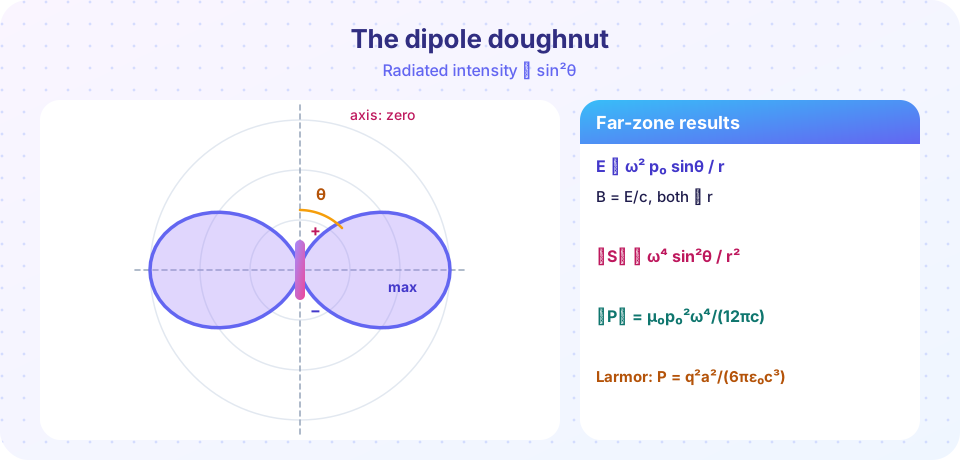
Read what it says. The field falls as 1/r, oscillates with the retarded phase t − r/c, is perpendicular to the direction of travel, and scales with ω²: doubling the frequency quadruples the field. The Poynting vector points radially outward with time-average
⟨S⟩ = (μ₀ p₀² ω⁴ / 32π² c) (sin²θ / r²) r̂
Integrating over a sphere (∫ sin³θ dθ dφ = 8π/3) gives
⟨P⟩ = μ₀ p₀² ω⁴ / (12π c)
The power grows as ω⁴. Blue light scatters from air molecules (small dipoles driven by sunlight) far more than red: (700/450)⁴ ≈ 5.9 times as strongly, which is why the sky is blue. Lord Rayleigh worked this out in 1871 and 1899. (Violet scatters even more, but the Sun emits less of it, the upper atmosphere absorbs some, and our eyes respond weakly to it, so the sky looks blue rather than violet.)
Worked example: a short wire antenna
Engineers prefer current to dipole moment. A short wire of length ℓ carrying uniform current I₀ cos ωt has ṗ = I₀ℓ cos ωt, so p₀ = I₀ℓ/ω. Take ℓ = 1 m, I₀ = 1 A, f = 1 MHz (λ = 300 m, so ℓ ≪ λ holds).
p₀ = I₀ℓ/ω = 1 / (2π × 10⁶) = 1.59 × 10⁻⁷ C·m
⟨P⟩ = μ₀ p₀² ω⁴ / (12πc) = μ₀ I₀² ℓ² ω² / (12πc) ≈ 4.4 mW
Comparing with ⟨P⟩ = ½ I₀² R_rad gives the radiation resistance R_rad = 80π² (ℓ/λ)² ≈ 8.8 mΩ. That is tiny: you must push a full ampere through the wire to radiate four milliwatts, and the wire's ordinary resistance (milliohms to ohms) wastes far more. This is why short antennas are inefficient, and why AM broadcast towers are tall, a good fraction of a wavelength (lesson 3). Real short antennas have current tapering to zero at the ends, which cuts R_rad to 20π²(ℓ/λ)², a quarter of this.
Larmor's formula
A charge q with acceleration a is a dipole p = q d with d̈ = a. For harmonic motion d̈ = −ω² d and the mean of a² is ω⁴d²/2, so ⟨P⟩ = μ₀ q² ⟨a²⟩/(6π c). The general (non-relativistic) result is
P = q² a² / (6π ε₀ c³) = μ₀ q² a² / (6π c)
It holds for any motion with v ≪ c. Radiated power goes as a², so a given charge radiates four times as much when its acceleration doubles.
Worked example: the classical hydrogen atom
In Bohr's picture the electron circles at r = 5.29 × 10⁻¹¹ m with speed v = 2.19 × 10⁶ m/s. Its acceleration a = v²/r ≈ 9.1 × 10²² m/s². Larmor gives
P = (1.602×10⁻¹⁹)² (9.1×10²²)² / (6π × 8.854×10⁻¹² × (2.998×10⁸)³) ≈ 4.7 × 10⁻⁸ W
The electron's kinetic energy is about 13.6 eV = 2.18 × 10⁻¹⁸ J, so radiating at this rate would remove that energy in about 5 × 10⁻¹¹ s. A classical atom would collapse in a hundredth of a nanosecond. Real atoms do not; this was one of the crises that led to quantum mechanics. (The estimate is order-of-magnitude, since the orbit shrinks as it radiates.)
The puzzle was sharp. Rutherford's 1911 nuclear atom had electrons orbiting like planets; Larmor's 1897 formula said they should spiral in. Niels Bohr's 1913 answer was to postulate stable orbits that do not radiate. Quantum mechanics later explained why: the ground state is not an orbit at all but a stationary wavefunction with no acceleration to radiate, and atoms emit only when they jump between stationary states.
Worked example: an electron in a magnetic field
A free electron with v = 0.01c (slow enough for Larmor's non-relativistic formula) circles in B = 1 T. The Lorentz force gives a = evB/m = 5.27 × 10¹⁷ m/s². Larmor's power is
P = e² a² / (6πε₀c³) ≈ 1.6 × 10⁻¹⁸ W
The kinetic energy is ½mv² = 4.1 × 10⁻¹⁸ J (about 26 eV), so the electron would lose all of it in KE/P ≈ 2.6 s. Because P ∝ v² and KE ∝ v², the ratio KE/P does not depend on speed: every slow electron in 1 T has an energy e-folding time of order a second (the exact damping time is 3πε₀m³c³/(e⁴B²), and it scales as 1/B²). Compare that with the cyclotron frequency eB/(2πm) ≈ 28 GHz: the electron makes about 7 × 10¹⁰ turns during that time. Radiation is a gentle effect here, but for electrons circulating at speeds close to c in a storage ring it dominates (synchrotron radiation, which needs the relativistic generalization of Larmor's formula).
"A charge in uniform circular motion does not radiate because its speed is constant." It is accelerating (direction changes) so it radiates (synchrotron radiation).
"Radiation is strongest along the dipole axis." It is zero there; the pattern is sin²θ.
"All energy goes into radiation at the antenna." In the near zone energy sloshes back and forth between source and field; only the radiated part leaves for good.
Try it
Press Run (or Ctrl + Enter) to see the result here.
Program input · what you'd type while the program runs
Type the answers before you press Run, one per line. Each time the program reads a line (with input()), it gets the next line from this box.
Press Run (or Ctrl + Enter) to see the result here.
Program input · what you'd type while the program runs
Type the answers before you press Run, one per line. Each time the program reads a line (with input()), it gets the next line from this box.
Press Run (or Ctrl + Enter) to see the result here.
Program input · what you'd type while the program runs
Type the answers before you press Run, one per line. Each time the program reads a line (with input()), it gets the next line from this box.
Check your understanding
Quick check · 6 questions
of 6 answered You scored / 6 · perfect!
-
1. A dipole's oscillation frequency is doubled with p₀ unchanged. The radiated power changes by
P ∝ ω⁴, and 2⁴ = 16. -
2. Along which direction does an oscillating dipole radiate zero power?
The pattern is sin²θ, which vanishes at θ = 0 and π. -
3. Larmor's formula says radiated power is proportional to
P = q²a²/(6πε₀c³). -
4. If a charge's acceleration is tripled, the Larmor power is multiplied by
P ∝ a², so tripling a gives 9 times the power. -
5. Why does the classical Larmor estimate trouble classical models of atoms?
A circulating electron accelerates and should radiate, spiraling into the nucleus in about 10⁻¹¹ s, which does not happen. -
6. A short wire (ℓ = 1 m) radiates at 1 MHz with I₀ = 1 A. Its radiation resistance 80π²(ℓ/λ)² is about
With λ = 300 m, (ℓ/λ)² = 1.1 × 10⁻⁵ and 80π² ≈ 790, giving about 8.8 × 10⁻³ Ω.
Summary
- An oscillating dipole radiates fields
∝ ω² sinθ / r, power∝ ω⁴ sin²θ / r². - Total power
⟨P⟩ = μ₀p₀²ω⁴/(12πc); Larmor:P = q²a²/(6πε₀c³). - Accelerating charges radiate; circular motion counts.
- The classical atom's predicted collapse motivated quantum theory.
Next: Antennas
Track your progress
Create a free account to tick off lessons and pick up where you left off on any device.
of Electrodynamics lessons completed