


















Lesson 16 of 49 · Electric Fields in Matter
Chapter 3 review: electric fields in matter
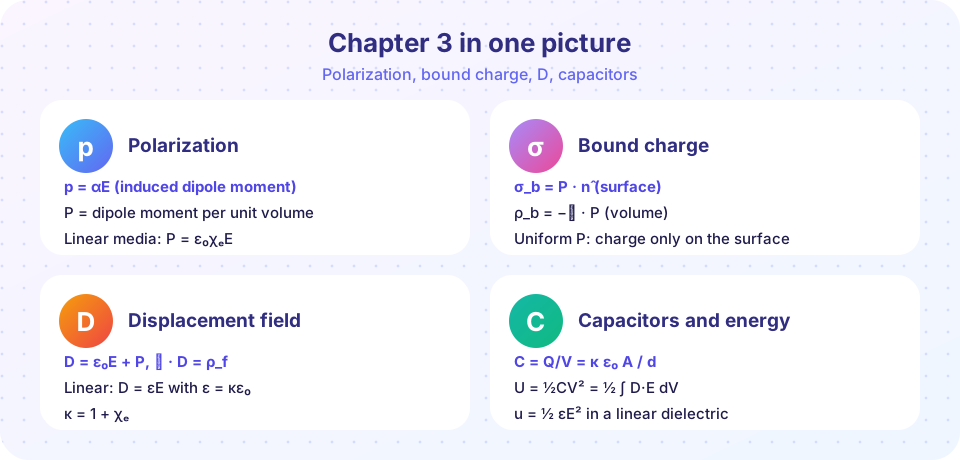
Review polarization, bound charge, the displacement field, linear dielectrics, capacitors and field energy with a one-page poster, a recap table, a plot and a 9-question quiz.
Chapter 3 showed what happens when charges are bound to matter instead of free in space. Atoms and molecules polarize, polarization creates bound charge, the displacement field D hides the bound charge, and linear dielectrics let you write D = εE. Capacitors are the practical payoff. This review lays it out on one page and tests you.
The chapter in a table
| Topic | Key result |
|---|---|
| Induced dipole | p = αE; polar molecules: ⟨p⟩ = p²E/3k_BT |
| Dipole in a field | τ = p × E, U = −p·E, F = (p·∇)E |
| Polarization | P = dipole moment per volume (C/m²) |
| Bound charge | σ_b = P·n̂, ρ_b = −∇·P |
| Displacement field | D = ε₀E + P, ∇·D = ρ_f |
| Linear dielectric | P = ε₀χₑE, D = εE, κ = 1 + χₑ |
| Boundary conditions | E∥ continuous; D⊥ jumps by σ_f |
| Capacitance | C = Q/V; plates κε₀A/d |
| Energy | U = ½CV², u = ½εE² |
A problem-solving checklist for dielectrics
- Identify the free charge (what you put on conductors).
- Use Gauss's law for D with the symmetry of the problem to get D.
- Convert:
E = D/εin each linear region. - Get the bound charge from
P = D − ε₀Eif asked. - Integrate E to get voltage and find
C = Q/V; compute energy with½CV². - Check limits: κ = 1 must reproduce the vacuum answer.
Common misconceptions
- "Dielectrics always weaken the field." They weaken the field produced by fixed free charge, but the energy and the force on the slab depend on whether the charge or the voltage is held fixed.
- "D and E are interchangeable in dielectrics." They differ by P, and their boundary conditions differ.
Try it
Press Run (or Ctrl + Enter) to see the result here.
Program input · what you'd type while the program runs
Type the answers before you press Run, one per line. Each time the program reads a line (with input()), it gets the next line from this box.
Press Run (or Ctrl + Enter) to see the result here.
Program input · what you'd type while the program runs
Type the answers before you press Run, one per line. Each time the program reads a line (with input()), it gets the next line from this box.
Check your understanding
Quick check · 9 questions
of 9 answered You scored / 9 · perfect!
-
1. The bound surface charge density on a polarized face with outward normal n̂ is
σ_b = P·n̂; the volume density is ρ_b = −∇·P. -
2. In a linear dielectric with κ = 6, the free charge on the plates is held fixed. By what factor does E change compared with vacuum?
E = D/(κε₀) with D = σ_f. -
3. Which boundary condition holds even when there is free surface charge?
∇×E = 0 gives continuity of the tangential component of E. -
4. A 5 μF capacitor is charged to 20 V. How much energy does it store?
U = ½CV² = 0.5 × 5e-6 × 400 = 1e-3 J. -
5. Two capacitors of 6 μF and 3 μF are in parallel. The total is
Parallel capacitances add. -
6. A dipole in a uniform field experiences
τ = p × E, and the forces on the two ends cancel. -
7. Gauss's law for D involves
∮D·dA = Q_free. -
8. Which is the correct relation among susceptibility, permittivity and κ?
κ = ε/ε₀ = 1 + χₑ. -
9. A slab of κ = 3 is inserted into a capacitor connected to a battery. The charge on the plates
V is fixed and C triples, so Q = CV triples.
Summary
- Fields polarize matter; bound charge
σ_b = P·n̂,ρ_b = −∇·Preduces the field inside. D = ε₀E + Phas only free charge as its source; in linear mediaD = εE.- Capacitors have
C = Q/Vand storeU = ½CV²with energy density½εE². - Boundary conditions: tangential E continuous, normal D jumps by σ_f.
Track your progress
Create a free account to tick off lessons and pick up where you left off on any device.
of Electrodynamics lessons completed