


















Lesson 29 of 49 · Electromagnetic Waves
Chapter overview: electromagnetic waves
A guided tour of electromagnetic waves: how Maxwell's equations predict them, what polarization and reflection mean, and how the spectrum fits together.
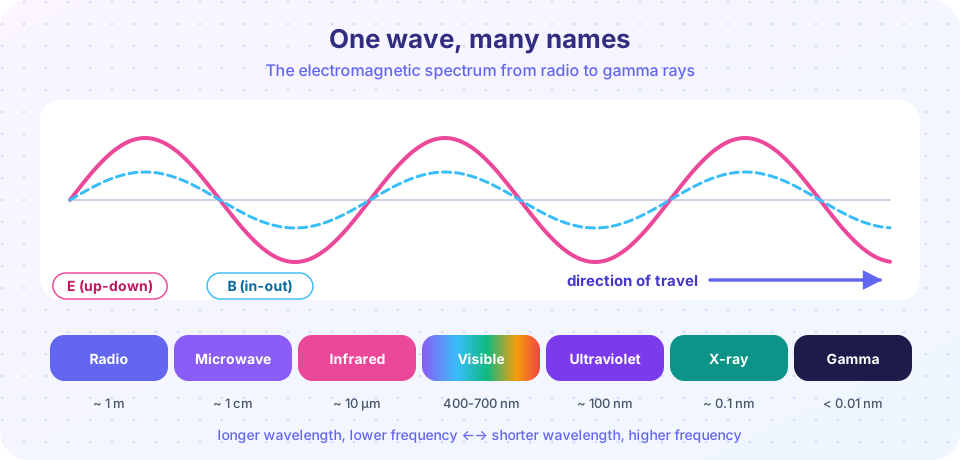
Radio, microwaves, visible light, X-rays: they differ in wavelength by a factor of a billion or more, yet they are all the same thing, a self-propagating oscillation of electric and magnetic fields. In this chapter you will derive that fact from Maxwell's equations and then explore what such waves do: how they carry energy, how their fields point (polarization), and how they behave when they meet a boundary or a metal.
The big picture
Three ideas organize the chapter.
- Waves exist. In empty space the Maxwell equations combine into
∇²E = μ₀ε₀ ∂²E/∂t², a wave equation with speedc. - Waves have structure. The fields are transverse, perpendicular to each other, in phase, with
E = cB. How the E vector points defines the polarization. - Waves meet matter. In a medium the speed drops to
v = c/n. At boundaries part of the wave is reflected; in conductors the wave decays within a skin depth.
Key terms. Wavelength λ: distance over which the wave repeats. Frequency f: oscillations per second (Hz). Wave number k = 2π/λ. Refractive index n = c/v. Polarization: the direction in which E oscillates. Skin depth: the depth at which a wave in a conductor falls to 1/e of its surface amplitude.
Press Run (or Ctrl + Enter) to see the result here.
Program input · what you'd type while the program runs
Type the answers before you press Run, one per line. Each time the program reads a line (with input()), it gets the next line from this box.
Chapter 6 roadmap
Meeting matter
Why it matters
How the idea was discovered
The story of this chapter is one of the neatest in physics. In 1856 the German physicists Wilhelm Weber and Rudolf Kohlrausch measured the ratio between the electrostatic and magnetic units of charge in the lab, using a Leyden jar and a current balance. The ratio came out close to 3 × 10⁸ m/s, and nobody knew why it had the units of a speed. In 1865 James Clerk Maxwell combined Faraday's law with his own displacement-current term and found that the fields obey a wave equation whose speed is 1/√(μ₀ε₀). The number matched the measured speed of light. Maxwell wrote that light "consists in the transverse undulations of the same medium" that causes electric and magnetic effects. Twenty-two years later, in 1887, Heinrich Hertz built a spark-gap transmitter and a loop receiver in Karlsruhe and showed that invisible waves of about 66 cm wavelength travel across a room, reflect from metal and can be polarized. That was the birth of radio.
The chapter has a clear logic: the first lesson derives the wave, the second studies the freedom in how its field points, and the third asks what a wave does when the world is not empty.
A worked example: one wave, three views
A Wi-Fi router transmits at f = 2.4 GHz. Three quantities describe the same wave:
- Wavelength in vacuum (air):
λ = c/f = 3.0 × 10⁸ / 2.4 × 10⁹ = 0.125 m, about 12.5 cm. A microwave oven uses nearly the same frequency (2.45 GHz) and therefore a wavelength near 12.2 cm. - Wave number:
k = 2π/λ = 50 rad/m. - Photon energy:
E = hf = 6.63 × 10⁻³⁴ × 2.4 × 10⁹ = 1.6 × 10⁻²⁴ J ≈ 9.9 µeV. That is about a million times too small to break a chemical bond (a few eV), which is why Wi-Fi heats nothing noticeable and cannot ionize molecules.
Now let the wave enter a block of glass with n = 1.5. The frequency is set by the source and does not change, but the speed drops to v = c/n = 2.0 × 10⁸ m/s, so the wavelength shrinks to λ/n = 8.3 cm. Keep this rule in mind through the chapter: frequency stays, speed and wavelength change at a boundary.
Press Run (or Ctrl + Enter) to see the result here.
Program input · what you'd type while the program runs
Type the answers before you press Run, one per line. Each time the program reads a line (with input()), it gets the next line from this box.
"Radio waves, light and X-rays are different kinds of waves." They are the same field oscillation. Only the frequency differs, and with it how the wave interacts with matter.
"A higher frequency means a faster wave." In vacuum every frequency travels at c. A higher frequency means a shorter wavelength, not more speed.
"Microwaves cook food because they are hot." They are a field oscillating at 2.45 GHz that makes polar molecules such as water rotate back and forth and lose energy as heat.
What each lesson covers
- Plane waves in vacuum: derive the wave equation, the relations between E, B and k, and the intensity.
- Polarization: linear, circular and elliptical states, plus Malus's law.
- Reflection, transmission and conductors: boundary conditions, Fresnel coefficients at normal incidence and skin depth.
- Chapter review: picture, table and ten questions.
Check your understanding
Quick check · 4 questions
of 4 answered You scored / 4 · perfect!
-
1. What is the wavelength of a 100 MHz FM radio wave in vacuum?
λ = c/f = 3.0 × 10⁸ / 1.0 × 10⁸ = 3 m. -
2. How are E, B and the propagation direction oriented in a plane wave in vacuum?
Electromagnetic waves in vacuum are transverse, and E×B points along the direction of travel. -
3. The refractive index of a medium in which light travels at 2.0 × 10⁸ m/s is about
n = c/v = 3.0 × 10⁸ / 2.0 × 10⁸ = 1.5. -
4. A 2.4 GHz wave enters glass of index 1.5. What happens to its frequency and wavelength?
The source sets the frequency. The speed drops to c/n, so λ = v/f shrinks by the factor n.
Summary
- Maxwell's equations predict transverse waves traveling at
c = 1/√(μ₀ε₀). - The spectrum spans radio to gamma rays: same physics, different
f. - Polarization, reflection and absorption are the new behaviors of this chapter.
Next: Plane waves in vacuum
Track your progress
Create a free account to tick off lessons and pick up where you left off on any device.
of Electrodynamics lessons completed