


















Lesson 13 of 49 · Electric Fields in Matter
Polarization and bound charge
Learn how electric fields polarize atoms and molecules, define the polarization vector P, and derive surface and volume bound charge with worked examples and code.
Inside a block of glass there are about 10²⁹ electrons and nuclei per cubic meter, all bound in place. Apply an electric field and every atom deforms a little. Each one becomes a small dipole, and together the dipoles form a collective response called polarization. This lesson builds the picture from one atom to one block, then shows how a tidy vector field P replaces the unmanageable list of individual dipoles.
What you will learn
- How an electric field creates dipoles in atoms (induced) and aligns molecules (permanent).
- The torque and energy of a dipole in a field.
- The definition of the polarization P and the formulas
σ_b = P·n̂andρ_b = −∇·P. - How to calculate the field of a uniformly polarized sphere.
Key terms
- Dipole moment p: for charges ±q separated by d,
p = q d, pointing from − to +. - Polarizability α: the proportionality constant in
p = α Efor an atom. - Polar molecule: a molecule with a permanent dipole moment, such as water.
- Polarization P: net dipole moment per unit volume (C/m²).
- Bound charge: the charge that appears at surfaces or where P is non-uniform.
Two kinds of response
Induced dipoles. A neutral atom has its electron cloud centered on the nucleus. An external field E pushes the nucleus one way and the cloud the other until the internal restoring force balances the push. For ordinary fields the displacement is tiny (less than a hundred-thousandth of an atomic radius at 10⁶ V/m) and proportional to E, so
p = α E
where α is the polarizability. As a rough model, treat the atom as a sphere of radius R with a uniform negative cloud around a point nucleus: balancing forces gives α = 4π ε₀ R³, which is the right order of magnitude (for hydrogen the exact quantum value is 4π ε₀ × 4.5 a₀³).
Permanent dipoles. Some molecules have a built-in dipole: in water the electrons are shifted toward oxygen, giving p = 6.2 × 10⁻³⁰ C·m (1.85 debye). Without a field, thermal motion points these dipoles randomly and the net moment is zero. A field creates a small preference for alignment. At temperature T the average alignment in a weak field is ⟨p⟩ = p² E / (3 k_B T), so the response drops as the temperature rises. Even so, it is why water has a relative permittivity near 80.
A dipole in an electric field
For a dipole p in a uniform field E:
- Net force: zero (the two charges feel opposite forces).
- Torque:
τ = p × E, which twists p toward E. - Potential energy:
U = −p · E, lowest when aligned.
In a non-uniform field there is also a net force F = (p · ∇) E, which pulls a dipole toward stronger field. That is how a charged comb picks up neutral bits of paper: induced dipoles are attracted to the stronger field near the comb.
The polarization vector
Define the polarization as the dipole moment per unit volume:
P = N p
where N is the number density of molecules (with N p meaning an average if p varies). It is measured in C/m². A material with P = 0 is unpolarized. Because P is smooth on a scale much larger than atoms, we can calculate the field of the whole material from P without caring about individual molecules.
Bound charge
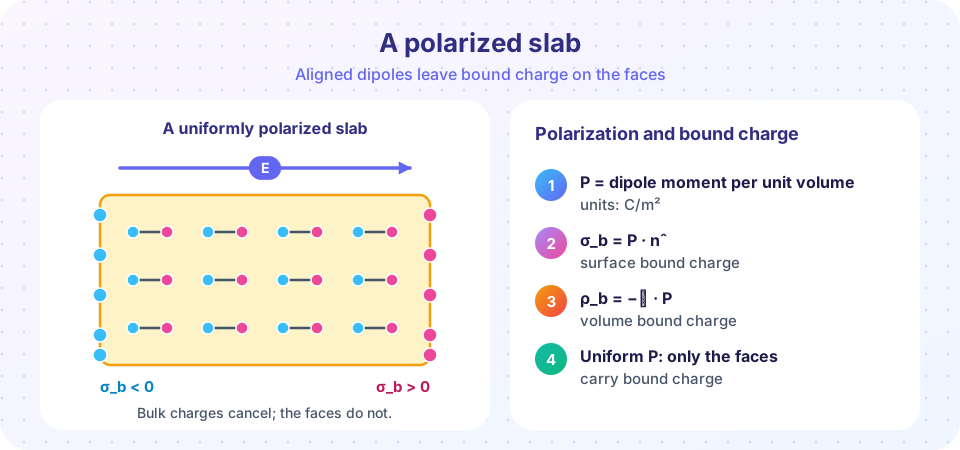
Suppose P points in +x and is uniform. Cut the material into slices: within the bulk, each positive end is cancelled by the negative end of the next dipole. But at the left face the negative ends have no partner to cancel and at the right face the positive ends stick out. So there is bound surface charge
σ_b = P · n̂
where n̂ is the outward normal. On the face with outward normal along P, σ_b is positive; on the opposite face it is negative, as in the figure.
When P is not uniform, the dipole density changes from place to place, and cancellation inside is incomplete. The leftover is a bound volume charge
ρ_b = −∇ · P
The total bound charge is always zero: ∮ P·dA = ∫ ∇·P dV, so the surface charge is exactly compensated by the volume charge. A neutral atom made of bound charges cannot create net charge from nothing.
The potential of a polarized object can be calculated from σ_b and ρ_b exactly as for any other charge. This is useful because they are ordinary charges that obey Gauss's law and Coulomb's law.
Worked example: a uniformly polarized sphere
A sphere of radius R has uniform polarization P along z. There is no volume charge (∇·P = 0), only a surface charge σ_b = P cosθ, where θ is the angle from the z axis. To find the field at the center, add contributions from each patch: a patch at angle θ creates a field component along −z of k σ_b cosθ dA / R². Integrating over the sphere:
E_z = −k P ∫ cos²θ dΩ = −k P (4π/3) = −P / (3ε₀)
So the field inside is uniform and antiparallel to P: E = −P / (3ε₀). This is the depolarizing field. Outside, the field is that of a pure dipole with moment p = (4π/3) R³ P. Notice that the polarization produces a field opposing itself, a simple preview of why the total field in a dielectric is smaller than the applied field.
Common misconceptions
- "A dipole feels a net force in a uniform field." No: the forces on the two charges cancel; there is only a torque. A force requires a gradient.
- "Polarization only occurs in polar molecules." Every atom has an induced response; polar molecules add an orientational one.
- "Bound charge exists only on surfaces." It also appears inside, wherever P is non-uniform:
ρ_b = −∇·P. - "P points from positive to negative." Like p, P points from the negative to the positive bound charge, and so, in equilibrium, along E.
Try it
The first demonstration shows how dipoles align as a field grows: each dipole has a random initial direction, and a stronger field turns it toward E. It is a toy model for the idea, not a simulation of a real material. The second plots the thermal alignment curve, and the third verifies the depolarizing field numerically.
Press Run (or Ctrl + Enter) to see the result here.
Program input · what you'd type while the program runs
Type the answers before you press Run, one per line. Each time the program reads a line (with input()), it gets the next line from this box.
Press Run (or Ctrl + Enter) to see the result here.
Program input · what you'd type while the program runs
Type the answers before you press Run, one per line. Each time the program reads a line (with input()), it gets the next line from this box.
Check your understanding
Quick check · 5 questions
of 5 answered You scored / 5 · perfect!
-
1. What is the torque on a dipole p in a uniform field E?
τ = p × E twists the dipole toward the field; the net force is zero in a uniform field. -
2. A slab is uniformly polarized with P = 2 × 10⁻⁶ C/m² perpendicular to its faces. What is the bound surface charge density on the face where P points outward?
σ_b = P · n̂ = P when n̂ is along P. -
3. What is the bound volume charge density in a uniformly polarized material?
ρ_b = −∇·P = 0 for uniform P; bound charge sits on the surface only. -
4. Why is a neutral piece of paper attracted to a charged comb?
In a non-uniform field a dipole feels F = (p·∇)E toward the stronger field. -
5. The field inside a uniformly polarized sphere, relative to P, is
The surface bound charge produces a depolarizing field −P/(3ε₀).
Summary
- Fields polarize matter: atoms get induced dipoles
p = αE, and polar molecules partially align (thermal average ∝ 1/T). - A dipole feels torque
p × Eand has energy−p·E; it feels a net force only in a non-uniform field. - The polarization
Pis dipole moment per volume; it produces bound chargeσ_b = P·n̂andρ_b = −∇·P. - A uniformly polarized sphere has an internal field
−P/(3ε₀)and an exterior dipole field.
Track your progress
Create a free account to tick off lessons and pick up where you left off on any device.
of Electrodynamics lessons completed