


















Lesson 32 of 49 · Electromagnetic Waves
Reflection, transmission and conductors
Boundary conditions, reflection and transmission at normal incidence, wave impedance, and skin depth in conductors with worked numbers for glass and copper.
When a wave runs into a change of material, part of it bounces back and part continues. A window reflects a faint copy of the room behind you; a metal sheet reflects nearly everything; a coating on a camera lens tries to reflect nothing. Maxwell's boundary conditions explain all of it. Inside a conductor, a wave does not travel far: it dies within a thin skin that depends on frequency.
What you will learn
- Write the boundary conditions for E and B at an interface.
- Compute amplitude and power reflection at normal incidence.
- Use the refractive index and wave impedance.
- Compute the skin depth of a good conductor and explain shielding.
Key terms
Interface boundary conditions: tangential E and tangential H are continuous (no surface current). Wave impedance Z = E/H; in vacuum Z₀ = √(μ₀/ε₀) ≈ 376.7 Ω. Reflection coefficient r and transmission coefficient t: amplitude ratios. Reflectance R = |r|². Skin depth δ = √(2/(μσω)).
Normal incidence on a dielectric
Medium 1 (index n₁) is on the left, medium 2 (n₂) on the right, both nonmagnetic (μ = μ₀). An incident wave E_i, reflected E_r and transmitted E_t all point along x. Continuity of tangential E and H = B/μ₀ gives
E_i + E_r = E_t
n₁ (E_i − E_r) = n₂ E_t
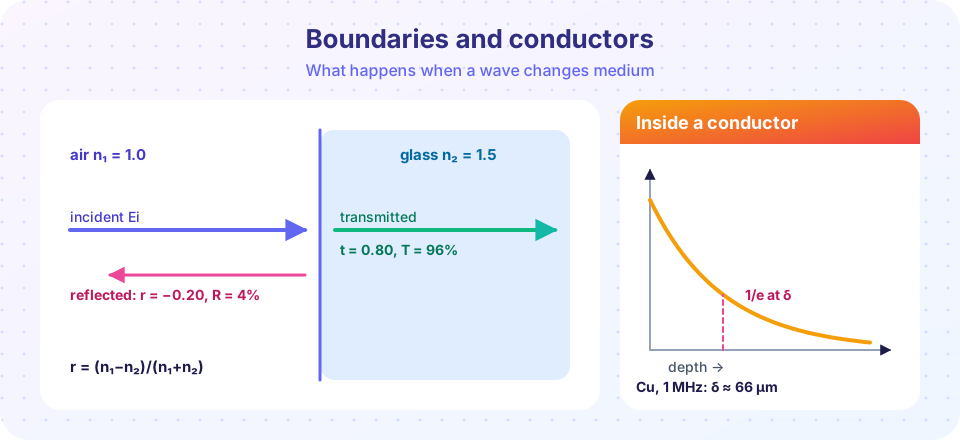
Solving: r = E_r/E_i = (n₁ − n₂)/(n₁ + n₂) and t = E_t/E_i = 2n₁/(n₁ + n₂). The power reflected is
R = ((n₁ − n₂)/(n₁ + n₂))², T = 1 − R (lossless)
Worked example: air to glass
With n₁ = 1.00 and n₂ = 1.50: r = −0.20, R = 0.04, t = 0.80. Four percent of the power is reflected per surface, and the minus sign means the reflected E field flips (a 180° phase shift when going into a higher index). A window pane has two surfaces so about 8% is lost in total (a bit less with multiple reflections accounted for). Camera lenses use thin coatings that interfere destructively with these reflections, such as a quarter-wavelength layer of index √(n₁n₂).
The amplitudes are not conserved but power is: T = (n₂/n₁) |t|² = 1.5 × 0.64 = 0.96.
At an angle
Oblique incidence uses the same boundary conditions plus Snell's law n₁ sin θ₁ = n₂ sin θ₂. The Fresnel equations show that p-polarized light has zero reflection at Brewster's angle tan θ_B = n₂/n₁ (56.3° for air to glass), which is why glare on water is mostly s-polarized and polarized sunglasses remove it. Beyond the critical angle sin θ_c = n₂/n₁ (for glass to air, 41.8°), light undergoes total internal reflection.
The same result with impedance
Define the wave impedance of a medium as Z = E/H = Z₀/n for a nonmagnetic material. Then r = (Z₂ − Z₁)/(Z₂ + Z₁). The formula is identical to the reflection of a pulse on a rope joining two strings, or an electrical signal at a joint between two transmission lines. A wave goes through without reflection only if the impedances match. Glass has Z = 376.7/1.5 = 251 Ω, so the step from air to glass is 376.7 → 251 Ω, and r = (251 − 376.7)/(251 + 376.7) = −0.20. Antenna cables, microwave guides and anechoic chambers are all exercises in impedance matching.
Worked example: an antireflection coating
A lens (n₃ = 1.52) with a coating of index n₂ and thickness d has two reflections: from air to coating and from coating to glass. Both flip the E sign if n₁ < n₂ < n₃. The wave that goes through the coating and back has an extra path 2d, so the two reflected waves cancel when 2d·n₂ = λ/2, that is d = λ/(4n₂). Complete cancellation needs equal amplitudes, n₂ = √(n₁n₃) = √1.52 = 1.23. Real coatings use magnesium fluoride (n₂ = 1.38, no durable material has 1.23). At λ = 550 nm the thickness is d = 550 / (4 × 1.38) ≈ 100 nm. The reflectance of the lens falls from 4.3% to about 1.3%. Multiple coating layers push it below 0.5% over the whole visible band. This is why a camera lens looks purple or green: the coating works best in the middle of the spectrum, and the leftover reflection is the blue and red end.
Oblique incidence in numbers
For light going from air into glass (n = 1.5) the reflected power is 4.0% at 0°, 5.0% at 45° averaged over polarizations, and then rises steeply toward 100% at grazing incidence (90°). The two polarizations behave very differently. At θ = 56.3° (Brewster's angle) the p reflectance is exactly zero while s is about 15%, so the reflected beam is completely s-polarized. David Brewster found this in 1815; it is the reason a polarizer oriented vertically removes the glare from a horizontal road or lake. The Fresnel formulas for the amplitudes are
r_s = (n₁cosθ_i − n₂cosθ_t) / (n₁cosθ_i + n₂cosθ_t)
r_p = (n₂cosθ_i − n₁cosθ_t) / (n₂cosθ_i + n₁cosθ_t)
The next TryIt tabulates them.
Waves in conductors and skin depth
In a conductor with conductivity σ, Ohm's law J = σE adds a loss. For a good conductor (σ ≫ ωε) the wave is attenuated: the amplitude falls as e^(−z/δ), with
δ = √(2 / (μ σ ω))
For copper (σ = 5.8 × 10⁷ S/m) at 1 MHz: δ = √(2 / (4π×10⁻⁷ × 5.8×10⁷ × 2π×10⁶)) ≈ 66 µm. At 50 Hz it is about 9 mm; at 10 GHz, about 0.66 µm. That is why a thin metal foil or a microwave-oven mesh shields so well at high frequency, and why a high-frequency current runs on the outside of a wire (the skin effect), making hollow conductors and silver plating effective.
Why a conductor is a mirror
The conduction electrons respond to the incident E so quickly and so freely that they set up a surface current that radiates a wave of its own. Inside the metal that wave is exactly opposite to the incident one (hence the decay), and outside it is the reflected wave. A perfect conductor (σ → ∞) has δ → 0 and r = −1: all power is reflected with a 180° flip of E, and the incident and reflected fields cancel on the surface, leaving a standing wave with nodes of E at distances λ/2 apart. Real metals at optical frequencies reflect 90 to 98% (silver and aluminum), not 100%, because at about 10¹⁵ Hz the electrons cannot follow perfectly and some energy is lost.
Worked example: communicating with submarines
Seawater has σ ≈ 4 S/m. At 1 kHz the skin depth is δ = √(2/(4π×10⁻⁷ × 4 × 2π × 10³)) ≈ 8 m; at 100 Hz about 25 m; and at 100 MHz (FM radio), δ ≈ 25 mm. Only extremely low frequencies (ELF, tens of hertz) get to a submerged submarine at useful depths, and navies built enormous antennas to use them. The price is a data rate of a few characters per minute.
"Reflected light has a 180° shift every time." Only when the wave goes toward the higher index (n₂ > n₁) at normal incidence. Going from glass to air, r is positive.
"A Faraday cage must be thick." It only needs to be a few skin depths thick at the frequency of concern; mesh holes must be much smaller than the wavelength.
"Conductors reflect because they absorb." They reflect because the induced currents re-radiate a wave that cancels the field inside, with only a tiny part absorbed in the skin depth.
Try it
Press Run (or Ctrl + Enter) to see the result here.
Program input · what you'd type while the program runs
Type the answers before you press Run, one per line. Each time the program reads a line (with input()), it gets the next line from this box.
Press Run (or Ctrl + Enter) to see the result here.
Program input · what you'd type while the program runs
Type the answers before you press Run, one per line. Each time the program reads a line (with input()), it gets the next line from this box.
Press Run (or Ctrl + Enter) to see the result here.
Program input · what you'd type while the program runs
Type the answers before you press Run, one per line. Each time the program reads a line (with input()), it gets the next line from this box.
Check your understanding
Quick check · 6 questions
of 6 answered You scored / 6 · perfect!
-
1. Light goes from air (n = 1) into water (n = 1.33) at normal incidence. What fraction of the power is reflected?
R = ((1 − 1.33)/(1 + 1.33))² = (0.1416)² ≈ 0.020. -
2. Which boundary conditions are used for the normal-incidence derivation?
With no surface charge or current, the tangential components of E and H are continuous. -
3. How does skin depth in a good conductor change as frequency increases?
δ = √(2/(μσω)), so it falls as 1/√f. -
4. At Brewster's angle, which polarization has zero reflection?
The p component vanishes at tan θ_B = n₂/n₁. -
5. A wave in copper falls to what fraction of its surface amplitude after one skin depth?
By definition the amplitude decays as e^(−z/δ). -
6. What is the ideal thickness of a quarter-wave antireflection coating of index 1.38 for λ = 550 nm?
d = λ/(4n) = 550 / (4 × 1.38) ≈ 99.6 nm.
Summary
- Tangential E and H are continuous; at normal incidence
r = (n₁−n₂)/(n₁+n₂)andR = r². - Air to glass reflects 4% per surface; going into a higher index flips the E phase.
- Brewster and critical angles follow from the same boundary conditions.
- In a good conductor
δ = √(2/(μσω)); copper at 1 MHz hasδ ≈ 66 µm.
Next: Chapter review
Track your progress
Create a free account to tick off lessons and pick up where you left off on any device.
of Electrodynamics lessons completed