


















Lesson 26 of 49 · Maxwell's Equations
Energy and the Poynting vector
Where does electromagnetic energy live and where does it go? Derive Poynting's theorem, compute sunlight fields and see energy flow into a resistor.
A battery connected to a bulb by two wires: does the energy travel inside the wire, like water in a pipe? The answer from Maxwell's theory is surprising. The energy travels in the fields surrounding the wires, and the wires only guide it. John Henry Poynting derived the rule for this flow in 1884.
What you will learn
- Write the energy density of E and B fields.
- State Poynting's theorem and the Poynting vector.
- Compute field strengths and radiation pressure from an intensity.
- Show that the Poynting flux into a resistor equals
V I.
Key terms
Energy density u: energy per unit volume, J/m³. Poynting vector S = E×B/μ₀: energy flow per unit area per unit time, W/m². Intensity: the time-average of |S|. Radiation pressure: momentum delivered per area per time, I/c for perfect absorption.
Energy stored in the fields
From electrostatics, the energy density of an electric field is ½ε₀E². For a magnetic field it is B²/(2μ₀). Together,
u = ½ ε₀ E² + B²/(2 μ₀)
Deriving the theorem step by step
Why these energy densities? Consider the work the fields do on moving charges. The Lorentz force does work only through the electric part (the magnetic force is perpendicular to the velocity), so the power per volume is J·E. Now eliminate J:
- From Ampere-Maxwell,
J = (1/μ₀) ∇×B − ε₀ ∂E/∂t, soJ·E = (1/μ₀) E·(∇×B) − ε₀ E·∂E/∂t. - From Faraday,
∇×E = −∂B/∂t, soB·(∇×E) = −B·∂B/∂t. - The product rule for divergence gives
∇·(E×B) = B·(∇×E) − E·(∇×B). - Substituting,
J·E = −(1/μ₀) ∇·(E×B) − ∂/∂t [½ ε₀ E² + B²/(2μ₀)], becauseE·∂E/∂t = ½ ∂(E²)/∂tand likewise for B.
The first bracket is u, the second term is the divergence of S. Poynting's theorem follows by moving everything to one side. Nothing about energy was assumed: the energy densities emerge from Maxwell's equations. In 1884 Poynting, and independently Oliver Heaviside, interpreted the result as energy flow.
Poynting's theorem is the energy ledger. Start with the work done on charges per volume per time, J·E. Use Ampere-Maxwell to replace J and Faraday to simplify; the vector identity ∇·(E×B) = B·(∇×E) − E·(∇×B) brings out the result
∂u/∂t + ∇·S = −J·E, S = (1/μ₀) E × B
In words: the energy density at a point rises when energy flows in (−∇·S) and falls when the fields do work on charges (−J·E). Integrated over a volume, the energy inside changes because of the Poynting flux through the surface plus the work done on matter.
Worked example 1: sunlight
The solar constant above the atmosphere is about I = 1361 W/m². For a plane wave I = ½ c ε₀ E₀², so
E₀ = √(2I/(c ε₀)) = √(2 × 1361 / (2.998×10⁸ × 8.854×10⁻¹²)) ≈ 1.01 × 10³ V/m
B₀ = E₀ / c ≈ 3.4 × 10⁻⁶ T
A perfectly absorbing surface facing the Sun feels the radiation pressure I/c ≈ 4.5 × 10⁻⁶ Pa; a perfect mirror gets twice that. Tiny, but it can steer solar sails and push dust out of comet tails.
Worked example 2: energy into a resistor
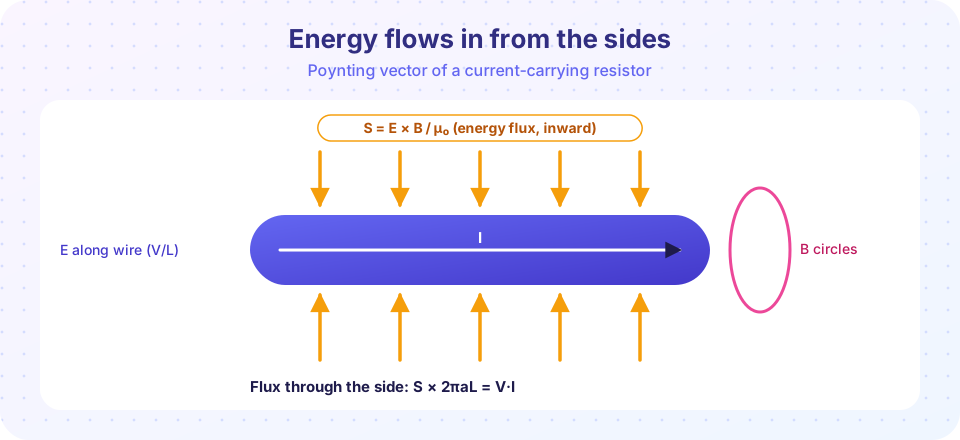
A straight wire of radius a and length L carries current I with voltage drop V along it. Then E = V/L along the axis, and at the surface B = μ₀ I/(2π a) circles the wire. E×B points radially inward, with magnitude S = (V/L)(I/(2π a)). Multiply by the side area 2π a L:
P = S × (2π a L) = V I
The energy that heats the resistor flows in through its sides from the surrounding field, and the total exactly matches the familiar P = V I.
Worked example 3: energy into a charging capacitor
Charge a parallel-plate capacitor of radius R = 5.0 cm and gap d = 1.0 mm with a steady current I = 0.50 A, at the moment when its voltage is V = 100 V. Between the plates E = V/d = 10⁵ V/m, pointing across the gap. The changing E produces a circulating magnetic field, and at the rim (from the Ampere-Maxwell law) B = μ₀ I/(2π R) = 2.0×10⁻⁶ T. The vector E×B points radially inward, with magnitude S = E B/μ₀ = 1.59×10⁵ W/m². The rim area is 2π R d = 3.14×10⁻⁴ m², so the inward flux is 50 W. That equals V I = 100 × 0.50 W and also the rate at which the stored energy ½ C V² grows, C V dV/dt = V I. The energy comes into the gap from the sides, carried by the fields, not down the wires between the plates.
Energy at human scale: which field stores more?
Compare a strong magnet and a strong electric field. A 1 T magnetic field has u = B²/(2μ₀) ≈ 4.0×10⁵ J/m³. An electric field of 10⁶ V/m, near the breakdown limit of air (about 3×10⁶ V/m), has only ½ε₀E² ≈ 4.4 J/m³. Magnetic energy storage is far denser at everyday scales, which is why motors, MRI magnets and inductors are bulky while capacitors are thin. In a light wave the two are equal because E = cB: a magnetic field of 1 T would need an electric field of 3×10⁸ V/m to match.
Momentum in the field
Fields carry momentum as well as energy. The momentum density is g = S/c² = ε₀ E×B. For sunlight, g = 1361 / c² ≈ 1.5×10⁻¹⁴ kg/(m²·s). Absorbed over time, this is the origin of radiation pressure, and the I/c result follows: momentum per area per second equals energy flux divided by c. Kepler suspected in 1619 that comet tails point away from the Sun because sunlight pushes on them, and Maxwell predicted the pressure in 1873; Pyotr Lebedev measured it in 1900.
"Energy flows inside the wire." In the field picture it flows in the space around the wire. In a DC circuit the Poynting vector in the gap runs from source to load.
"Poynting vector gives the exact energy path." S is only defined up to adding the curl of any vector field, since that has no divergence. Net flux through a closed surface is physical; the local direction is a convention.
Try it
Press Run (or Ctrl + Enter) to see the result here.
Program input · what you'd type while the program runs
Type the answers before you press Run, one per line. Each time the program reads a line (with input()), it gets the next line from this box.
Press Run (or Ctrl + Enter) to see the result here.
Program input · what you'd type while the program runs
Type the answers before you press Run, one per line. Each time the program reads a line (with input()), it gets the next line from this box.
Press Run (or Ctrl + Enter) to see the result here.
Program input · what you'd type while the program runs
Type the answers before you press Run, one per line. Each time the program reads a line (with input()), it gets the next line from this box.
Check your understanding
Quick check · 6 questions
of 6 answered You scored / 6 · perfect!
-
1. What are the units of the Poynting vector?
S is energy per unit time per unit area, W/m². -
2. In a plane wave in vacuum, how do the electric and magnetic energy densities compare?
With B = E/c, ε₀E²/2 equals B²/(2μ₀). -
3. A light beam has intensity 600 W/m². What is the pressure on a perfectly absorbing surface?
P = I/c = 600 / (3.0 × 10⁸) = 2.0 × 10⁻⁶ Pa. -
4. In Poynting's theorem, the term −J·E stands for
J·E is the power per volume the fields transfer to charges (Joule heating in a resistor). -
5. What is the energy density of a 2.0 T magnetic field?
u = B²/(2μ₀) = 4 / (2 × 4π×10⁻⁷) ≈ 1.6×10⁶ J/m³. -
6. The momentum density of an electromagnetic field is
g = S/c² = ε₀ E×B, which is why light exerts pressure.
Summary
- Energy density
u = ½ε₀E² + B²/(2μ₀); energy fluxS = E×B/μ₀. - Poynting's theorem:
∂u/∂t + ∇·S = −J·E. - Sunlight:
E₀ ≈ 1.0 kV/m,B₀ ≈ 3.4 µT, pressureI/c. - Energy enters a resistor or a charging capacitor through its sides, and the total flux is
V I. - Fields also carry momentum,
g = S/c², which is the source of radiation pressure. - At everyday scales magnetic fields store far more energy per volume than electric fields.
Next: Potentials and gauges
Track your progress
Create a free account to tick off lessons and pick up where you left off on any device.
of Electrodynamics lessons completed