


















Lesson 4 of 49 · Getting Started
Units, constants and orders of magnitude
Master SI units for electromagnetism, the constants ε₀ and μ₀, dimensional analysis and the scales of electric fields from weather to atoms, with a unit-checking tool.
Physics results are only as good as their units. In electrodynamics, units also tell a deeper story: the constants ε₀ and μ₀ are not arbitrary numbers, they combine to give the speed of light. This lesson sets up the toolkit you will use all course: the SI base units, how electrical units derive from them, quick dimensional analysis, and a feel for how large or small electromagnetic quantities really are.
What you will learn
- The SI base units and how the coulomb, volt, farad and tesla are built from them.
- The meaning and values of
ε₀,μ₀andc, and the relationc² = 1/(μ₀ε₀). - How to check any formula with dimensional analysis, by hand and with a small program.
- Typical sizes of fields, charges and voltages, so that your answers feel right.
Key terms
- SI: the International System of Units: meter, kilogram, second, ampere (and kelvin, mole, candela).
- Ampere (A): the SI base unit of current; one coulomb per second is one ampere.
- Dimensional analysis: checking that both sides of an equation have the same units.
- Permittivity ε₀: the vacuum constant in Coulomb's law.
- Permeability μ₀: the vacuum constant in magnetic force laws.
The SI electromagnetic units
Since 2019 the ampere is defined by fixing the elementary charge exactly: e = 1.602 176 634 × 10⁻¹⁹ C. The other units follow from force and energy:
| Quantity | Unit | In base units |
|---|---|---|
| Charge | coulomb (C) | A·s |
| Electric field | N/C = V/m | kg·m·s⁻³·A⁻¹ |
| Potential | volt (V) = J/C | kg·m²·s⁻³·A⁻¹ |
| Capacitance | farad (F) = C/V | kg⁻¹·m⁻²·s⁴·A² |
| Magnetic field | tesla (T) = N/(A·m) | kg·s⁻²·A⁻¹ |
| Resistance | ohm (Ω) = V/A | kg·m²·s⁻³·A⁻² |
Two older ways to write units appear in books. In Gaussian units the Coulomb constant is 1 and the electric and magnetic fields have the same units; many theorists like them. We use SI because it is the language of engineering and of almost every experiment.
The constants
Two constants set the strength of the electric and magnetic interactions in vacuum:
ε₀ = 8.854 187 8128 × 10⁻¹² F/m(permittivity of free space), wherek = 1/(4πε₀) = 8.988 × 10⁹ N·m²/C².μ₀ = 1.256 637 0621 × 10⁻⁶ N/A²(permeability of free space). Before 2019 this was exactly4π × 10⁻⁷; it is now measured, but agrees to about ten digits.
Their product is not arbitrary. It equals 1/c², where c = 299 792 458 m/s is the speed of light. Maxwell found this in the 1860s, which led him to say that light is an electromagnetic wave. You will derive it in Chapter 6; for now, the identity is a powerful unit check.
Dimensional analysis
Every term in a physical equation must have the same dimensions. That alone catches most mistakes. Example: is E = kQ/r or E = kQ/r² the right form for a point charge?
k Q / r²: units(N·m²/C²)(C)/(m²) = N/C✓.k Q / r: unitsN·m/C, which is J/C = V. That is the potential, not the field.
Another example: a capacitor stores energy U = ½ C V². Units: F·V² = (C/V)·V² = C·V = J ✓.
Dimensional analysis cannot give you pure numbers like ½ or 4π, but it can tell you the form of a relation. The small program in the Try it section checks products of quantities by tracking the exponents of kg, m, s and A.
Orders of magnitude
Build your intuition with these typical values:
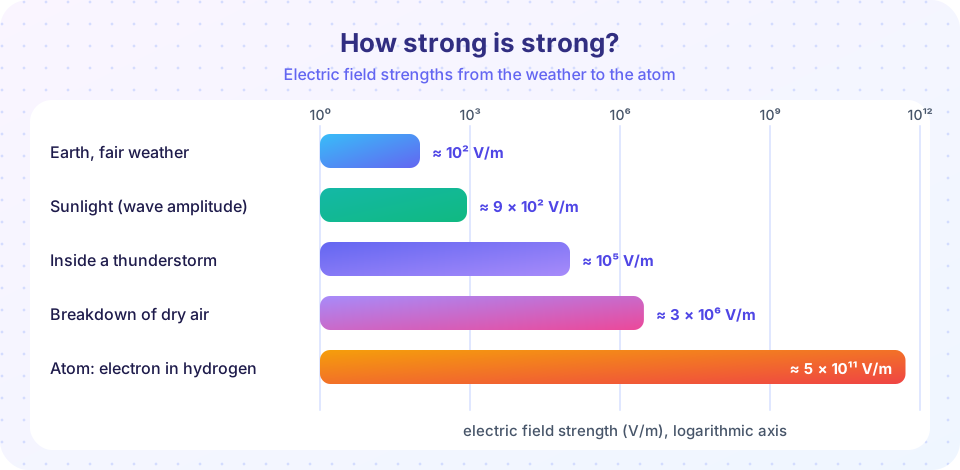
- Fair-weather atmospheric electric field near the ground: about 100 V/m (the field is directed downward).
- A static spark in dry air happens near 3 × 10⁶ V/m, the breakdown field of air.
- The electric field in a thundercloud can reach about 10⁵ V/m before lightning.
- The field that holds the electron in a hydrogen atom,
e k / a₀², is about 5 × 10¹¹ V/m. - Sunlight's electric field amplitude is about 9 × 10² V/m (from intensity near 1000 W/m²).
- A strong refrigerator magnet gives about 5 mT; Earth's field is about 50 μT; an MRI scanner uses 1.5 to 3 T.
- A typical wall socket has an RMS voltage of 120 V or 230 V; a lightning stroke carries tens of kiloamperes.
Atomic fields are enormous. That is why ordinary laboratory fields hardly disturb atoms: a spark is a field of only 10⁻⁵ of the atomic field.
Common misconceptions
- "Volts measure the force on a charge." Volts measure energy per charge. Field strength (V/m) is the force per charge.
- "One coulomb is a small unit." It is enormous: two 1 C charges 1 m apart would push each other with about 9 × 10⁹ N.
- "ε₀ and μ₀ are independent constants you can change separately." Their product is fixed by the speed of light.
- "Using Gaussian units is wrong." Different unit systems are fine, but never mix formulas from different systems in the same calculation.
Try it
The first example is a unit-checker: each quantity carries its exponents of kg, m, s and A, and products and quotients combine them. The second computes the field scales of the picture from the formulas where they come from.
Press Run (or Ctrl + Enter) to see the result here.
Program input · what you'd type while the program runs
Type the answers before you press Run, one per line. Each time the program reads a line (with input()), it gets the next line from this box.
Press Run (or Ctrl + Enter) to see the result here.
Program input · what you'd type while the program runs
Type the answers before you press Run, one per line. Each time the program reads a line (with input()), it gets the next line from this box.
Check your understanding
Quick check · 5 questions
of 5 answered You scored / 5 · perfect!
-
1. Which unit is NOT equivalent to the unit of electric field?
J/C is the volt, a unit of potential. Electric field is V/m or N/C. -
2. How is the product μ₀ε₀ related to the speed of light?
Maxwell found c² = 1/(μ₀ε₀), which identified light as an electromagnetic wave. -
3. Check the formula E = kQ/r by units. What does it give?
k Q / r has units N·m/C = J/C = volts. It is the potential of a point charge, not the field. -
4. Roughly how large is the field inside a hydrogen atom compared with the breakdown field of air?
5 × 10¹¹ V/m against 3 × 10⁶ V/m gives a ratio of about 2 × 10⁵. -
5. Which is the SI base unit from which the coulomb is built?
The ampere is a base unit and 1 C = 1 A·s.
Summary
- SI electromagnetism rests on the ampere; since 2019 the elementary charge is exactly
1.602 176 634 × 10⁻¹⁹ C. ε₀ = 8.854 × 10⁻¹² F/m,μ₀ = 1.2566 × 10⁻⁶ N/A²andc² = 1/(μ₀ε₀).- Dimensional analysis checks the form of any formula; always do it before trusting an answer.
- Fields run from about 100 V/m (calm weather) to 5 × 10¹¹ V/m (atoms), so real-world fields rarely rival atomic ones.
- One coulomb is a huge charge; practical electrostatics uses nC and μC.
Next: Chapter 1 review
Track your progress
Create a free account to tick off lessons and pick up where you left off on any device.
of Electrodynamics lessons completed