


















Lesson 30 of 49 · Electromagnetic Waves
Plane waves in vacuum
Derive the electromagnetic wave equation from Maxwell's equations, find plane-wave solutions, and relate E, B, k, energy and intensity.
Now to the central calculation of the whole subject. Start from Maxwell's equations in empty space and eliminate one field: a wave equation appears, and with it the speed of light. Then study its simplest solutions, plane waves, which are the building blocks of almost everything else in optics and radio.
What you will learn
- Derive
∇²E = μ₀ε₀ ∂²E/∂t²from Maxwell's equations. - Write the plane-wave solution and relate
ω,kandc. - Show E and B are in phase, transverse, with
E = cB. - Compute intensity from the field amplitude.
Key terms
Plane wave: all fields constant on planes perpendicular to the direction of travel. Wave vector k: points along the travel direction, |k| = 2π/λ. Angular frequency ω = 2πf. Phase velocity ω/k. Transverse: field components perpendicular to k.
The wave equation
In vacuum (ρ = 0, J = 0) take the curl of Faraday's law:
∇×(∇×E) = −∂(∇×B)/∂t = −μ₀ε₀ ∂²E/∂t²
The identity ∇×(∇×E) = ∇(∇·E) − ∇²E and ∇·E = 0 turn the left side into −∇²E. Hence
∇²E = μ₀ε₀ ∂²E/∂t², ∇²B = μ₀ε₀ ∂²B/∂t², c = 1/√(μ₀ε₀)
Every Cartesian component obeys the same equation. Maxwell computed c from the constants measured in electrical experiments and found a number matching the speed of light, about 2.998 × 10⁸ m/s. Light, he concluded, is an electromagnetic wave.
Monochromatic plane wave
Try E(r, t) = E₀ cos(k·r − ωt + δ) with a constant vector E₀. Substituting shows ω² = c² k²: the dispersion relation ω = ck. The three conditions ∇·E = 0, ∇·B = 0 and Faraday's law then give:
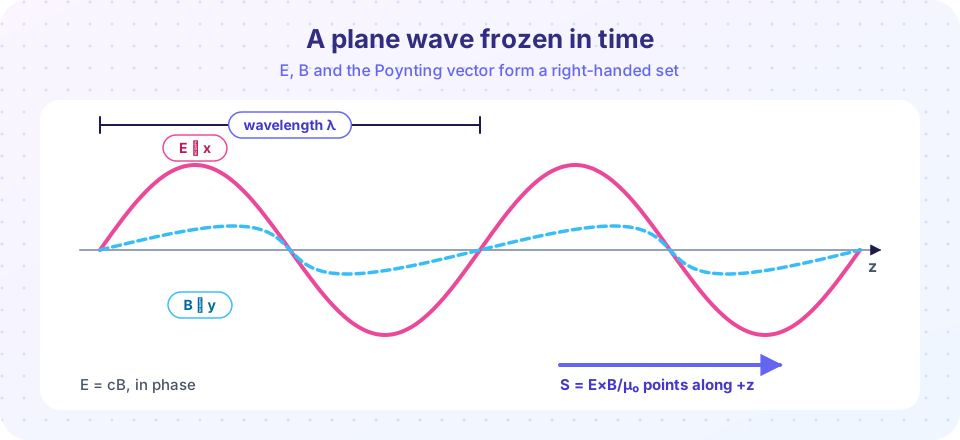
E₀ · k = 0: E is perpendicular to k (transverse).B = (1/ω) k × E, soB = (1/c) k̂ × E: B is perpendicular to both, in phase with E.|E| = c |B|.
For a wave along z with E = E₀ cos(kz − ωt) x̂, we get B = (E₀/c) cos(kz − ωt) ŷ. The sign check: E×B points along +ẑ, the direction of travel.
Energy and intensity
The electric and magnetic energy densities are equal (ε₀E² = B²/μ₀), so u = ε₀E². The Poynting vector S = E×B/μ₀ = c u k̂: energy moves at speed c. Averaging cos² gives ½:
I = ⟨S⟩ = ½ c ε₀ E₀²
A radio signal with I = 1.0 × 10⁻⁹ W/m² (a strong signal) has E₀ = √(2I/(cε₀)) ≈ 0.87 mV/m. Compare with about 1 kV/m for sunlight.
Why Faraday's law fixes B: a step-by-step check
Take the wave along z with E = E₀ cos(kz − ωt) x̂. Faraday's law is ∇×E = −∂B/∂t. The curl of a field with only an x component that depends only on z has a single nonzero component:
(∇×E)_y = ∂E_x/∂z = −k E₀ sin(kz − ωt)
So ∂B_y/∂t = k E₀ sin(kz − ωt). Integrate over time: B_y = (k/ω) E₀ cos(kz − ωt) = (E₀/c) cos(kz − ωt), because ω/k = c. There is no way to get a B that is out of phase: the time derivative of B must match the space derivative of E, and both are sines of the same phase. That is the mathematical reason "in phase" is not a choice. Ampère-Maxwell, ∇×B = μ₀ε₀ ∂E/∂t, gives the consistent result and also confirms c² = 1/(μ₀ε₀): put B_y in, and the factor that appears is k²c² = ω².
Worked example 1: sunlight at the top of the atmosphere
The solar constant is about I = 1361 W/m². Then
E₀ = √(2I / (cε₀)) = √(2 × 1361 / (2.998×10⁸ × 8.854×10⁻¹²)) ≈ 1.01 × 10³ V/m
B₀ = E₀ / c ≈ 3.4 × 10⁻⁶ T
The electric amplitude is about a kilovolt per meter, still 3000 times weaker than the roughly 3 MV/m at which dry air sparks. The magnetic amplitude, 3.4 µT, is smaller than the Earth's own field of roughly 50 µT. Both are real and measurable, but the wave carries energy so efficiently that you feel it as heat.
Worked example 2: a Wi-Fi router
A router radiates P = 0.1 W roughly equally in all directions (an unrealistic simplification, but fine for an estimate). At r = 10 m the power spreads over a sphere of area 4πr² = 1257 m²:
I = 0.1 / 1257 ≈ 8.0 × 10⁻⁵ W/m²
E₀ = √(2I/(cε₀)) ≈ 0.25 V/m
A quarter of a volt per meter, enough for a receiver antenna a few centimeters long to produce millivolts. The 1/r² falloff is the geometric reason signal drops quickly with distance: double the distance and the intensity falls to a quarter, E₀ to a half.
Momentum and radiation pressure
The wave also carries momentum, with density g = S/c² = u/c. Light that is fully absorbed delivers pressure p = I/c; fully reflected, 2I/c. For sunlight I/c = 1361 / 3.0×10⁸ = 4.5 µPa. Tiny, but on a spacecraft sail of 100 m² it adds up to about 0.45 mN, and over months this force steers real probes (the Japanese IKAROS sail of 2010 demonstrated it). Johannes Kepler guessed at the effect in 1619 when he noticed comet tails point away from the Sun; Pyotr Lebedev measured the pressure in 1900, and Ernest Nichols and Gordon Hull confirmed it in 1901.
Waves from any direction
Real sources produce spherical waves, but far away a small patch looks like a plane wave. Superposition lets you build any field from plane waves with different k and ω.
"E and B are 90° out of phase, like a pendulum trading energy." In an EM wave in vacuum they peak together. Energy does not slosh between the fields; it moves forward.
"Light needs a medium (the ether)." Maxwell's equations carry no medium in them; the wave is the field itself.
"c depends on the observer." The equations fix c in terms of μ₀ and ε₀; Chapter 8 shows why it is the same in every inertial frame.
Try it
Press Run (or Ctrl + Enter) to see the result here.
Program input · what you'd type while the program runs
Type the answers before you press Run, one per line. Each time the program reads a line (with input()), it gets the next line from this box.
Press Run (or Ctrl + Enter) to see the result here.
Program input · what you'd type while the program runs
Type the answers before you press Run, one per line. Each time the program reads a line (with input()), it gets the next line from this box.
Check your understanding
Quick check · 7 questions
of 7 answered You scored / 7 · perfect!
-
1. A plane wave in vacuum has E₀ = 60 V/m. What is B₀?
B₀ = E₀/c = 60 / (3.0 × 10⁸) = 2.0 × 10⁻⁷ T. -
2. Which relation links ω and k for light in vacuum?
The dispersion relation ω = ck follows from the wave equation. -
3. In a plane wave, the phase difference between E and B is
They oscillate in phase, reaching maxima at the same place and time. -
4. Intensity of a plane wave in terms of E₀ is
I = ⟨|S|⟩ = ½ c ε₀ E₀². -
5. A wave travels along +z with E along +x at some instant and place. B points along
E×B must point along +z; x̂ × ŷ = ẑ, so B is along +y. -
6. A source of power 100 W radiates equally in all directions. What is the intensity 10 m away?
I = P/(4πr²) = 100/1257 ≈ 0.080 W/m². The power spreads over a sphere of area 4πr². -
7. Sunlight of intensity 1361 W/m² is fully absorbed. The radiation pressure is about
p = I/c = 1361 / 3.0 × 10⁸ ≈ 4.5 × 10⁻⁶ Pa.
Summary
- Maxwell's equations imply
∇²E = μ₀ε₀ ∂²E/∂t², soc = 1/√(μ₀ε₀). - Plane waves:
ω = ck,E ⊥ B ⊥ k,B = k̂ × E / c, in phase. - Intensity
I = ½cε₀E₀², and the energy travels atc.
Next: Polarization
Track your progress
Create a free account to tick off lessons and pick up where you left off on any device.
of Electrodynamics lessons completed