


















Lesson 31 of 49 · Electromagnetic Waves
Polarization of electromagnetic waves
Understand linear, circular and elliptical polarization from the motion of the E vector, apply Malus's law and compute light through crossed polarizers.
A plane wave fixes the direction of travel, but not the direction in which E oscillates. Because E is perpendicular to k, there are two independent directions to choose from. How the two perpendicular components are combined defines the wave's polarization. It explains polarized sunglasses, 3D cinema glasses, liquid-crystal displays and why some radio antennas must be rotated to receive a signal.
What you will learn
- Describe a wave as the sum of two perpendicular components with a phase difference.
- Identify linear, circular and elliptical polarization from amplitudes and phase.
- Apply Malus's law
I = I₀ cos²θto chains of polarizers. - Explain why unpolarized light loses half its intensity at an ideal polarizer.
Key terms
Linear polarization: E oscillates along a fixed line. Circular polarization: equal amplitudes, 90° phase shift, E rotates at constant length. Elliptical: the general case. Polarizer: a device that passes only one component of E. Unpolarized light: a mixture of many randomly changing polarizations.
Two components, one ellipse
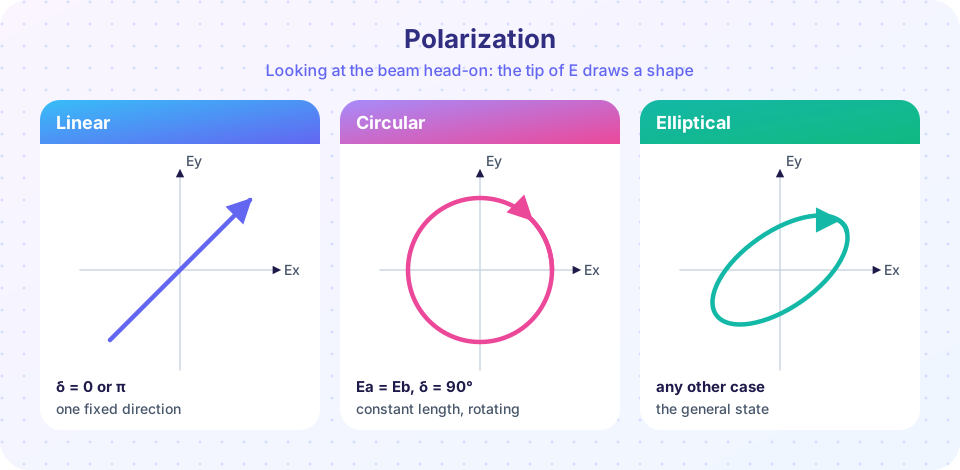
For a wave along z, write
E_x = E_a cos(kz − ωt)
E_y = E_b cos(kz − ωt + δ)
At a fixed position the tip of E traces:
| Condition | Shape |
|---|---|
δ = 0 or π |
a straight line (linear) |
E_a = E_b, δ = ±π/2 |
a circle (circular) |
| anything else | an ellipse (elliptical) |
Which sense of rotation is called "left" or "right" circular differs between optics and engineering books, so always state the convention you use. A circular wave carries angular momentum: each photon has spin ±ħ along the beam, which explains why absorbing circular light can spin a tiny particle.
Malus's law
An ideal polarizer passes only the component of E along its axis. If the incident light is linearly polarized at angle θ from the axis, the transmitted amplitude is E₀ cos θ and, since intensity goes like E²,
I = I₀ cos² θ
Unpolarized light is an equal incoherent mix of all directions; the average of cos²θ is 1/2, so an ideal polarizer halves it.
Worked example: three polarizers
Unpolarized light I₀ meets a polarizer at 0°: I₁ = I₀/2. Then one at 45°: I₂ = I₁ cos²45° = I₀/4. Then one at 90°: I₃ = I₂ cos²45° = I₀/8. Remove the middle one and the 0° and 90° pair is crossed: I = 0. Inserting a polarizer increases the transmitted light, because the middle one rotates the polarization in steps.
"A polarizer absorbs all light except a slit's worth, like a picket fence." The fence picture shows the geometry, but the physics is about components of E, not slits; the transmitted component is the projection.
"Sound waves can also be polarized." Sound in fluids is longitudinal, so it has no transverse directions to choose from. Polarization is a property of transverse waves.
"A circularly polarized wave has no oscillation." Its E vector keeps a constant length but rotates, so each component still oscillates; at a fixed instant the tip of E traces a helix along the beam.
Who found it
Étienne-Louis Malus noticed in 1808 that sunlight reflected from the windows of the Luxembourg Palace in Paris changed in brightness when he looked at it through a calcite crystal and turned the crystal, and he named the effect "polarization". The cos²θ law carries his name. Thomas Young and Augustin Fresnel then explained why light could not be longitudinal: in 1817 Young suggested that light waves are transverse, and Fresnel built the full theory of reflection amplitudes (the Fresnel coefficients of the next lesson). Maxwell's theory later made the "transverse" in their argument concrete: it is E and B that oscillate sideways. George Stokes introduced four measurable parameters in 1852 that describe any partially polarized beam.
Worked example: a quarter-wave plate
Some crystals, such as quartz, have two refractive indices for two perpendicular polarization directions (they are birefringent). A slab of thickness d delays one component relative to the other by a phase
δ = 2π d Δn / λ
For a quarter-wave plate δ = π/2, so d = λ/(4Δn). Quartz has Δn ≈ 0.009. At λ = 589 nm the needed thickness is d = 589×10⁻⁹ / (4 × 0.009) ≈ 16 µm (real plates are usually thicker by a whole number of wavelengths for strength, giving "multi-order" plates). Send linearly polarized light at 45° to the plate's axes: the two components are equal in amplitude, the plate adds 90°, and the output is circularly polarized. Rotate the plate by 90° and you get the opposite handedness. A second quarter-wave plate turns the light back to linear, rotated by 90°: the principle behind the glasses of some 3D cinemas and behind the circular filters that stop a camera's autofocus from being confused by reflections.
Worked example: angular momentum
Right- and left-circular light carries angular momentum ±ħ per photon. A beam of power P and angular frequency ω has P/(ħω) photons per second, so the torque on a perfect absorber is τ = P/ω. For P = 1 W at 500 nm (ω = 2πc/λ = 3.77 × 10¹⁵ rad/s) that is 2.7 × 10⁻¹⁶ N·m: absurdly small for a bulk object, but enough to spin a micrometer-sized birefringent particle in laser tweezers. Richard Beth measured it in 1936 with a suspended quartz-wave-plate disk.
Many polarizers: the slow turn
Put N ideal polarizers in a row, each turned by 90°/N from the previous one. The transmitted fraction of polarized light is [cos²(90°/N)]^N. For N = 2 that is 0.25, for N = 3 it is 0.42, for N = 10 it is 0.78, and as N → ∞ it approaches 1. In the limit a stack of polarizers rotates the polarization by 90° without loss. The same mathematics appears in quantum mechanics as the quantum Zeno effect.
"Circularly polarized light has a rotating field, so it must rotate the beam." The beam does not turn. At each point E rotates in the plane perpendicular to the beam; along the beam the tip of E traces a corkscrew.
"Polarizing sunglasses make light 'less bright' because they absorb colors." They block the horizontally polarized part (glare from roads and water, which reflect s-polarization more strongly). They are not color filters.
Try it
Press Run (or Ctrl + Enter) to see the result here.
Program input · what you'd type while the program runs
Type the answers before you press Run, one per line. Each time the program reads a line (with input()), it gets the next line from this box.
Press Run (or Ctrl + Enter) to see the result here.
Program input · what you'd type while the program runs
Type the answers before you press Run, one per line. Each time the program reads a line (with input()), it gets the next line from this box.
Press Run (or Ctrl + Enter) to see the result here.
Program input · what you'd type while the program runs
Type the answers before you press Run, one per line. Each time the program reads a line (with input()), it gets the next line from this box.
Check your understanding
Quick check · 7 questions
of 7 answered You scored / 7 · perfect!
-
1. Linearly polarized light of intensity 8.0 W/m² meets a polarizer at 60° to its polarization. What intensity passes?
I = I₀ cos²60° = 8.0 × 0.25 = 2.0 W/m². -
2. What fraction of unpolarized light passes an ideal polarizer?
The average of cos²θ over all directions is 1/2. -
3. Which conditions give circular polarization?
A 90° shift makes the two components trade off as cos and sin, tracing a circle. -
4. Two crossed polarizers (0° and 90°) block all light. What happens when a third at 45° is put between them?
I = I₀/2 × cos²45° × cos²45° = I₀/8. -
5. Why can sound waves in air not be polarized?
Polarization needs transverse oscillations; sound in air oscillates along the direction of travel. -
6. Linearly polarized light at 45° to the axes of a quarter-wave plate leaves the plate
The two components have equal amplitudes and the plate adds a 90° phase shift between them. -
7. A quartz plate has Δn = 0.009. About what thickness gives a quarter-wave delay at 589 nm?
d = λ/(4Δn) = 589 nm / 0.036 ≈ 16 µm.
Summary
- Polarization describes how E moves in the plane perpendicular to
k. - Linear, circular and elliptical states come from two components with amplitude and phase.
- Malus's law:
I = I₀ cos²θ; unpolarized light is halved by an ideal polarizer. - Intermediate polarizers can rotate polarization and increase transmission.
Track your progress
Create a free account to tick off lessons and pick up where you left off on any device.
of Electrodynamics lessons completed