


















Lesson 2 of 49 · Getting Started
Coulomb's law and electric charge
Understand electric charge, quantization and conservation, then use Coulomb's law in vector form with worked examples and a simulation of the inverse-square law.
Every electromagnetic effect begins with charge. Rub a balloon on your hair, switch on a lamp, or send a signal across the ocean: charges are pushing and pulling on other charges. In the 1780s Charles-Augustin de Coulomb measured that push and pull with a torsion balance and found a simple rule. That rule, Coulomb's law, is the first and most basic equation of electrodynamics.
What you will learn
- The three basic facts about charge: two signs, quantization and conservation.
- Coulomb's law in magnitude and vector form, and the meaning of the constants k and ε₀.
- How to add forces from several charges with the superposition principle.
- How strong the electric force really is compared with gravity.
Key terms
- Coulomb (C): the SI unit of charge. The elementary charge is e = 1.602 × 10⁻¹⁹ C.
- Quantization: free charge comes only in integer multiples of e (quarks aside).
- Conservation of charge: the total charge of an isolated system never changes.
- Point charge: a charged object so small compared with all distances that its size does not matter.
- Superposition: the net force is the vector sum of the forces from each charge alone.
Charge: the three basic facts
Two signs. Charge is positive or negative. Like charges repel, unlike charges attract. The names come from convention (Benjamin Franklin's), and nothing physical depends on which sign we call positive.
Quantization. Every free particle carries a charge that is an integer multiple of e. A proton has +e, an electron has −e, a neutron has 0. Quarks carry thirds of e but are never found alone. For everyday objects the steps of e are so tiny that charge looks continuous: one microcoulomb is about 6 × 10¹² elementary charges.
Conservation. Charge is never created or destroyed. When a gamma ray makes an electron-positron pair, the new charges are −e and +e and sum to zero, exactly the charge of the photon. This conservation is local, which later becomes the continuity equation (Chapter 5).
Coulomb's law
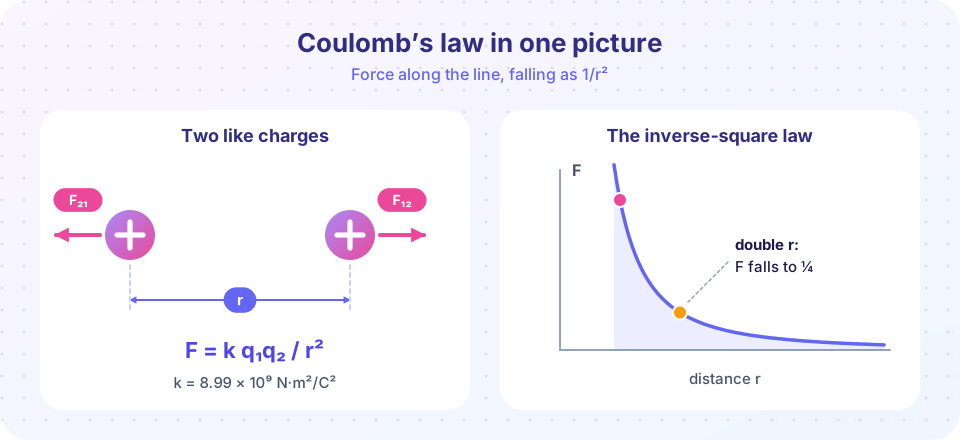
For two point charges q₁ and q₂ at rest, separated by a distance r, the magnitude of the force on each is
F = k |q₁ q₂| / r²
with k = 1 / (4π ε₀) = 8.988 × 10⁹ N·m²/C² and ε₀ = 8.854 × 10⁻¹² C²/(N·m²) (equivalently F/m). The force is directed along the line joining the charges: repulsive when the charges have the same sign, attractive otherwise.
In vector form, with r pointing from charge 1 to charge 2 and r̂ = r / |r|:
F₂₁ = k q₁ q₂ r̂ / r² (force on charge 2 caused by charge 1)
By Newton's third law, F₁₂ = −F₂₁. Notice the sign: if q₁q₂ > 0, the force on charge 2 points along r̂, away from charge 1, which is repulsion.
Why 4π? It is a convenience. Because the area of a sphere is 4πr², the 4π moves out of the field of a point charge and out of Gauss's law (Chapter 2), where the equations come out cleaner as ∇·E = ρ/ε₀.
Worked example 1: two microcoulombs
Two charges of +1.0 μC sit 10 cm apart. The force on each is
F = (8.99 × 10⁹)(1.0 × 10⁻⁶)² / (0.10)² = 0.90 N
That is about the weight of a 90 g object, a big force from tiny charges at a small distance. This tells you that one coulomb is a huge amount of charge. Real objects in everyday electrostatics carry nanocoulombs to microcoulombs.
Worked example 2: three charges in a line
A charge +2 μC sits at x = 0, −1 μC at x = 1 m, and a test charge +1 μC at x = 2 m. The 2 μC charge pushes the test charge to the right with 9 × 10⁹ × 2e-6 × 1e-6 / 4 = 4.5 × 10⁻³ N. The −1 μC charge pulls it to the left with 9 × 10⁹ × 1e-6 × 1e-6 / 1 = 9 × 10⁻³ N. The net force on the test charge is 4.5 − 9 = −4.5 mN, to the left. The superposition principle lets you do this addition for any number of charges.
Superposition
Experiments show that Coulomb forces do not interfere. The force on charge Q from several charges is simply
F = Σ k Q qᵢ r̂ᵢ / rᵢ²
You must add vectors, not magnitudes. In 2D or 3D, add components. This linearity is what makes electrostatics tractable: any complicated arrangement is a sum (or integral) of simple pieces.
How strong is the electric force?
In a hydrogen atom the electron and proton sit about 5.29 × 10⁻¹¹ m apart. The electric force between them is about 8 × 10⁻⁸ N, while gravity is about 10⁻⁴⁷ N, a ratio near 2 × 10³⁹. Gravity matters in the sky only because planets and stars are electrically neutral to enormous precision; their positive and negative charges cancel while their masses add.
Common misconceptions
- "The proton pulls harder on the electron than the electron pulls on the proton because it is heavier." No: the forces are equal and opposite. The electron simply accelerates more because it has less mass.
- "Coulomb's law works for any moving charges." It is exact for charges at rest. Moving charges also create magnetic fields, and when they accelerate the information travels at the speed of light (Chapters 5 to 8).
- "Charge and mass are measured on the same scale." Charge can be positive, negative or zero; mass is always positive.
Try it
The first example is a small force calculator that applies the formula. The second plots the inverse-square law on a log scale, where a power law becomes a straight line with slope −2. The third adds forces from three charges in 2D.
Press Run (or Ctrl + Enter) to see the result here.
Program input · what you'd type while the program runs
Type the answers before you press Run, one per line. Each time the program reads a line (with input()), it gets the next line from this box.
Press Run (or Ctrl + Enter) to see the result here.
Program input · what you'd type while the program runs
Type the answers before you press Run, one per line. Each time the program reads a line (with input()), it gets the next line from this box.
Press Run (or Ctrl + Enter) to see the result here.
Program input · what you'd type while the program runs
Type the answers before you press Run, one per line. Each time the program reads a line (with input()), it gets the next line from this box.
Check your understanding
Quick check · 5 questions
of 5 answered You scored / 5 · perfect!
-
1. Two charges are moved from 2 m apart to 1 m apart. What happens to the force between them?
F is proportional to 1/r², so halving r multiplies F by 4. -
2. A glass rod and a silk cloth are rubbed together. The rod ends with +3.2 × 10⁻⁹ C. How many electrons did it lose?
N = 3.2e-9 / 1.602e-19 ≈ 2.0e10 electrons. -
3. Which statement about the forces on two interacting point charges is correct?
Newton's third law applies: F₁₂ = −F₂₁, whatever the sizes of the charges. -
4. Why does gravity dominate over electricity for planets?
Positive and negative charges cancel nearly perfectly in bulk matter, while masses always add. -
5. The vector form F₂₁ = k q₁q₂ r̂ / r² gives a force pointing along r̂ (away from charge 1). What does this mean for q₁q₂ > 0?
A force along r̂ pushes charge 2 away from charge 1, which is repulsion between like charges.
Summary
- Charge has two signs, comes in multiples of e = 1.602 × 10⁻¹⁹ C and is conserved.
- Coulomb's law:
F = k q₁q₂ / r²along the line between the charges, withk = 1/(4πε₀) = 8.99 × 10⁹ N·m²/C². - Forces from several charges add as vectors (superposition).
- The electric force between an electron and a proton in hydrogen is about 10³⁹ times larger than the gravitational force.
- Coulomb's law is exact for stationary charges only.
Track your progress
Create a free account to tick off lessons and pick up where you left off on any device.
of Electrodynamics lessons completed