


















Lesson 28 of 49 · Maxwell's Equations
Chapter review: Maxwell's equations
A one-page recap of Faraday's law, displacement current, Poynting's theorem and potentials, with a ten-question quiz mixing the whole chapter.
You have now assembled the complete theory of classical electromagnetism. This review puts the chapter on one page, then tests you with ten mixed questions.
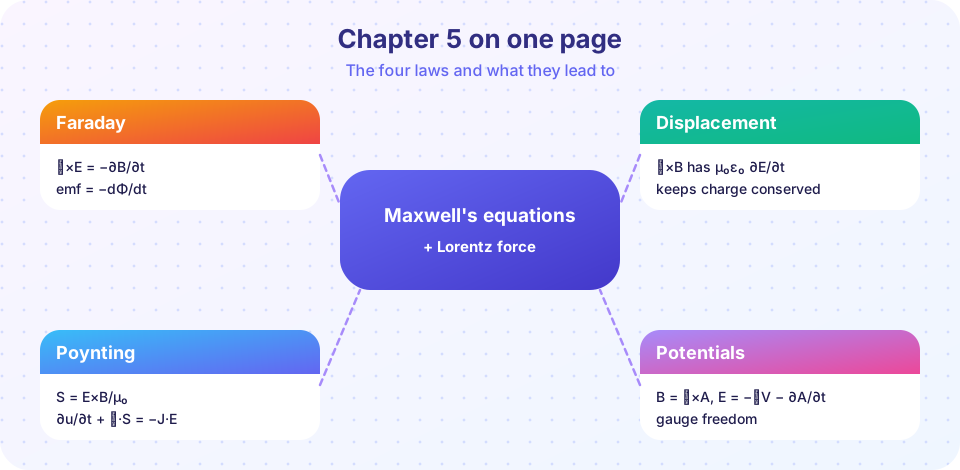
Recap table
| Lesson | Key result | Typical number |
|---|---|---|
| Faraday's law | ∇×E = −∂B/∂t, emf = −dΦ/dt |
Alternator peak emf N B A ω |
| Displacement current | ∇×B = μ₀J + μ₀ε₀ ∂E/∂t |
I_d = I in a capacitor |
| Poynting vector | S = E×B/μ₀, u = ½ε₀E² + B²/2μ₀ |
Sunlight: 1.36 kW/m², E₀ ≈ 1 kV/m |
| Potentials | B = ∇×A, E = −∇V − ∂A/∂t |
Lorenz gauge gives □V = −ρ/ε₀ |
Which law do I use?
| Situation | Reach for | First step |
|---|---|---|
| Charge distribution with symmetry, find E | Gauss's law | Pick a Gaussian surface where E is constant |
| Flux through a coil changes, find emf | Faraday's law | Compute Φ(t), then differentiate |
| Current or charging capacitor, find B | Ampere-Maxwell law | Choose an Amperian loop; include I_d if E changes |
| How much energy flows or arrives | Poynting vector | S = E×B/μ₀, then multiply by area |
| Radiation or retarded fields later in the course | Potentials in the Lorenz gauge | Solve □V and □A, then take derivatives |
Worked problem: one coil, three answers
A coil of N = 50 turns and radius 4.0 cm has a total resistance of 2.0 Ω. A field perpendicular to its plane rises uniformly from 0 to 0.50 T in 0.20 s.
- Area
A = π (0.040)² = 5.03×10⁻³ m². Final flux per turn= 0.50 × 5.03×10⁻³ = 2.51×10⁻³ Wb. - Average emf
= N ΔΦ/Δt = 50 × 2.51×10⁻³ / 0.20 ≈ 0.63 V. - Current
I = 0.63/2.0 ≈ 0.31 A; Joule powerI² R ≈ 0.20 W. - By Lenz's law the induced current makes a field pointing against the rising applied field, so seen from the source the coil resists the change.
The same chain shows how the chapter fits together: Faraday gives the emf, the Poynting vector says the 0.20 W arrives through the wire's surface, and the induced E field is a nonconservative one with a curl, so no potential V describes it alone.
Common mistakes to avoid
Dropping the displacement current when the electric field is changing, for example in a charging capacitor or in any wave.
Using E = −∇V in time-dependent problems. You need E = −∇V − ∂A/∂t.
Treating gauge-dependent quantities as physical. Only E, B, forces and loop integrals of A are measurable.
Mixing up flux and rate of change. A large steady flux gives zero emf; a small changing flux gives a nonzero one.
Three habits to keep:
- Check units of every term in an equation:
μ₀ε₀ ∂E/∂tmust have the units ofμ₀J. - A changing flux induces emf; a steady one never does.
- Gauge choices change potentials, never E or B.
Try it
Press Run (or Ctrl + Enter) to see the result here.
Program input · what you'd type while the program runs
Type the answers before you press Run, one per line. Each time the program reads a line (with input()), it gets the next line from this box.
Press Run (or Ctrl + Enter) to see the result here.
Program input · what you'd type while the program runs
Type the answers before you press Run, one per line. Each time the program reads a line (with input()), it gets the next line from this box.
Press Run (or Ctrl + Enter) to see the result here.
Program input · what you'd type while the program runs
Type the answers before you press Run, one per line. Each time the program reads a line (with input()), it gets the next line from this box.
Check your understanding
Quick check · 10 questions
of 10 answered You scored / 10 · perfect!
-
1. A coil of 50 turns sees its flux linkage per turn go from 0.020 Wb to 0.080 Wb in 0.30 s. What is the average emf magnitude?
emf = N ΔΦ/Δt = 50 × 0.060 / 0.30 = 10 V. -
2. Which statement about ∇×E is correct in a changing magnetic field?
That is Faraday's law. -
3. Taking the divergence of the Ampere-Maxwell law yields
∇·(∇×B) = 0 combined with Gauss's law gives ∇·J = −∂ρ/∂t. -
4. Energy flows from a battery to a bulb mainly
The Poynting vector E×B/μ₀ describes the flow in the fields surrounding the conductors. -
5. A plane wave has E₀ = 300 V/m. What is B₀?
B₀ = E₀/c = 300 / (3.0 × 10⁸) = 1.0 × 10⁻⁶ T. -
6. Under a gauge transformation, which quantity changes?
A changes by ∇λ; E, B and forces are gauge-invariant. -
7. Why does displacement current matter for waves?
Without the term, a changing E would not create B and no self-sustaining wave could exist. -
8. The magnetic field outside a charging circular capacitor at distance r from the axis (r > R) is
Outside the plates the total enclosed current is I, so the field matches that of a straight wire. -
9. What is the SI unit of the vector potential A?
B = ∇×A, so A has units of tesla times meter. -
10. Which gauge condition is ∇·A = −μ₀ε₀ ∂V/∂t?
It is the Lorenz gauge, which gives symmetric wave equations for V and A.
Summary
- Four equations plus the Lorentz force are the whole theory.
- Faraday and displacement current couple E and B in time.
- The Poynting vector tracks energy; potentials simplify the equations.
- Chapter 6 shows that these equations predict waves traveling at
c.
Track your progress
Create a free account to tick off lessons and pick up where you left off on any device.
of Electrodynamics lessons completed