


















Lesson 33 of 49 · Electromagnetic Waves
Chapter review: electromagnetic waves
Review plane waves, polarization, reflection and skin depth with a one-page picture, a recap table and a ten-question mixed quiz.
Chapter 6 showed that Maxwell's theory predicts waves, and then explored how they carry energy, point in different ways and respond to boundaries. This review collects the formulas and tests the whole chapter.
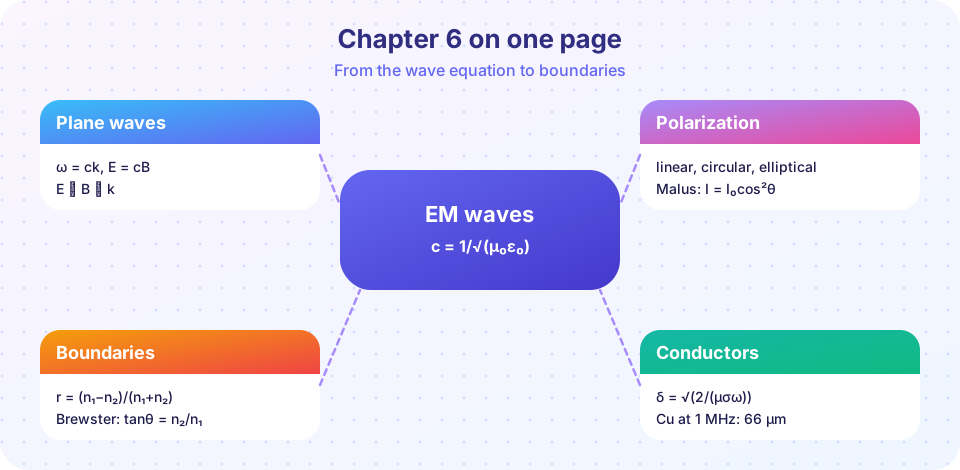
Recap table
| Topic | Key result | Number to remember |
|---|---|---|
| Wave equation | ∇²E = μ₀ε₀ ∂²E/∂t² |
c = 2.998 × 10⁸ m/s |
| Plane wave | ω = ck, E = cB, E ⊥ B ⊥ k |
Z₀ = 376.7 Ω |
| Intensity | I = ½ c ε₀ E₀² |
1 kW/m² means E₀ ≈ 870 V/m |
| Polarization | Malus: I = I₀cos²θ |
Three polarizers: I₀/8 |
| Dielectric boundary | r = (n₁−n₂)/(n₁+n₂) |
Glass: R = 4% |
| Skin depth | δ = √(2/(μσω)) |
Copper, 1 MHz: 66 µm |
The chapter as one argument
The chapter can be told in five sentences. Faraday's law and the Ampère-Maxwell law, taken together in empty space, give a wave equation (Maxwell, 1865). Its solutions are transverse, in-phase E and B waves with E = cB, carrying energy S = E×B/μ₀ and momentum S/c² (lesson 1). Because there are two independent transverse directions, the wave has a polarization, which Malus's law and wave plates let you analyze and control (lesson 2). At a boundary, the continuity of tangential E and H splits the wave into reflected and transmitted parts with coefficients set by the impedance ratio, and in a conductor the wave decays over the skin depth (lesson 3). Hertz confirmed all of it in 1887.
Worked review problems
- From field to power. A laser beam has
E₀ = 2.0 × 10³ V/m. IntensityI = ½cε₀E₀² = 0.5 × 3.0×10⁸ × 8.85×10⁻¹² × 4.0×10⁶ = 5.3 kW/m²; if the beam is 1 mm in radius, the area is3.1 × 10⁻⁶ m²and the power is about 17 mW. - Polarizer plus reflection. Unpolarized light hits a glass plate at Brewster's angle. The reflected beam is purely s-polarized, with about 15% of the s component. Of the unpolarized power,
½ × 0.15 ≈ 7.4%is reflected in total. - Shielding. A copper shield 0.1 mm thick at 1 MHz (
δ = 66 µm) attenuates the field bye^(−0.1/0.066) = e^(−1.5) ≈ 0.22through absorption alone. Because the reflection is also strong, real shielding is far better. At 100 MHz,δ = 6.6 µm, and the same foil givese^(−15) ≈ 3 × 10⁻⁷. - Medium change. A 5 GHz wave enters a material of
n = 2. The frequency stays 5 GHz, speed becomes1.5 × 10⁸ m/s, wavelength falls from 6.0 cm to 3.0 cm, andR = 1/9of the power is reflected at normal incidence.
Common slips at review time. (1) Using E₀ where E_rms is needed: I = ε₀cE_rms². (2) Forgetting the factor 2 in δ = √(2/(μσω)). (3) Mixing amplitude reflection r and power reflection R = r². (4) Thinking the E phase flips for every reflection.
Try it
Press Run (or Ctrl + Enter) to see the result here.
Program input · what you'd type while the program runs
Type the answers before you press Run, one per line. Each time the program reads a line (with input()), it gets the next line from this box.
Press Run (or Ctrl + Enter) to see the result here.
Program input · what you'd type while the program runs
Type the answers before you press Run, one per line. Each time the program reads a line (with input()), it gets the next line from this box.
Press Run (or Ctrl + Enter) to see the result here.
Program input · what you'd type while the program runs
Type the answers before you press Run, one per line. Each time the program reads a line (with input()), it gets the next line from this box.
Check your understanding
Quick check · 10 questions
of 10 answered You scored / 10 · perfect!
-
1. What is the wavelength of 5 GHz Wi-Fi in vacuum?
λ = c/f = 3.0 × 10⁸ / 5 × 10⁹ = 0.06 m. -
2. For a plane wave, which statement is true?
Plane waves in vacuum are transverse with E = cB, in phase. -
3. Intensity 2.0 W/m² corresponds to E₀ of about
E₀ = √(2I/(cε₀)) = √(4.0/2.654 × 10⁻³) ≈ 39 V/m. -
4. Unpolarized light of 100 W/m² passes through two crossed ideal polarizers. The output is
After the first, 50 W/m² linearly polarized; the crossed second polarizer blocks it. -
5. R for light going from air to a material of n = 2 at normal incidence is
r = −1/3, so R = r² = 1/9 ≈ 11%. -
6. At normal incidence from air to glass, the reflected E field
r = (1 − 1.5)/(1 + 1.5) is negative. -
7. If frequency is multiplied by 4, the skin depth is multiplied by
δ ∝ 1/√f, and √4 = 2. -
8. Brewster's angle for light going from air to a medium of n = 1.33 is
tan θ_B = 1.33, so θ_B ≈ 53.1°. -
9. Circular polarization requires
Equal amplitudes with a quarter-cycle phase difference make the E vector rotate with constant length. -
10. Why do microwave ovens use a metal mesh in the door?
The 12 cm microwaves cannot pass holes of a few millimeters, while visible light passes.
Summary
- A plane wave is transverse, in phase, with
E = cBandω = ck. - Polarization, Malus's law and boundary behavior all come from the same field equations.
- Skin depth makes conductors shields that get better as frequency rises.
- Next, accelerating charges: how waves are made.
Track your progress
Create a free account to tick off lessons and pick up where you left off on any device.
of Electrodynamics lessons completed