


















Lesson 16 of 45 · Transformers
Chapter 3 Review: Transformers
Review transformers: ideal ratios, equivalent circuit, open and short-circuit tests, regulation, efficiency, three-phase connections and autotransformers, with a ten-question quiz.
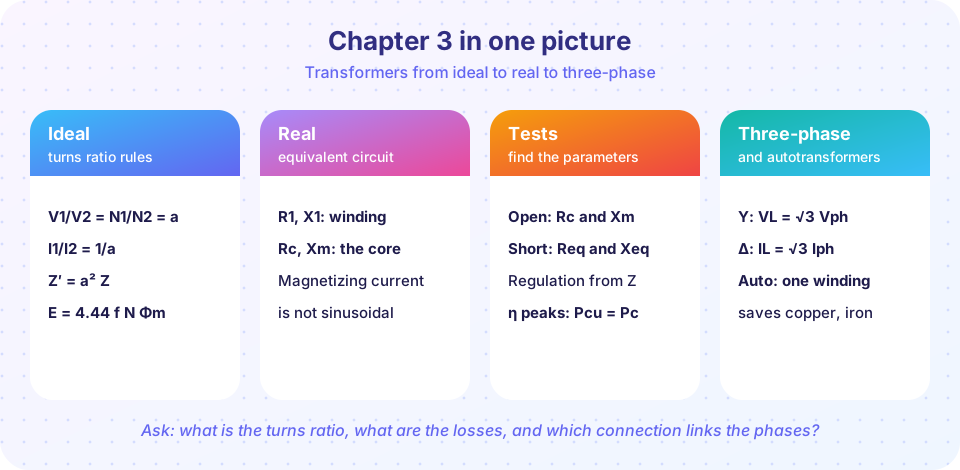
The transformer is the machine in which you met the equivalent circuit, the idea of referring quantities to one side, and testing with two small experiments. These habits will serve you throughout the course. This review collects the chapter's formulas in one place and asks ten mixed questions.
What you will learn
- How the five lessons link together.
- The key formulas and the order in which to use them.
- A checklist for solving transformer problems.
The chapter at a glance
| Lesson | Big idea | Key formulas |
|---|---|---|
| Overview | Two coils on one core; high-voltage transmission | v1/N1 = v2/N2, I²R loss |
| Ideal transformer | Ratios and the EMF equation | E = 4.44 f N Φm, Z' = a² Z |
| Equivalent circuit | Resistors and reactances for each imperfection | R2' = a² R2, R_eq, X_eq |
| Tests and regulation | Find parameters, regulation, efficiency | Rc = V0²/P0, R_eq = Psc/Isc², x = √(Pc/Pcu) |
| Three-phase and auto | Star, delta, vector groups, one-winding units | VL = √3 Vph, 1 − V2/V1 |
A checklist for transformer problems
- Identify the ratings: kVA and the two voltages, hence rated currents.
- Decide which side to refer to (usually the side where the data are given).
- Draw the approximate equivalent circuit with
R_eqandX_eq. - For voltage questions, use the series impedance and the load power factor.
- For efficiency questions, collect
P_candP_cuand apply the load fractionx. - For three-phase units, work per phase, then convert with
√3.
Common misconceptions
"Core loss changes with load." At constant primary voltage it is practically constant; copper loss follows the load squared.
"A lagging power factor load improves regulation." It worsens it; a leading load can improve (even reverse) it.
Try it
Press Run (or Ctrl + Enter) to see the result here.
Program input · what you'd type while the program runs
Type the answers before you press Run, one per line. Each time the program reads a line (with input()), it gets the next line from this box.
Check your understanding
Quick check · 10 questions
of 10 answered You scored / 10 · perfect!
-
1. An ideal transformer has 2000 primary turns and 200 secondary turns. A 10 Ω load is on the secondary. What impedance does the primary source see?
a = 10, so Z' = a² × 10 = 1000 Ω. -
2. A 100-turn winding is exposed to a peak flux of 8 mWb at 50 Hz. What is the induced RMS emf?
E = 4.44 × 50 × 100 × 0.008 = 177.6 V. -
3. Which test gives the core loss?
At rated voltage and no load, input power is the core loss. -
4. Short-circuit test: 50 V, 10 A, 200 W. What is X_eq?
Zeq = 5 Ω, Req = 2 Ω, Xeq = √(25 − 4) = 4.58 Ω. -
5. A lagging load at rated current and 0.9 pf gives a fall of 2.4 % in V2. At unity pf the fall would likely be:
With a transformer where Xeq dominates, a lagging load drops more voltage than a unity-pf load. -
6. Core loss 300 W and full-load copper loss 1200 W. At what load fraction is efficiency maximum?
x = √(300/1200) = 0.5. -
7. In a star winding, 690 V line-to-line corresponds to a phase voltage of about:
Vph = 690/√3 = 398 V. -
8. A delta winding carries a line current of 100 A. The phase current is:
Iph = IL/√3 = 57.7 A. -
9. A 460 V to 230 V autotransformer feeds a 4 kVA load. How much power must be transformed by the core?
1 − 230/460 = 0.5, so 2 kVA. -
10. Why do distribution transformers favor low core loss?
Core loss is paid 24 hours a day, so it dominates the all-day efficiency of lightly loaded units.
Summary
- Ideal:
V1/V2 = N1/N2,I1/I2 = N2/N1,Z' = a² Z,E = 4.44 f N Φm. - Real: add
R1, X1, R2', X2'in series andRc ∥ Xmin shunt; tests find them. - Regulation depends on the load power factor; efficiency peaks where
Pcu = Pc. - Three-phase work per phase with
√3; autotransformers transform only1 − V2/V1of the power.
Track your progress
Create a free account to tick off lessons and pick up where you left off on any device.
of Electrical Machines lessons completed