


















Lesson 11 of 45 · Transformers
Transformers: The Big Picture
Get the big picture of transformers: how two coils on a shared core change voltage, why the grid needs them, core and shell construction, and the types you will meet.
Follow the electricity in your home back to the power station and you will cross a transformer at least four or five times. Generators produce power at around 11 to 25 kV, step-up transformers raise it to hundreds of kilovolts for long-distance lines, and step-down transformers bring it back to 230 V (or 120 V) at your wall socket. Without transformers, the modern grid, and your phone charger, would not exist.
A transformer is the simplest machine in this course because nothing moves. It is also the best place to learn the ideas that carry over to every rotating machine: flux linkage, induced voltage, leakage, equivalent circuits and losses.
What you will learn
- How a transformer works in one paragraph.
- Why power systems use high voltage and transformers.
- The main constructions (core type and shell type) and common types.
- What each lesson in this chapter covers.
Key terms
Primary winding: the winding connected to the source.
Secondary winding: the winding connected to the load.
Turns ratio (a): N1 / N2, the number of primary turns divided by secondary turns.
Step-up / step-down: the secondary voltage is higher / lower than the primary.
Leakage flux: the part of the flux that links only one winding.
How a transformer works
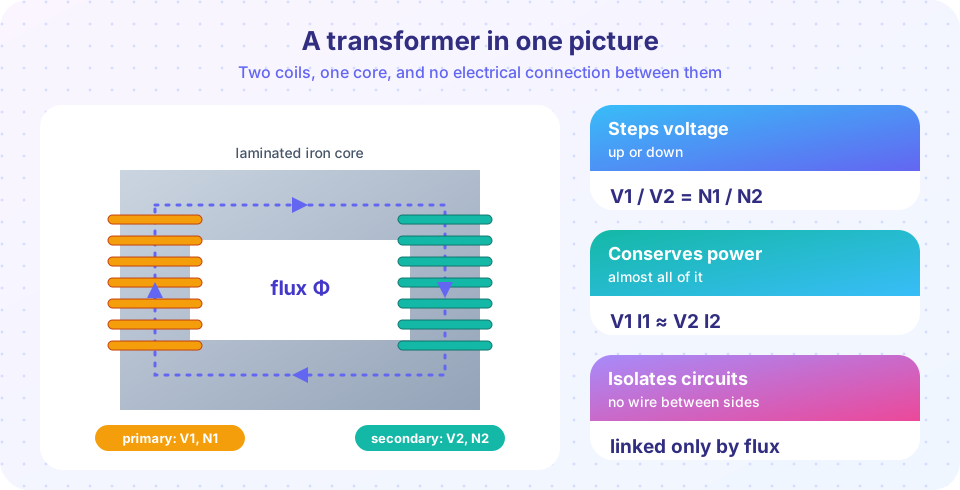
An alternating voltage v1 across the primary drives an alternating current that creates an alternating flux in the iron core. Almost all of that flux also threads the secondary coil. By Faraday's law, a changing flux linking N turns induces a voltage e = N dΦ/dt. The same flux links both windings, so the voltage per turn is the same in both:
v1 / N1 = v2 / N2 (ideal)
Choose N2 larger than N1 and the voltage steps up; smaller and it steps down. When a load is connected, the secondary current creates a flux that opposes the core flux, and the primary draws extra current to restore it. The result is that power flows from primary to secondary while the two circuits remain electrically separate, which also gives isolation for safety.
Transformers work only on alternating (or pulsating) current. A steady DC voltage gives a steady flux, which induces no voltage, and the primary current would be limited only by the winding resistance, which can burn the coil.
Why the grid uses high voltage
For a given power P = V I, higher voltage means lower current, and line loss is I² R. A simplified single-phase example: transmit 10 MW over a line of total resistance 5 Ω.
| Voltage | Current | Line loss | Share of power |
|---|---|---|---|
| 11 kV | 909 A | 4.13 MW | 41 % |
| 110 kV | 90.9 A | 41.3 kW | 0.41 % |
Raising the voltage by 10 times cuts the current by 10 times and the loss by 100 times. This is the economic reason for the step-up transformers at power stations. (Real lines are three-phase, but the scaling is the same.)
A transformer's journey
From grid to socket
Construction
- Core-type: two legs, each carrying part of each winding; the winding surrounds the core. Most large power transformers.
- Shell-type: three legs; the windings are on the center leg and the core surrounds the windings. Common in small and some very large units.
- Laminated core: thin insulated sheets of silicon steel, to cut eddy-current loss (previous chapter).
- Windings: copper (sometimes aluminum). High-voltage windings use many turns of thin wire; low-voltage windings use few turns of thick wire. The low-voltage winding is often nearest the core to reduce insulation.
- Cooling: small units are air-cooled (dry type); large units are immersed in mineral or synthetic oil that carries heat to radiators.
Common types
| Type | Purpose |
|---|---|
| Power transformer | Step-up and step-down in transmission |
| Distribution transformer | Final step to consumer voltage |
| Instrument transformers | Scale high voltage and current for meters and relays (VT and CT) |
| Isolation transformer | Safety and noise separation, ratio near 1:1 |
| Autotransformer | One tapped winding (lesson 5 of this chapter) |
Large power transformers are extremely efficient, typically 98 to 99.5 %, which makes them among the most efficient machines ever built.
What each lesson covers
- This overview.
- The ideal transformer: turns ratio, the EMF equation, impedance reflection.
- The equivalent circuit: winding resistance, leakage reactance, core loss and magnetizing current.
- Tests, regulation and efficiency: open- and short-circuit tests.
- Three-phase connections and autotransformers.
- Chapter review.
Common misconceptions
"A transformer makes power." Power out is slightly less than power in. Voltage goes up, current goes down by the same factor.
"A transformer works from a battery." Only a changing flux induces a voltage, so DC does not work (a switching circuit can turn DC into pulses first).
"The secondary voltage is exactly V1 × N2/N1." That is the ideal value; the real value falls a little under load (voltage regulation, lesson 4).
Try it
Press Run (or Ctrl + Enter) to see the result here.
Program input · what you'd type while the program runs
Type the answers before you press Run, one per line. Each time the program reads a line (with input()), it gets the next line from this box.
Check your understanding
Quick check · 5 questions
of 5 answered You scored / 5 · perfect!
-
1. Which part of a transformer is connected to the load?
The primary connects to the source; the secondary supplies the load. -
2. A transformer has 1000 primary turns and 250 secondary turns on a 400 V supply. What is the ideal secondary voltage?
V2 = V1 × N2/N1 = 400 × 250/1000 = 100 V. -
3. Why is high voltage used for long-distance transmission?
P = VI; raising V lowers I, and the loss I²R falls with the square of the current. -
4. What happens if you connect a 50 Hz transformer primary to a steady DC supply of the same voltage?
Steady flux induces no voltage, so the current is limited only by the small winding resistance. -
5. Large power transformers have efficiencies of roughly:
They have no moving parts and well-designed cores, so their losses are very small.
Summary
- A transformer links two coils through a common core flux;
v1/N1 = v2/N2in the ideal case. - It works only with changing flux (AC) and gives voltage change plus electrical isolation.
- High-voltage transmission cuts
I² Rloss dramatically, which is why transformers are everywhere. - Constructions: core type and shell type with laminated cores; cooling by air or oil.
Next: The Ideal Transformer
Track your progress
Create a free account to tick off lessons and pick up where you left off on any device.
of Electrical Machines lessons completed