


















Lesson 4 of 45 · Getting Started
Ratings, Losses and Efficiency
Read a nameplate, classify machine losses (copper, core, mechanical, stray), calculate efficiency and temperature effects, and find the load of maximum efficiency.
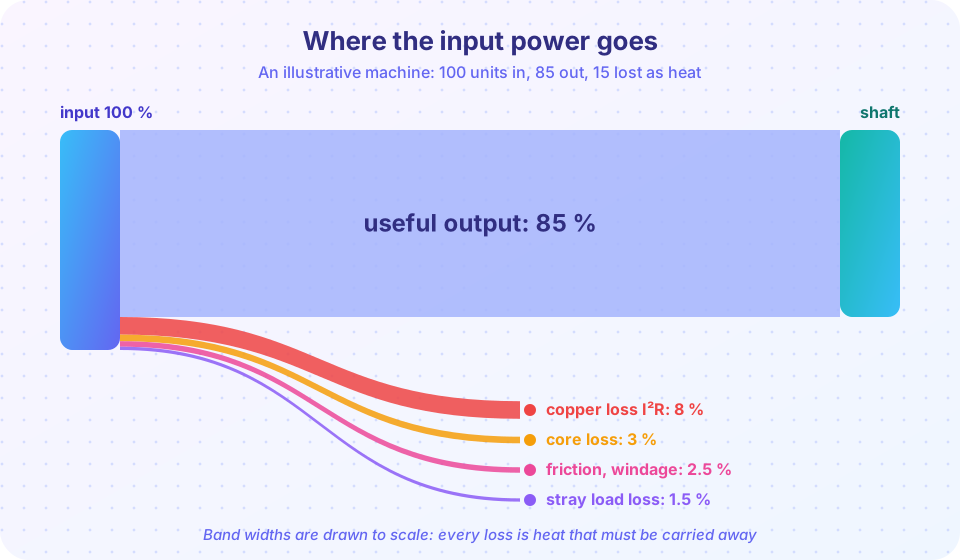
No machine is perfect. A good large motor wastes 3 to 5 percent of its input power; a small one may waste 30 percent or more. Every watt of loss becomes heat, and heat is what ultimately limits how much power a machine can deliver without destroying its insulation. That is why ratings, losses and efficiency are tied together.
In this lesson you will learn how to read a rating plate, how the four kinds of loss arise, how to compute efficiency, and where a machine's efficiency peaks.
What you will learn
- What the rating on a nameplate means.
- The four kinds of loss and which ones change with load.
- How to compute efficiency and the effect of temperature on winding resistance.
- Why efficiency peaks when the variable loss equals the constant loss.
Key terms
Rated output: the power a machine can deliver continuously without exceeding its temperature limit. For a motor this is mechanical power at the shaft; for a generator or transformer it is electrical power (kW or kVA).
Copper loss: I²R heating in the windings.
Core (iron) loss: hysteresis and eddy-current heating in the magnetic iron.
Efficiency (η): P_out / P_in.
Insulation class: the temperature rating of the winding insulation (for example class F: 155 °C).
Reading a nameplate
A typical induction-motor plate lists the rated output (say 15 kW), supply voltage and connection (400 V delta), rated current, frequency (50 Hz), rated speed (1460 rpm), power factor, duty type (S1 means continuous running), insulation class, and an enclosure code (IP, for dust and water protection). Rated values are the conditions under which the manufacturer guarantees the machine will live a normal lifetime.
The ratings are limits of heat, not of magic: a motor can usually deliver more than its rated power for a few minutes, but long overload cooks the insulation. A common rule of thumb says that every 10 °C above the insulation's rating halves its life, which makes temperature control very important.
The four losses
- Copper loss
P_cu = I²R. It grows with the square of the current, so it is a variable loss: double the load current and it quadruples. - Core loss, also called iron loss. Alternating flux heats the iron through hysteresis (the magnetic material resists reversing its magnetization) and eddy currents (circulating currents induced in the iron itself). It depends on flux density and frequency, so it is nearly constant when the machine runs at fixed voltage and frequency. Chapter 2 looks at it in detail.
- Mechanical loss: friction in the bearings and brushes, and windage (air drag on the rotor and the cooling fan). It depends on speed and is roughly constant for a machine running at constant speed.
- Stray load loss: extra eddy and leakage-flux effects that appear only under load. It is small and difficult to measure, so standards assign it a conventional fraction of the output.
So there are two groups: constant (fixed) losses, mostly core and mechanical, and variable losses, mostly copper.
Worked example: efficiency of a motor
A motor delivers 15 kW. Losses at this load: copper 0.9 kW, core 0.4 kW, mechanical 0.3 kW. Total loss 1.6 kW, so:
P_in = 15 + 1.6 = 16.6 kW
η = 15 / 16.6 = 0.9036 = 90.4 %
Check by using a second route: η = 1 - P_loss / P_in = 1 - 1.6 / 16.6 = 0.9036. The heat to remove is 1.6 kW, about as much as a small electric heater.
Temperature and winding resistance
Copper's resistance rises about 0.39 percent for each degree. For copper the exact relation (using the "inferred zero" of the resistance-temperature line) is:
R2 / R1 = (234.5 + T2) / (234.5 + T1) (T in °C)
Worked example. A winding measures 0.50 Ω at 25 °C. At 75 °C its resistance is 0.50 × (234.5 + 75) / (234.5 + 25) = 0.596 Ω. With 20 A flowing, the copper loss rises from 200 W (cold, using 0.50 Ω) to 239 W hot. Efficiency figures are therefore quoted at a reference temperature (for example 75 °C or the operating temperature).
Why heat limits ratings
Insulation classes set the maximum winding temperature:
| Class | A | E | B | F | H |
|---|---|---|---|---|---|
| Maximum temperature | 105 °C | 120 °C | 130 °C | 155 °C | 180 °C |
Machines are designed so that ambient temperature plus the temperature rise stays below the class limit. Typical rise limits (resistance method, 40 °C ambient) are around 80 K for class B and 105 K for class F, with a margin built in. Better cooling (bigger fan, finned frame, liquid cooling) lets a given frame carry more load.
Where efficiency peaks
Let x be the load fraction (x = 1 is full load). Output is x P_rated, the constant loss is P_c, and the variable loss is x² P_v where P_v is its value at full load. Then:
η(x) = x P_rated / ( x P_rated + P_c + x² P_v )
Differentiating shows the maximum is where the variable loss equals the constant loss:
x_opt = √(P_c / P_v)
Worked example. P_rated = 15 kW, P_c = 0.70 kW, P_v = 1.00 kW. Then x_opt = √0.7 = 0.837, i.e. at 83.7 % of full load. The output there is 12.55 kW, the total loss 0.7 + 0.7 = 1.4 kW, and η_max = 12.55 / 13.95 = 89.96 %. Machines are usually designed to peak between half and full load, since few run permanently at 100 %.
Common misconceptions
"Efficiency is highest at full load." Not necessarily. It peaks where variable and constant losses are equal, often at 60 to 90 percent of rated load.
"Rated power is electrical input." For motors the rating is the output at the shaft. The input is larger by the losses.
"Copper loss is constant." It scales with I². Only the core and mechanical losses are nearly constant.
Try it
Press Run (or Ctrl + Enter) to see the result here.
Program input · what you'd type while the program runs
Type the answers before you press Run, one per line. Each time the program reads a line (with input()), it gets the next line from this box.
Press Run (or Ctrl + Enter) to see the result here.
Program input · what you'd type while the program runs
Type the answers before you press Run, one per line. Each time the program reads a line (with input()), it gets the next line from this box.
Check your understanding
Quick check · 5 questions
of 5 answered You scored / 5 · perfect!
-
1. A generator delivers 40 kW and its total losses are 4 kW. What is its efficiency?
P_in = 44 kW, so η = 40 / 44 = 0.909. -
2. Which of these losses is essentially constant at fixed voltage and frequency?
Core loss depends on flux and frequency, which stay fixed, while copper loss follows I² and stray load loss follows the load. -
3. If the load current doubles, what happens to copper loss (resistance unchanged)?
P = I²R, so doubling I multiplies the loss by 4. -
4. A winding is 2.00 Ω at 20 °C. Using R2/R1 = (234.5 + T2)/(234.5 + T1), what is it at 80 °C?
2.00 × 314.5 / 254.5 = 2.47 Ω. -
5. At what load does the machine have maximum efficiency?
Maximizing η(x) gives x = √(P_c / P_v): variable loss equals constant loss.
Summary
- A machine's rating is the continuous output it can give without overheating; temperature, not magic, sets the limit.
- Losses: copper (
I²R, variable), core (hysteresis and eddy currents, nearly constant), mechanical (friction and windage), and stray load loss. η = P_out / P_in = 1 - P_loss / P_in; copper resistance rises with temperature by(234.5 + T2)/(234.5 + T1).- Maximum efficiency occurs where variable loss equals constant loss,
x = √(P_c / P_v).
Track your progress
Create a free account to tick off lessons and pick up where you left off on any device.
of Electrical Machines lessons completed