


















Lesson 27 of 45 · Synchronous Machines
Chapter overview: synchronous machines
A map of the synchronous machine chapter: why a DC-excited rotor locks onto the rotating field, how alternators make nearly all grid power, and what the lessons cover.
Nearly all of the electricity on the grid starts in a synchronous machine. In a coal, gas, nuclear or hydro plant a turbine spins a rotor, and the rotor induces three-phase voltages in a stator. The same machine run backward is a synchronous motor: feed the stator with three-phase power and the rotor turns at exactly the speed of the rotating field.
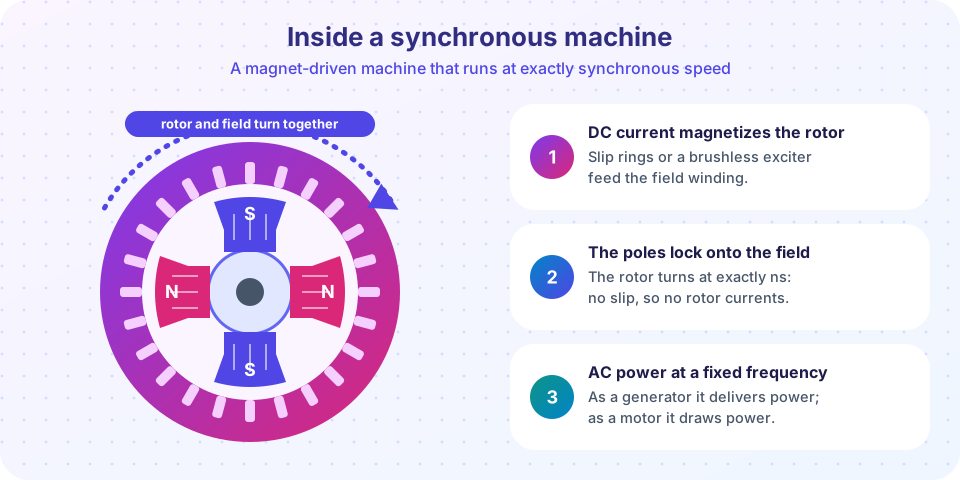
The word "synchronous" is the whole story. The rotor carries its own magnetic poles, made by direct current in a field winding or by permanent magnets. Those poles lock onto the stator's rotating field like two magnets that attract each other, so the rotor turns at ns = 120 f / P and never at anything else. There is no slip and, in steady state, no current induced in the rotor.
What you will learn
- How an alternator generates a voltage and what limits its output.
- How to draw and use the phasor diagram to find voltage regulation.
- How a synchronous motor carries load through the load angle and why it can correct power factor.
- Why a synchronous motor cannot start on its own and how that is fixed.
The chapter in slides
Alternator
Lesson 2: EMF, the equivalent circuit and regulation.
Phasors
Lagging loads lower the voltage most.
Motor
Lesson 3: power-angle curve and V-curves.
Lessons in this chapter
- Alternator EMF and regulation: speed, frequency, the equivalent circuit and a worked example for lagging, unity and leading loads.
- The synchronous motor and the power angle: torque, stability limits, starting, V-curves and synchronous condensers.
- Chapter review: one picture, a recap table and a ten-question quiz.
Try it
A generator's frequency is fixed by its speed and number of poles: f = P n / 120. This small calculator shows why hydro generators have many poles and steam turbines have few.
Press Run (or Ctrl + Enter) to see the console output here.
No output.
The reverse question: how many poles does a slow machine need for 60 Hz?
Press Run (or Ctrl + Enter) to see the result here.
Program input · what you'd type while the program runs
Type the answers before you press Run, one per line. Each time the program reads a line (with input()), it gets the next line from this box.
Summary
- A synchronous machine has a DC-excited (or permanent-magnet) rotor that locks onto the stator's rotating field.
- Its speed is exactly
120 f / P; there is no slip. - As an alternator it makes grid power; as a motor it runs at fixed speed and can correct power factor.
Track your progress
Create a free account to tick off lessons and pick up where you left off on any device.
of Electrical Machines lessons completed